Chris Dryden’s website
< Previous | Index | Next >
On the web – 1
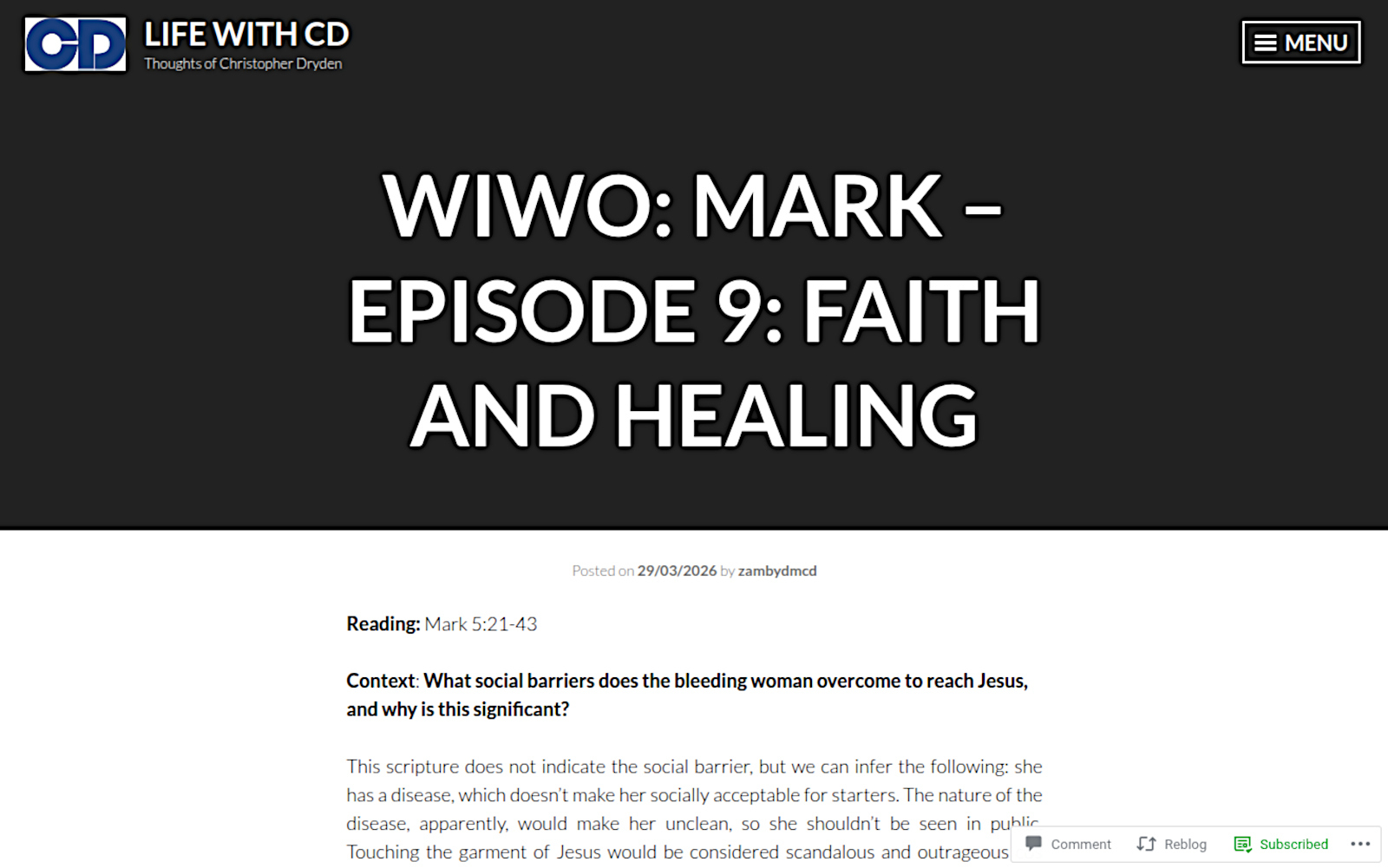
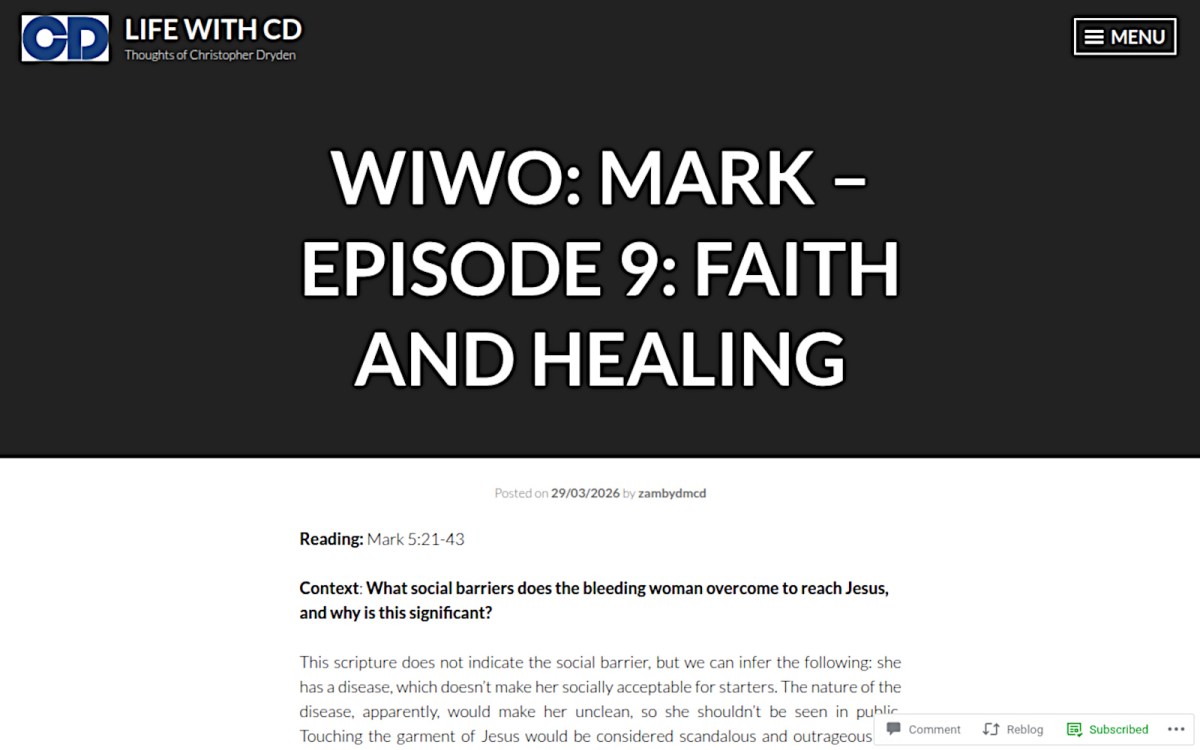
Sometimes I read something so good that I want to share it with my readers. This happened recently with one of Christoper Dryden’s posts. When I asked if I might republish it here, he very generously agreed. But I’m having second thoughts. Not about sharing it, but about sharing it in full. I think it will be better to share enough that my readers will want to go and read the rest on CD’s blog.
The extract
Reading: Mark 5:21-43
Context: What social barriers does the bleeding woman overcome to reach Jesus, and why is this significant?
This scripture does not indicate the social barrier, but we can infer the following: she has a disease, which doesn’t make her socially acceptable for starters. The nature of the disease, apparently, would make her unclean, so she shouldn’t be seen in public. Touching the garment of Jesus would be considered scandalous and outrageous cos the belief was that those touched by the unclean would be unclean themselves. She’s a social outcast, and she should know her place and deal with the fact that she’s worse off for looking to get her problem sorted, only for it not to work out. She’s a woman, that also ain’t becoming of someone who wishes to approach this guy. Seen in that light, the amount she’s overcome to reach out speaks volumes about the level of faith she has that one touch could make all the difference. It explains Jesus’ own commentary on the situation, namely that her faith has made her whole. And as I reflect on that, there’s the nudge to consider what level of faith can be exercised to trust Jesus. And also, there’s a challenge of how we can demonstrate and declare, for the benefit of other social outcasts, that their issues can be solved by reaching out to touch Jesus, who is near them?
In first-century Jewish society, a woman approaching a rabbi — in public, uninvited, without the mediation of a husband or male relative — was itself an act that would raise eyebrows and clench jaws. Layer on top of that the twelve years of haemorrhaging, which under the Levitical code rendered her perpetually ritually unclean (Leviticus 15:25-27), and you start to appreciate what she was carrying before she ever took a single step toward Jesus. It wasn’t just a physical condition. It was a sentence. Twelve years of isolation. Twelve years of being untouchable. Twelve years of being told, in effect, that she didn’t qualify.
She had also spent everything she had on physicians who left her worse off, not better. So not only is she socially marginalised, she is financially spent and medically hopeless. She has nothing left to lose. And that, right there, might be the very thing that unlocks her faith. When you’ve exhausted every other option, the audacity to reach for Jesus becomes a lot less surprising.
Seen in that light, the amount she’s overcome to reach out speaks volumes about the faith she has that a single touch could make all the difference. It explains Jesus’ own commentary on the situation: her faith has made her whole. And as I reflect on that, there’s a nudge to consider what level of faith is required to trust Jesus. And also, there’s a challenge of how we can demonstrate and declare, for the benefit of other social outcasts, that their issues can be solved by reaching out to touch Jesus, who is near them?
Someone might feel like they don’t qualify. They feel like they’ve been told — by circumstance, by history, by the voice in their own head — that the door to Jesus isn’t for them. This woman’s story is a loud and clear rebuttal of that lie. She reached, He responded, and the power that went out of Him was not accidental. He knew. He always knows. And He is never contaminated by what comes to Him, broken and desperate. He is only ever transformative.
Content: How does Jesus treat both the synagogue leader and the unclean woman with equal dignity?
What a fascinating word – dignity. Let’s get ourselves a running definition or walking, if we prefer the strolling approach. Dignity is about worth, value and honour. To treat people with dignity is to confer on them a sense that they are of worth and value and should be duly honoured…
Reading more
My hope is that you’ll want to read the whole thing. Don’t miss the opportunity, you will not regret it! And if you like Dryden’s writing as much as I do, you’ll bookmark his site and keep coming back for more.
< Previous | Index | Next >
You might also like:
Useful? Interesting?
If you enjoyed this or found it useful, please like, comment, and share below. (If you don’t see those links, click the article’s title above the main photo and they will appear.) Send a link to friends who might enjoy the article or benefit from it – Thanks! My material is free to reuse (see conditions), but a coffee is always welcome and encourages me to write more often! 
Share this:


 Journeys of Heart and Mind