Terraced border at Blenheim

Much of this slope is being managed by rows of stones so that each section of soil will have a reduced slope. Trailing plants like Aubretia can be planted behind the stones.

< Previous | Index | Next >

Image of the day – 146

What’s in an image? Sometimes quite a lot, more than meets the eye. I’m posting an image every few days.

What to do with a sloping garden

Click to enlarge

There are many things that need managing in gardens great and small; one of these things is a slope. If your garden is on a hillside and the slope is steep, you will need to create a winding path to exchange steepness for distance, or as an alternative, build some steps. If you have a sloping flower bed you can make a bank and plant ground cover plants to stabilise the soil and reduce erosion, or you could build a rock garden.

Terracing

In this photo, you can see the initial phase in construction of a third way of dealing with a sloping border – a terraced border. Much of this slope is being managed by rows of stones so that each section of soil will have a reduced slope. Trailing plants like Aubretia can be planted behind the stones, or low shrubs or herbaceous plants could be planted in the lower tiers with tall plants and small trees such as Acer cultivars at the back. The terraced area in the photo will look lovely as it becomes established with some mature plants. Perhaps I’ll go back in future to take more photos for comparison.

A rockery

A rockery would be designed differently, the stones would be carefully placed in a naturalistic way with alpines growing amongst them, but not hiding them. Again, taller bushes and small trees would fit well at the top, concealing the fact the the ‘outcrop’ of rock is of limited height. A well-built rockery should respect overall angles of bedding planes, even though no such planes really exist. But making it look as if they do can give a fine impression of structure. Each stone needs to be angled in two dimensions to fit with angles of all the others. They must all lean backward or forward at the same angle, and they must lie from side to side in agreement as well.

It’s usually best for the stones to lie backwards rather than forwards, they will be much more stable and better supported, but they will also proved better opportunities for planting after the stones are all in place. Careful planting can hide the gaps between some of the stones, giving the appearance of much larger blocks of stone. It’s very convincing if done well!

A hillside

If the garden is large enough, a winding path with several terraced or rockery sections (perhaps both) can be very pleasing. This is a great way of using a hillside, though few of us can afford such an expansive space. But it’s a great idea for shopping centres, university campuses, industrial sites, and parks where there is already a natural slope large enough for this kind of feature.

See also:

< Previous | Index | Next >

Useful? Interesting?

If you enjoyed this or found it useful, please like, comment, and share below. (If you don’t see those links, click the article’s title above the main photo and they will appear.) Send a link to friends who might enjoy the article or benefit from it – Thanks! My material is free to reuse (see conditions), but a coffee is always welcome and encourages me to write more often!
You might like these posts too…

A view of ancient remains

Cirencester is the site of Britain’s second city in Roman times, Corinium … The row of trees beyond the lake is close to the Roman city wall.

< Previous | Index | Next >

Image of the day – 145

What’s in an image? Sometimes quite a lot, more than meets the eye. I’m posting an image every few days.

Click to enlarge

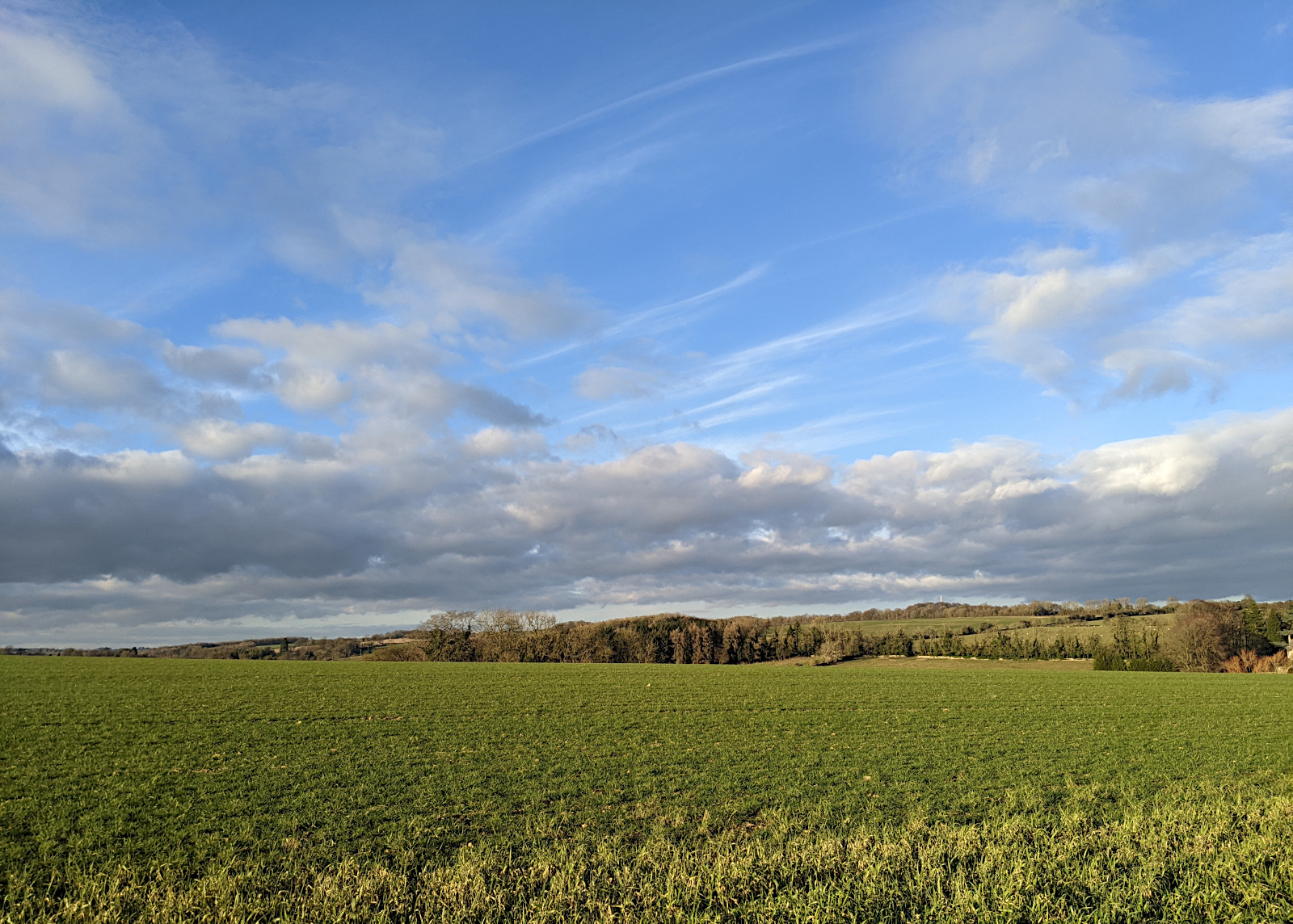
What’s in an image? And indeed what’s in a field? Let’s take it a stage at a time.

The Abbey

The grass in the foreground is part of one of Cirencester’s public parks, the Abbey Grounds. As the name suggests, this is part of the medieval abbey; the abbey buildings and the great abbey church are out of sight behind you in this view. All of those abbey remains are invisible, remaining as only foundations. After the dissolution of the abbeys by Henry VIII, the stonework was pulled down and re-used as building material as the town developed.

You are looking north-east. The first thing you can see beyond the grassed area is a stretch of water. This was dug by the monks to widen and deepen a branch of the River Churn to form a lake to supply fish. You will need to expand the image to see it clearly, it’s marked by benches, life buoys and low vegetation. The two figures in the extreme right are a good guide, they are just our side of the lake.

Abbey House

Also behind us in this view stood Abbey House, demolished in the 1960s. The Abbey land was later owned by the Chester-Master family who built the house, and the park was their private garden. There is one remaining structure from that time in the photo; the large mound at the extreme right covers the ice house built and used by the Chester-Masters.

The Romans

Cirencester is the site of Britain’s second city in Roman times – Corinium, or to give it its full name, Corinium Dobunnorum. The row of trees beyond the lake is close to the Roman city wall. Roman stone was also robbed to build structures in the later town, but out of site to the right of the ice house is a substantial bank and underlying that, the remaining Roman masonry. Some of it has been excavated and remains visible today. If you are visiting the town it’s well worth a look.

While we’re thinking of the Romans, the Abbey Grounds lie entirely within the Roman city and there’s almost certainly more to be discovered here. Just beyond the row of trees mentioned above is another branch of the River Churn. This, and the city wall would together have formed a barrier sufficient to force all traffic in and out of the city through the five large city gates.

Tar Barrow Field

The rising land beyond the line of trees up to the woodland along the sky line is known locally as Tar Barrow Field. ‘Tar’ is probably a corruption of ‘Thor’. The barrows would have been Neolithic or possibly Saxon, but the Medieval inhabitants clearly thought the Norse god Thor was involved in some way. There was also a Roman temple in this field and that would have been reached by a road or footpath from the Roman gate over what is today London Road.

Take a look yourself

If you are visiting Cirencester and interested in the town’s background and history, consider visiting the Corinium Museum (linked below). In addition to checking out the museum itself, you can pick up leaflets about historical sites to visit around the town.

See also:

< Previous | Index | Next >

Useful? Interesting?

If you enjoyed this or found it useful, please like, comment, and share below. (If you don’t see those links, click the article’s title above the main photo and they will appear.) Send a link to friends who might enjoy the article or benefit from it – Thanks! My material is free to reuse (see conditions), but a coffee is always welcome and encourages me to write more often!
Holes in a wall

When I was young, nobody took the trouble to fill these holes again, but these days they’re probably protected as historical curiosities.

< Previous | Index | Next >

Image of the day – 139

What’s in an image? Sometimes quite a lot, more than meets the eye. I’m posting an image every day or so.

Click to enlarge

Some of you might know what these two, rectangular holes are for, but many might not. Holes like these can be found all around Cirencester, usually along the main roads leading into or out of the town.

They date back to the dark days of World War Two when Britain faced invasion by German forces. The invasion never took place because Germany was unable to defeat the RAF and air dominance was essential before the invasion fleet could be launched.

The holes in these walls, if you haven’t already guessed, are sniper or machine gun positions to enable the defenders to fire on German forces from behind the temporary safety of masonry. One round from a German tank would been more than enough to destroy the wall, of course.

When I was young, nobody took the trouble to fill these holes again, but these days they’re probably protected as historical curiosities. A reminder if one is needed, that war can come visiting at short notice (as in Ukraine) and that no nation should assume it will always be safe.

See also:

< Previous | Index | Next >

Useful? Interesting?

If you enjoyed this or found it useful, please like, comment, and share below. (If you don’t see those links, click the article’s title above the main photo and they will appear.) Send a link to friends who might enjoy the article or benefit from it – Thanks! My material is free to reuse (see conditions), but a coffee is always welcome and encourages me to write more often!

An old survivor

Much of the old tree would have survived for while, so the new shoot was shaded and would have grown out at an angle, attracted towards the light. Since then, the new growth has itself become a mature tree.

< Previous | Index | Next >

Image of the day – 138

What’s in an image? Sometimes quite a lot, more than meets the eye. I’m posting an image every day or so.

Click to enlarge

I spotted this old tree when we visited Blenheim Palace today. It’s probably an ancient oak though I didn’t get close enough to check with certainty.

The thickest part, the lumpy-looking base is the remaining stump, all that remains of the original tree that would have grown from an acorn many hundreds of years ago. That tree was a sapling, then a youthful, vigorously growing tree; eventually if became a mature, majestic oak. But then the rot would have set in – literally. Holes made by a woodpecker, or damage from a storm cracking off a branch, gave access to unprotected wood beneath the bark. Insects may have burrowed into the wood, and eventually fungal spores would have germinated and started the decay process in earnest.

The weakened tree would have lost its vigour and been reduced to a hollow stump and failing branches. But finally, a new shoot must have appeared near the base and formed new, young growth. Much of the old tree would have survived for while, so the new shoot was shaded and would have grown out at an angle, attracted towards the light. Since then, the new growth has itself become a mature tree.

Another possibility is that a branch of the original tree survived, and with the other branches missing, grew into the shape we now see. A careful examination of the tree might reveal the truth. But however this curious old tree survived, it certainly has an unusual story to tell!

Donna and I enjoyed our day at Blenheim and will visit again from time to time this year as the seasons roll by. I’ll probably write about the place again.

See also:

< Previous | Index | Next >

Useful? Interesting?

If you enjoyed this or found it useful, please like, comment, and share below. (If you don’t see those links, click the article’s title above the main photo and they will appear.) Send a link to friends who might enjoy the article or benefit from it – Thanks! My material is free to reuse (see conditions), but a coffee is always welcome and encourages me to write more often!
Inside out

In this photo, taken from outside the church after dark, the relatively bright, modern lighting inside shows up the windows very nicely.

< Previous | Index | Next >

Image of the day – 137

What’s in an image? Sometimes quite a lot, more than meets the eye. I’m posting an image every day or so.

Click to enlarge

These windows are inside-out. They are stained-glass, and part of Cirencester’s Parish Church. When they were built, the idea was that they would look impressive from the interior in a world without anything much brighter than a candle or an oil lamp. Illuminated in daylight and seen from within a relatively dark building, they would have been amazing – and they still are.

But in this photo, taken from outside the church after dark, the relatively bright, modern lighting inside shows up the windows very nicely. The makers could hardly have imagined them being seen in this way!

See also:

< Previous | Index | Next >

Useful? Interesting?

If you enjoyed this or found it useful, please like, comment, and share below. (If you don’t see those links, click the article’s title above the main photo and they will appear.) Send a link to friends who might enjoy the article or benefit from it – Thanks! My material is free to reuse (see conditions), but a coffee is always welcome and encourages me to write more often!

From the Stone Age

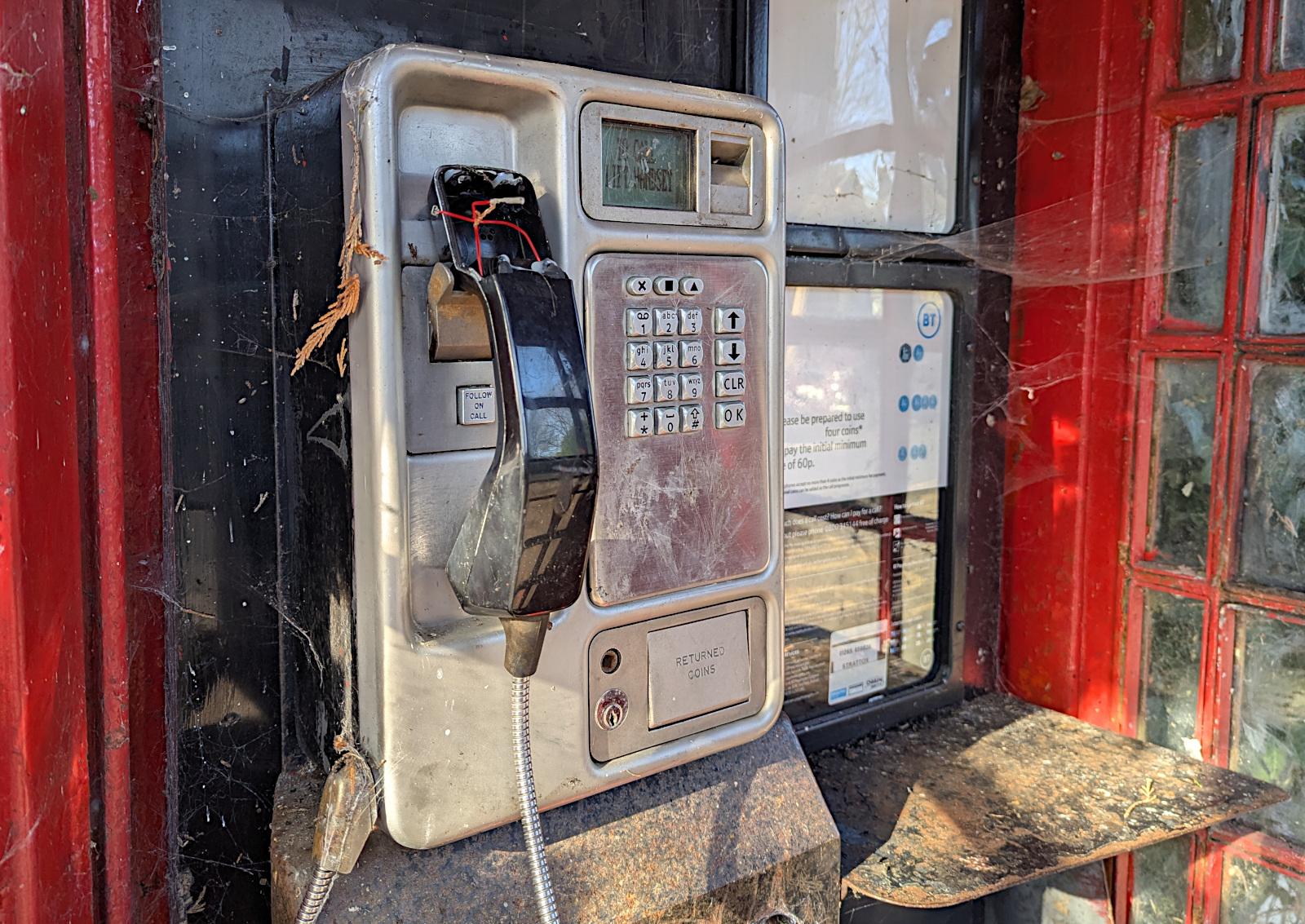
As mobile phones became more affordable and widely available the need for phone boxes vanished. This one was never removed and stands forgotten by the pavement, more or less unnoticed, draped in cobwebs, laden with layers of dust.

< Previous | Index | Next >

Image 136 – What’s in an image? Sometimes quite a lot, more than meets the eye. I’m posting an image every day or so.

Click to enlarge

Stone Age?

Well – Stone Age in terms of communications technology! A long time ago, way, way back in the 1980s, telephone kiosks like this one were widespread in the UK. You can see the red paint for which these phone boxes were so famous.

This particular box stands at the junction of the Gloucester Road and the Cheltenham Road in Stratton, where we live. It must have been quite busy when it was first installed. I well remember standing waiting at a box like this, sometimes there might even have been a queue of three or four people waiting to make a call.

And I remember the standard phone box smell as well. There was always a certain degree of dampness about them, often mixed with stale tobacco smoke. There was a little shelf containing a local residential directory and a yellow pages with business numbers and adverts.

This example of the British Telecom (BT) phone box has seen better days. It was converted with up-to-date equipment that must have replaced the original, black, bakelite handset with its black, enamelled, steel coin-box with Button A and Button B. But as mobile phones became more affordable and widely available the need for phone boxes vanished. This one was never removed and stands forgotten by the pavement, more or less unnoticed, draped in cobwebs, laden with layers of dust.

See also:

< Previous | Index | Next >

Useful? Interesting?

If you enjoyed this or found it useful, please like, comment, and share below. (If you don’t see those links, click the article’s title above the main photo and they will appear.) Send a link to friends who might enjoy the article or benefit from it – Thanks! My material is free to reuse (see conditions), but a coffee is always welcome and encourages me to write more often!

The Marine Lake

The Marine Lake was built in the 1920s and has just been dredged and refurbished. It’s free to use, and within the lake the tide never goes out, but on every high tide some of the water is replaced to keep it clean.

< Previous | Index | Next >

Image 135 – What’s in an image? Sometimes quite a lot, more than meets the eye. I’m posting an image every day or so.

Click to enlarge

This is one of the jewels of Weston-super-Mare – The Marine Lake. One feature of the coastline here is that it has one of the highest tidal ranges in the world (14.5 m), second only to the Bay of Fundy in Canada, I believe. The beach is very gently shelving as well, so at low tide the sea retreats between two and a half and 3 kilometres!

The Marine Lake was built in the 1920s and has just been dredged and refurbished. It’s free to use, and within the lake the tide never goes out, but on every high tide some of the water is replaced to keep it clean. It’s also large enough for a lot of people to use it at the same time, and it includes a large, sandy beach above the waterline. It’s also right in the heart of busy part of town, with plenty of cafes and restaurants, shops, the big wheel, the pier and much more just a stroll away.

My photo was taken late in the evening after sunset in September so there are few people using the Marine Lake. But believe me, in the middle of the afternoon on a sunny day in July it would be quite crowded. There’s a very long and wide sandy beach stretching north and south of Weston pier, and many people use that for sunbathing or making sandcastles regardless of the state of the tide.

The Marine lake is a marvellous feature. Without it, Weston would not seem like Weston at all!

See also:

< Previous | Index | Next >

Useful? Interesting?

If you enjoyed this or found it useful, please like, comment, and share below. (If you don’t see those links, click the article’s title above the main photo and they will appear.) Send a link to friends who might enjoy the article or benefit from it – Thanks! My material is free to reuse (see conditions), but a coffee is always welcome and encourages me to write more often!

Meeting old friends

We all make new friends right through our lives, don’t we? And that’s good. But our old friends, even if we hardly keep in touch, always have a special place in our hearts and minds.

< Previous | Index | Next >

Image 134 – What’s in an image? Sometimes quite a lot, more than meets the eye. I’m posting an image every day or so.

Donna and I are on the right in this selfie, our friends Tony and Faith are there on the left. Donna and I have been married nearly 27 years now and Tony was my best man, but he and I go back a lot further than that.

I moved to Yatton way back in 1975 with my first wife, Judy. Yatton is a large village between Bristol and Weston-super-Mare, and two of the first local people we got to know were Tony and Faith. They became great friends and we were deeply involved in exciting times of rapid and informal church growth in and around the village. Two other local friends, Paul and Jenny, were part of that too and the six of us became close. Later, things moved on and we drifted apart a bit, but we began meeting very frequently again when Judy became ill with cancer. She died at the and of 1995.

We all make new friends right through our lives, don’t we? And that’s good. But our old friends, even if we hardly keep in touch, always have a special place in our hearts and minds. Shared experiences are never forgotten and can always be re-lived in our minds. The gratitude and joy are permanent, the bond remains, those things don’t depend on seeing a person recently or regularly.

I have precious friends all over the globe. I’m really bad at keeping in touch, but I’ll name a few places – Cirencester, Florida, Germany, New Zealand, Nottingham, Stamford, St Neots, Sweden, Texas, and many other places in the UK, of course. And I have other good friends I have yet to meet! Electronic forms of conversation make that entirely possible.

See also:

< Previous | Index | Next >

Useful? Interesting?

If you enjoyed this or found it useful, please like, comment, and share below. (If you don’t see those links, click the article’s title above the main photo and they will appear.) Send a link to friends who might enjoy the article or benefit from it – Thanks! My material is free to reuse (see conditions), but a coffee is always welcome and encourages me to write more often!
Wall art in Weston

Some of the other street art includes a giant chicken peering at shoppers around a street corner, and a turtle flying over what looks like a hilly landscape; or is it swimming over an underwater coral reef?

< Previous | Index | Next >

Image 133 – What’s in an image? Sometimes quite a lot, more than meets the eye. I’m posting an image every day or so.

Street art

This painted building is in Weston-super-Mare, near the sea front. There’s a lot of great street art in Weston, some of the best I’ve seen anywhere, and this is just one example of many.

I love the way the sealions’ eyes are also the centres of flowers, and how the blue background is clearly sky in the left of the picture but then becomes water with the goldfish swimming through it on the right, yet the horizon from the left continues on the right. There are so many subtle clues and miscues, it’s a delightful, yet confusing image. What kind of mind can come up with art like this? Although the picture’s on the wall, it’s also off the wall so to speak! And is that a banana I see there? Or is it a yellow eel?

Some of the other street art includes a giant chicken peering at shoppers around a street corner, and a turtle flying over what looks like a hilly landscape; or is it swimming over an underwater coral reef? These are the sorts of paintings that stop you in your tracks because of the enigmas and optical illusions they create.

See also:

< Previous | Index | Next >

Useful? Interesting?

If you enjoyed this or found it useful, please like, comment, and share below. (If you don’t see those links, click the article’s title above the main photo and they will appear.) Send a link to friends who might enjoy the article or benefit from it – Thanks! My material is free to reuse (see conditions), but a coffee is always welcome and encourages me to write more often!
Knightstone Causeway

The largest boat you can see is the Steep Holm Ferry. It makes return trips out to Steep Holm island with a stay of ten to twelve hours, and basically it’s the only way to get there unless you have your own seaworthy vessel.

< Previous | Index | Next >

Image 132 – What’s in an image? Sometimes quite a lot, more than meets the eye. I’m posting an image every day or so.

Click to enlarge

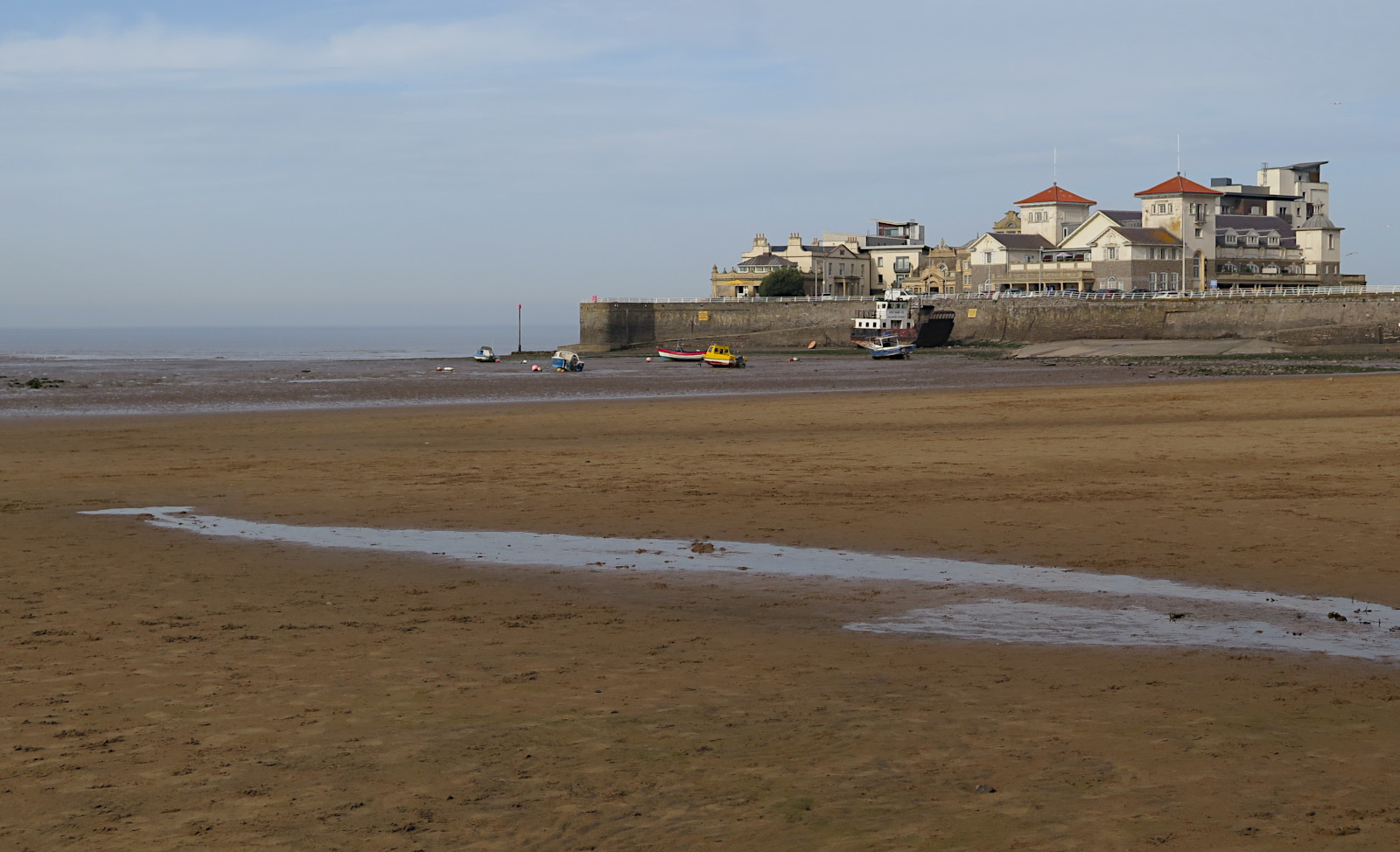
The beach in the photo is at Weston-super-Mare. Beyond it is Knightstone Harbour with boats high and dry because the tide is partly out. And beyond the harbour and the causeway you can see the buildings including Dr Fox’s Tearoom, Knightstone baths, Stones Cafe, and Knightstone Opera House. When we’re in Weston, Donna and I sometimes enjoy breakfast at Stones.

Originally it must have been a sandbank jutting out towards the Severn Estuary, perhaps with a backbone of exposed rock. Today it’s been built up and would barely be recognisable to the local people of two hundred years ago.

The largest boat you can see is the Steep Holm Ferry. It makes return trips out to Steep Holm island with a stay of ten to twelve hours, and basically it’s the only way to get there unless you have your own seaworthy vessel. The water here can’t make up its mind whether it’s the River Severn estuary or the North Somerset coast. It’s sixteen or so kilometres wide, in terms of weather and water conditions it can be treacherous.

See also:

< Previous | Index | Next >

Useful? Interesting?

If you enjoyed this or found it useful, please like, comment, and share below. (If you don’t see those links, click the article’s title above the main photo and they will appear.) Send a link to friends who might enjoy the article or benefit from it – Thanks! My material is free to reuse (see conditions), but a coffee is always welcome and encourages me to write more often!