Orchids grow wild here in the UK, they’re not as showy as many of the tropical ones, and the flowers are far smaller, but they are still beautiful plants.
What’s in an image? Sometimes quite a lot, more than meets the eye. I’m posting an image every few days.
Click to enlarge
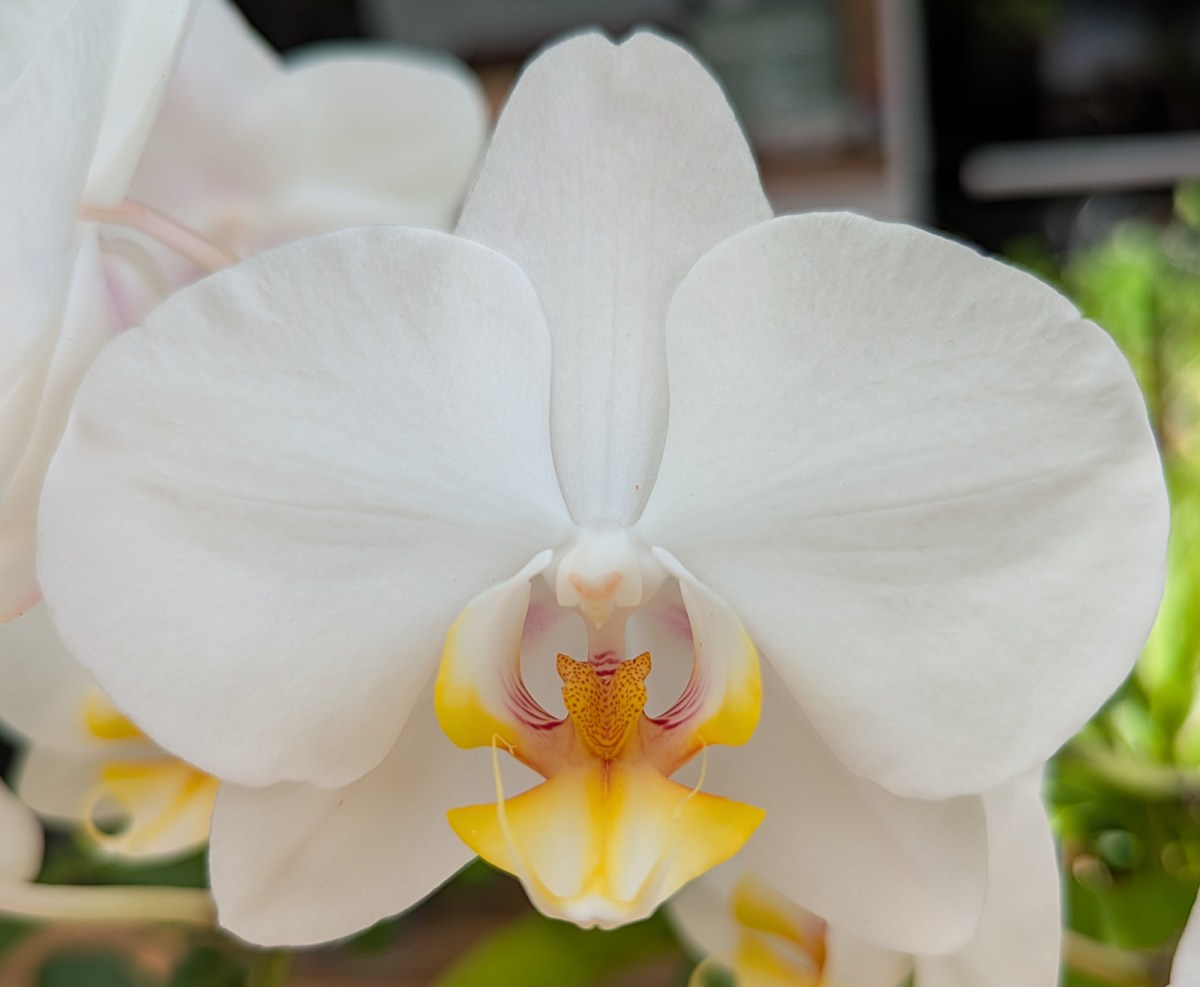
Orchids produce such beautiful flowers, often in great abundance, and they last for months if protected from too much heat and strong sun. This lovely, white Phalaenopsis flowers every year for us, but this year it had a bad plague of scale insect on the backs of the petals and on the leaves.
Scale insects are not hard to deal with as they can be wiped off with a soft tissue moistened with methylated spirit. Or even just wiped away gently with your finger. But you have to be persistent because you need to remove all the adults and then keep on removing the smaller insects until you have broken their reproductive cycle.
Orchids grow wild here in the UK, they’re not as showy as many of the tropical ones, and the flowers are far smaller, but they are still beautiful plants. Some orchids have flowers that mimic insects such as bees, butterflies, and flies. The insects are attracted to the flowers, and sometimes even attempt to mate with them; they act as pollinators, spreading the orchid pollen from one flower to another and so helping the orchid produce viable seed.
If you enjoyed this or found it useful, please like, comment, and share below. (If you don’t see those links, click the article’s title above the main photo and they will appear.) Send a link to friends who might enjoy the article or benefit from it – Thanks! My material is free to reuse (see conditions), but a coffee is always welcome and encourages me to write more often!
Like all dogs, Marple and Maizi spend a lot of time asleep. They sleep at night of course, just like we do; but they also sleep after meals, after walks, and any time they fancy during the day.
What’s in an image? Sometimes quite a lot, more than meets the eye. I’m posting an image every few days.
Click to enlarge
Here’s a five-year-old photo of my brother-in-law Paul’s dog, one of a pair of black Labradors, lovely, soppy, friendly creatures. This one is Marple, I think, though it’s hard to tell them apart without seeing both at the same time – if not Marple, she is Maizi.
Like all dogs, Marple and Maizi spend a lot of time asleep. They sleep at night of course, just like we do; but they also sleep after meals, after walks, and any time they fancy during the day. Apart from doing what they are told they have no responsibilities, no chores, no planning or organising, but plenty of time to rest. And like all carnivores, they mostly want to find something to eat and then rest until hunger pangs set in again. It’s a dog’s life!
Now five years older, at 14-years-old, they sleep even more than before.
Paul and his wife Vanessa live in Weston-super-Mare, a seaside town with a wonderfully long and wide beach and some fine woodland on a hill. Needless to say, Marple and Maizi have always loved visiting both the beach and the woodland. And it’s in those environments that I’ve seen some of the special closeness of interaction between human and dog; the throw, chase, catch, bring back, drop process for example, redone over and over and over again!
The close interaction between people and dogs developed a very long time ago, in his book, ‘Sapiens’, Yuval Noah Harari writes:
We have incontrovertible evidence of domesticated dogs from about 15,000 years ago. They may have joined the human pack thousands of years earlier. Dogs were used for hunting and fighting, and as an alarm system against wild beasts and human intruders. With the passing of generations, the two species co-evolved to communicate well with each other. Dogs that were most attentive to the needs and feelings of their human companions got extra care and food, and were more likely to survive.
Labradors possibly take this cooperative union further than almost any other breed. The bond between dog and owner can be really close. It’s been my privilege to see that very clearly with Paul, his wife Vanessa, and their dogs Maizi and Marple.
If you enjoyed this or found it useful, please like, comment, and share below. (If you don’t see those links, click the article’s title above the main photo and they will appear.) Send a link to friends who might enjoy the article or benefit from it – Thanks! My material is free to reuse (see conditions), but a coffee is always welcome and encourages me to write more often!
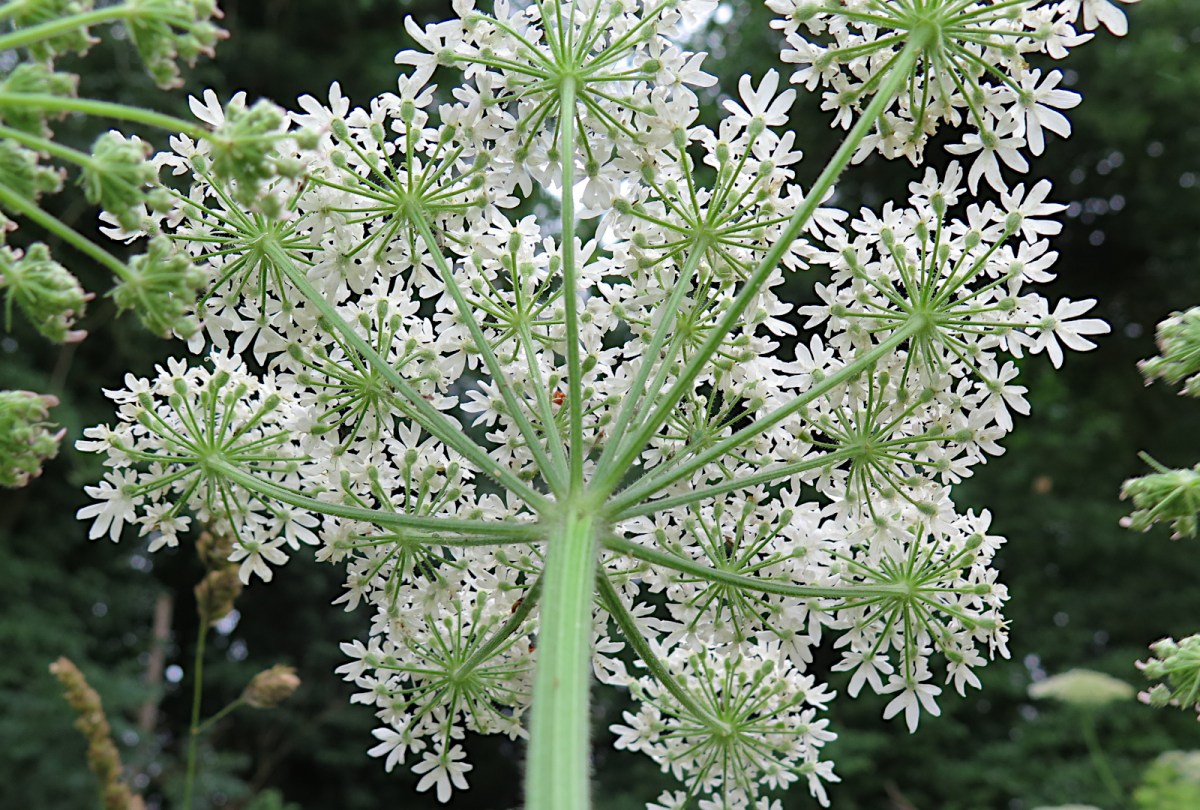
Notice how every part is sized precisely for the task it performs. The main stem is stout and sturdy, the stems that spring from it are much smaller and each one carries a number of flowers.
What’s in an image? Sometimes quite a lot, more than meets the eye. I’m posting an image every few days.
Click to enlarge
This photo was taken at a different time and place from the previous Umbellifer image, but the structure of this flower is very similar to the previous one. The main difference is that this time we’re viewing it from below. This reveals the exquisite architecture of an umbel.
Notice how every part is sized precisely for the task it performs. The main stem is stout and sturdy, the stems that spring from it are much smaller and each one carries a number of flowers. Those flower stalks in turn are smaller yet, and each one carries a single, tiny flower. It’s exactly how an engineer might design something, each part as large and strong as it needs to be, but no more. Why and how? Well, in the case the engineer, because lightness means less material, less mass, and therefore lower cost. Failure will be unusual because the forces will have been calculated and the values increased just a little to ensure safety.
Your car is designed this way, it could be designed and built to survive a collision with little or no damage, but it would be unaffordable because of the high cost of the extra material required, and it would consume much more fuel because of its high mass. That’s why you drive a car when travelling, not a tank!
The same argument applies to plant structures. The umbel could be made to survive a hurricane, but it would demand much more photosynthesis to provide the cullulose and other materials required to make it tough enough to survive such powerful winds. That’s why coconut palms have far stronger stems than the umbellifer! Living things are not designed by engineers, they adjust to their environment little by little over many generations by a trial and error system we call evolution.
Sometimes people say, ‘It’s only a theory’, meaning that something is a bit shaky and not to be trusted. That is to misunderstand what scientists mean by the word ‘theory’. In everyday use the word has a sense of an untested idea, something you just dreamed up as a way to explain something – might be wrong, might be right. Scientists have a word for that, but the word is not ‘theory’ – it’s ‘hypothesis’. In science, a theory is something so well tested as to be essentially unrejectable. Evolution is a theory in that sense, like the theories of relativity or quantum physics or plate tectonics. Theories have almost no room left for argument.
You can’t believe in evolution, it’s not a matter of faith but of overwhelming evidence. Following Jesus, as I and many others do, is based on faith, and I write about that too on Journeys of heart and mind.
You might be surprised to learn that engineers sometimes use evolution to design things like aircraft wings. The software to do that makes a long series of small tweaks to an initial design and calculates which changes improve performance. And this process is repeated many times enabling the final result to be stronger, lighter and more effective. An aircraft wing (or other structure) created in this way is not designed with paper and pencil or with CAD in the normal way, it evolves.
If you enjoyed this or found it useful, please like, comment, and share below. (If you don’t see those links, click the article’s title above the main photo and they will appear.) Send a link to friends who might enjoy the article or benefit from it – Thanks! My material is free to reuse (see conditions), but a coffee is always welcome and encourages me to write more often!
What’s in an image? Sometimes quite a lot, more than meets the eye. I’m posting an image every few days.
Click to enlarge
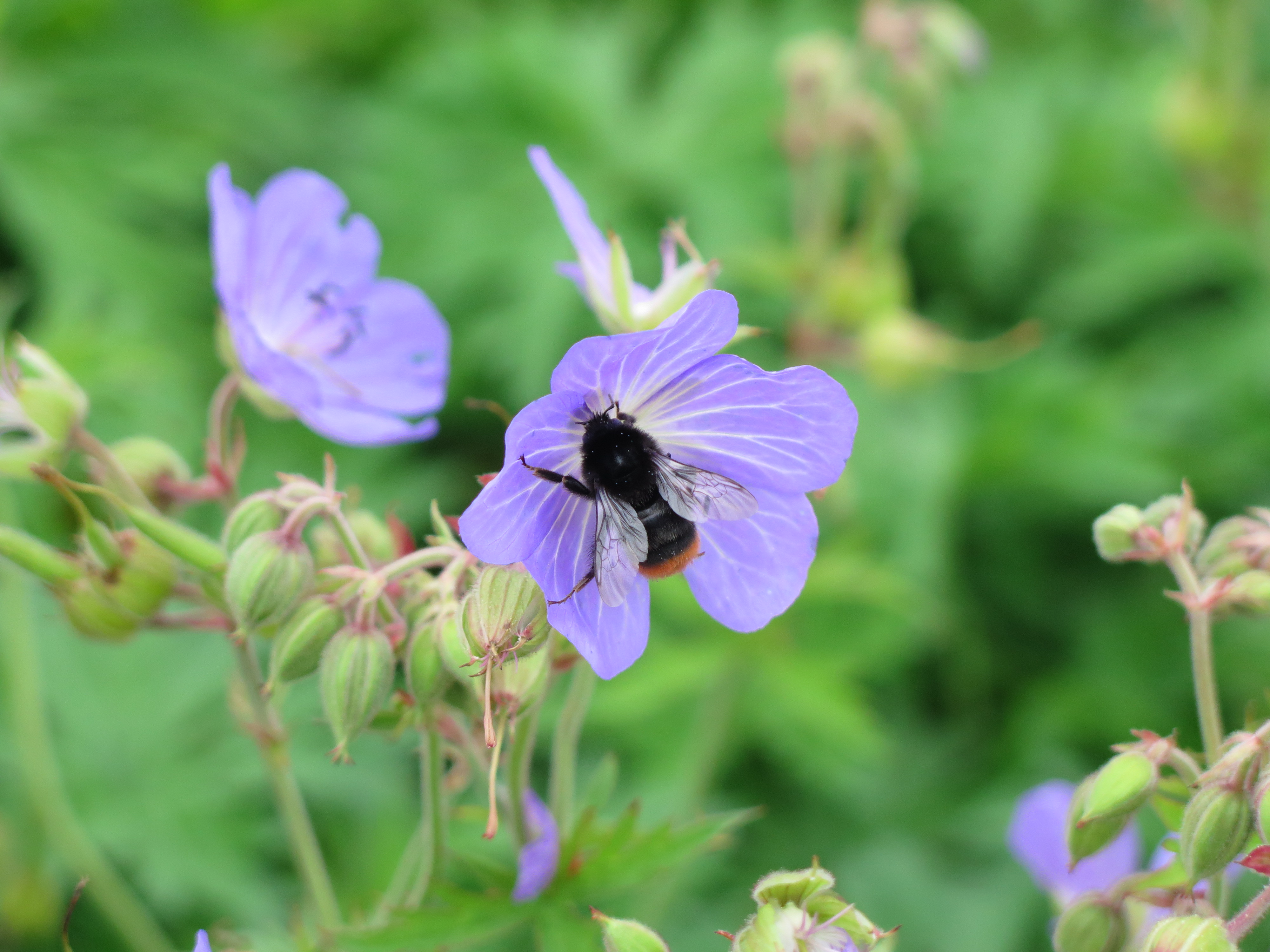
Here’s a bumble bee busy collecting nectar from a meadow cranesbill flower in a field margin just a brief walk from my home. The cranesbills are wild geraniums, close relatives of the pelargoniums; both genera are widely grown as decorative plants in pots or garden borders.
The photo is sharp enough when enlarged that you can see individual pollen grains on the bee’s black, furry body. Click the thumbnail image and stretch it to full size, then look for little white dots on the bee, those are the pollen grains.
Mutual benefit
The bees and flowering plants co-evolved, ancestors of both succeeded best in the presence of the other. Presumably the bee ancestors fed on the pollen of wind pollinated plants, incidentally transferring pollen more efficiently than the wind. And plants that provided sugary solutions and flagged this with colourful leaves near the nectar and pollen source were more successful than those that did not. After a while the insect and plant species were locked into a mutually beneficial relationship. Flowers are wonderfully adapted to attract bees and supply them with energy and a protein source to feed to their larvae. Bees are wonderfully adapted to collect and store nectar and pollen while moving some pollen grains from one flower to another.
If you enjoyed this or found it useful, please like, comment, and share below. (If you don’t see those links, click the article’s title above the main photo and they will appear.) Send a link to friends who might enjoy the article or benefit from it – Thanks! My material is free to reuse (see conditions), but a coffee is always welcome and encourages me to write more often!
What’s in an image? Sometimes quite a lot, more than meets the eye. I’m posting an image every few days.
Click to enlarge
This is a flower head of cow parsley or one of its relatives, a wild plant that grows extensively in Britain on untrimmed grass verges, along hedgerows, and in similar places. It’s a member of the carrot family, the Apiaceae ( until 2011, Umbelliferae), the word ‘umbellifer’ is related to ‘umbrella’ and you can probably see why!
The umbellifers are an interesting group of plants, including carrot, parsnip, celery, parsley, dill, fennel, coriander and many more. Cow parsley, like the others listed here, is safe to eat – but be very careful; hemlock looks much like cow parsley and is deadly poisonous. The infamous giant hogweed is another harmful umbellifer.
It was a hemlock extract that the Greek philosopher Socrates was required to drink following a guilty verdict in Athens.
If you enjoyed this or found it useful, please like, comment, and share below. (If you don’t see those links, click the article’s title above the main photo and they will appear.) Send a link to friends who might enjoy the article or benefit from it – Thanks! My material is free to reuse (see conditions), but a coffee is always welcome and encourages me to write more often!
The natural world always behaves like this. It attempts, in its own way, to overcome every obstacle put in its path. Organisms of all kinds make the best they can of every situation.
What’s in an image? Sometimes quite a lot, more than meets the eye. I’m posting an image every few days.
Click to enlarge
Fancy a swim? No, I don’t either.
As with the last two Image of the day posts, this is once again from the River Great Ouse. Rubbish of all kinds gets into the river by a variety of routes. Sometimes people may just chuck stuff in – empty cans, plastic wrappers, paper bags. More often, perhaps, they leave items on the grass or the path, the wind blows, and voila! More flotsam.
But there’s not just human junk here, there are a lot of feathers too, mostly swan feathers though there might be goose and duck feathers as well. And there are leaves carelessly discarded by the trees in the park. However, the situation is not as bad as it seems; the photo was taken in a little corner where the river current doesn’t reach, a stagnant space where, if things move at all, they go around in lazy circles. There’s also some kind of floating weed here, thriving amongst the trash.
The natural world always behaves like this. It attempts, in its own way, to overcome every obstacle put in its path. Organisms of all kinds make the best they can of every situation. Often, the impact of floating waste is negative, but sometimes there may be exceptions.
On a much larger scale
I expect readers are aware of the massed floating zones of plastic at the centres of our oceans, the so-called Pacific garbage patch is the best known example although there are others. Some organisms have adopted these patches as suitable places to settle and there are now thriving colonies of algae, fish, and more. Attempts to collect the plastic for removal may need to be reconsidered and the situation is still under investigation.
Humans individually and collectively
It’s tempting to assume that my individual action has little effect. And there’s some truth in that – If I throw away a plastic sandwich wrapper as I walk in the countryside (having a quick look around first to see if anyone’s watching, of course), it’s easy to assume it doesn’t matter. But if I do it it every day that will be 365 plastic sandwich wrappers lying in the countryside. And if a thousand other people do the same thing that’s a third of a million wrappers. Suddenly the problem seems greater than I first imagined!
Collectively we are doing an enormous amount of damage. We need collective actions to make things better. This is happening, and we can all contribute, individually and collectively. If I act to improve things a little, and do it often, I will make a real difference. Or a local group removing litter from public spaces can make a larger difference much more quickly.
Somehow, collectively, we need to change from causing more damage to thinking things through and acting more responsibly. If we can’t or won’t, things will go from really bad (where we are now) to far, far worse (a place we definitely don’t want to be). Yet there’s still time, if not to put everything right, at least to reduce the harm very significantly.
It’s not only about rubbish
There are many things we can do to help the world cope better. Some of the links below offer good practical suggestions. Thinking about what we eat, how we use water, reducing energy consumption (and many other actions) can help the planet.
If you enjoyed this or found it useful, please like, comment, and share below. (If you don’t see those links, click the article’s title above the main photo and they will appear.) Send a link to friends who might enjoy the article or benefit from it – Thanks! My material is free to reuse (see conditions), but a coffee is always welcome and encourages me to write more often!
Downtime is recuperative. It gives us time to just be, time to think, contemplate, dream. And when we return to the business of the day, perhaps we’ll do it with renewed vigour and purpose.
What’s in an image? Sometimes quite a lot, more than meets the eye. I’m posting an image every few days.
Click to enlarge
I took this photo in 2012 when we lived in St Neots. It shows one of the bridges across the River Great Ouse in Bedford, much of the area around the river is parkland. It’s a wonderful breathing space in the heart of the hustle and bustle of the town and a relaxing stroll at lunchtime is always good in the middle of a busy day. There are places to eat and drink, or you can bring your own food and find a place to sit on the grass or choose a bench by the water. Lovely.
Downtime is important in our lives, it’s not good to be busy all the time. So whether it’s a week’s holiday, or even two; or a day off; or just 30 minutes in the middle of the day in the sunshine – downtime is recuperative. It gives us time to just be, time to think, contemplate, dream. And when we return to the busy business of the day, perhaps we’ll do it with renewed vigour and purpose.
And there’s something else in this photo.
Crossing a bridge
It’s impossible to miss the man crossing the footbridge. He looks purposeful, yet relaxed. The placid beauty of his surroundings would make it easy to feel relaxed. He’s crossing from one side to the other and I think he knows where he’s going.
Now I’m going to say something that some will accept and others will reject. But please reject it slowly if that’s your response. Read to the end and then reject it if that’s your decision. The man on the bridge is like a person following Jesus. That’s a bridge I have crossed in my own life. We’re all free to choose, but before walking away (if that’s your choice) please consider that even if you don’t believe all of his claims, Jesus is worth your attention because of his philosophy. He chose kindness, love and generosity over the prickly hatred and meanness that we so often see in our world. Jesus is worth hearing for his non-spiritual views, quite apart from anything else. Take a look. I did. My story is here on Journeys of heart and mind.
If you enjoyed this or found it useful, please like, comment, and share below. (If you don’t see those links, click the article’s title above the main photo and they will appear.) Send a link to friends who might enjoy the article or benefit from it – Thanks! My material is free to reuse (see conditions), but a coffee is always welcome and encourages me to write more often!
I made a tracing using a soft grade of pencil, then turned the tracing paper over on top of a dull yellow sheet of art-grade paper, and rubbed down the traced lines.
Image 101 – What’s in an image? Sometimes quite a lot, more than meets the eye. I’m posting an image every day or so.
Larger view
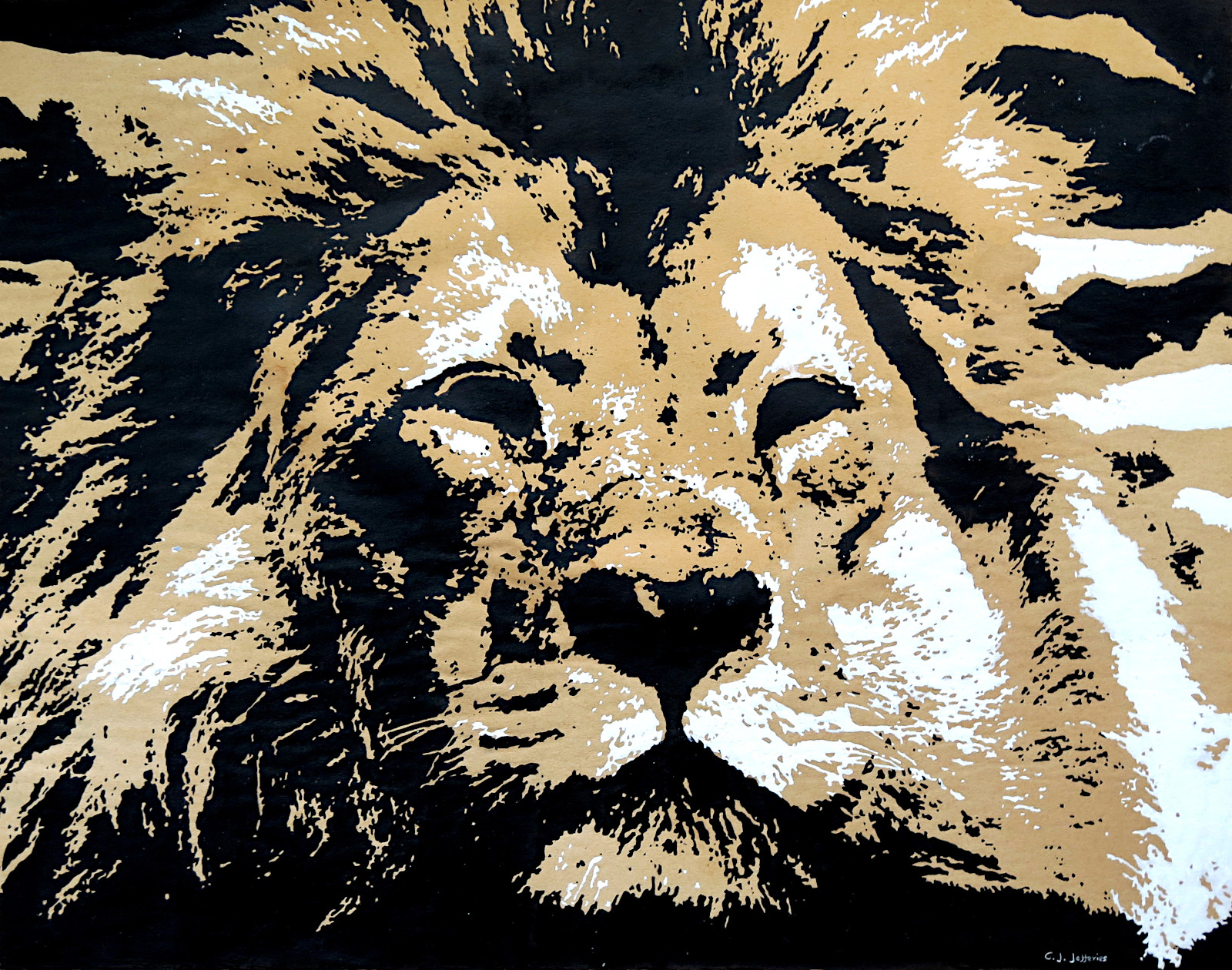
Meet Leo! I’m going to share the story behind this image.
This image of a lion first appeared printed on paper carrier bags from a British menswear chain in the 1960s. The chain was Foster Brothers, and I had bought something there and was given the paper carrier. I was impressed with the picture on the bag, it was in white, grey (not yellow), and black and I was fascinated at the way it had been rendered in three brightness levels. These days it would be dead easy with image manipulation software, but in the 1960s it must have involved clever photographic printing at high contrast levels and then some work by an artist.
I was so impressed by the image that I decided to make a copy of it for my girlfriend, Judy (later my wife). I made a tracing using a soft grade of pencil, then turned the tracing paper over on top of a dull yellow sheet of art-grade paper, and rubbed down the traced lines to leave an impression on the yellow paper. (For a lion, dull yellow seemed far more suitable than grey.)
Then, using white and black Indian inks, I filled in the traced areas using the carrier bag for guidance. The carrier had a cut-out to act as a handle, so I had to make up the missing area. It took a long time, but the final result is what you see here, and I was pleased with it. I also made a wooden frame for the picture and used a scrap piece of greenhouse glass salvaged from the family’s nursery business, suitably cut to size.
Judy was surprised as she didn’t know I’d been working on it. And she was delighted with it too. It hung on her bedroom wall at her parent’s house, and then after we were married, in our bedsit, then our flat, and finally our house in Yatton. After Judy died in 1995, and Donna and I married, Leo came too and still hangs on the wall in our dining room. I was about 18 when I made the picture, now I’m 76 and I still have it.
That’s the story of how Leo came to be. But I have more to say, not about the picture but about the nature of a lion. I might get to that tomorrow, but if not, then certainly within the next week or two.
If you enjoyed this or found it useful, please like, comment, and share below. (If you don’t see those links, click the article’s title above the main photo and they will appear.) Send a link to friends who might enjoy the article or benefit from it – Thanks! My material is free to reuse (see conditions), but a coffee is always welcome and encourages me to write more often!
Images fade, especially if exposed to light, they are susceptible to damage by fire, water, mechanical action and so forth.
For some years now I’ve been transferring family photos, videos and documents to digital storage in an attempt to preserve the information. There are pros and cons to both physical storage and digital storage and we’ll discuss those in this article.
But first, lets take a look at an example photo.
An old photo from my collection – May 1969
The image above is from a 35 mm transparency. It shows my fellow students on the Bath University Horticulture degree course the year before we graduated. We were visiting a commercial horticultural business and there’s a TV personality in the image as well. (One of our lecturers, Peter Thoday, later became well known as the narrator in the TV series, The Victorian Kitchen Garden. He’s at the back of the group on the right in the photo, tall and with very dark hair.)
Details of the photos and how I manage them
Quite a few of the old photos I have are colour transparencies; these come in different sizes depending on the type of camera and film that were used. The majority are on 35 mm film stock, with sprocket holes along two sides; these engage with the film transport mechanism in the camera. After the film was processed and dried it was cut into individual frames and mounted in card or plastic frames. My film scanner can handle mounted and unmounted slides and saves them as digital image files.
Once I have the images in digital format I remove slides from their frames and check the frame numbers exposed on the film when it was manufactured. This makes it easy to get the slides into correct sequence as they may have been reordered accidentally or even deliberately when they were projected in the past. Having confidence that the photos are correctly in sequence makes it much more likely that I can eventually arrange the films into longer sequences based on events, people and places in the images. This is a work of reconstruction, sometimes easy, sometimes very difficult. I keep notes of what I have done and why, for my own reference and for anyone else who might find the information useful later. I’ve got better at doing this with experience.
Advantages and disadvantages of physical storage
The original negatives and transparencies contain more information than digital copies. For one thing, the dynamic range is greater and the resolution is always going to be a little higher. Scanning processes are very good indeed these days, but they’ll never be absolutely perfect.
On the other hand, originals deteriorate over long time periods. Images fade, especially if exposed to light, they are susceptible to damage by fire, water, mechanical action and so forth. And as each image is unique, if it’s lost or damaged there is no way to recover it.
And two final points – storing negatives, transparencies and prints takes a lot of space, more and more as the numbers increase. And viewing them becomes an issue, only a few people can view them at a time.
Advantages and disadvantages of digital storage
Digital copies of the images can be almost as good as the originals for most purposes, and digital processing can improve colours and remove blemishes when the originals are faded, scratched or have dust that is strongly attached to the surface. In these cases, the digital copy may be more acceptable than the original.
Digital storage is increasingly cheap and capacious, so a very large collection of photos can be stored on a cheap, tiny SD card. This in turn makes it possible to have multiple copies in multiple locations, providing security far beyond anything possible with the originals. Remote storage on Dropbox or similar facilities takes this a step further. Multiple copies and remote storage both make it possible for many people to be able to view the images independently and from wherever they happen to be.
Perhaps the biggest downside of digital storage is the need to constantly move images from old storage media to newer technology. How many of us have devices to read data from a floppy disk or an old CD? Remote storage helps again because the company offering the service takes on the task of managing data storage and retrieval and moving to newer technologies whenever necessary.
And there’s a hidden factor here too, the images need to be stored in a file format that is still readable on current devices. JPG and PNG are widely used and may be readable by future devices for a very long time, but nothing is certain and it may become necessary to re-save the images in a different file format in future. This would be a major task for a large image collection.
My approach to all this
I’ve thought about this a lot. Currently, everything is stored in high quality JPG format. Yes, I know there are very slight compression artefacts in JPG, but unless the images are repeatedly edited and re-saved this is not an issue in practical terms. I use an Epson Perfection V600 Photo scanner which for me is a good compromise between quality and price. The images are stored initially on my laptop and automatically to Dropbox, and I back up my laptop on an external hard drive at intervals. Other members of the family have their own copies of some of the data, though keeping this refreshed has been a problem.
Something I have not yet fully resolved is what happens when I’m no longer able to manage all this data. Of course, at that point the future of the images will no longer be of personal interest. Nonetheless, I’d like to have some kind of plan in place, perhaps handing on access to my Dropbox account would be a good way forward.
If you enjoyed this or found it useful, please like, comment, and share below. (If you don’t see those links, click the article’s title above the main photo and they will appear.) Send a link to friends who might enjoy the article or benefit from it – Thanks! My material is free to reuse (see conditions), but a coffee is always welcome and encourages me to write more often!
For this holiday, Dad (a keen photographer himself) helped me out by buying me a colour transparency film and I used it to take the photo you see here.
What’s in an image? Sometimes quite a lot, more than meets the eye.
I’m posting an image every two days (or as often as I can). A photo, an image from the internet, a diagram or a map. Whatever takes my fancy.
One of my earliest colour photos
I’m going to take a break from the Irish holiday photos I’ve been working through. Instead, here’s one of my earliest colour shots, from 1962 when I was fourteen-years-old. This is a holiday photo as well, we were spending two weeks on the Welsh coast at the village of Aberporth, a little north of Cardigan. From left to right you see Dad, Mum, Chloe the dog, and my three sisters, Cindy, Ruth and Rachael.
Colour film was expensive so usually I took black and white negatives and had the films developed and printed by a local chemist in the town. Later I started making contact prints myself though these were very tiny. Later again I learned to develop the negatives myself, and print them using an enlarger at the place where I worked. But for this holiday Dad (a keen photographer himself) helped me out by buying me a colour transparency film and I used it to take the photo you see here.
I’ve always been fascinated by old photos and the way they capture something long since gone – and now even some of my own photos are old enough to have that effect!
For a while I plan to continue with a range of different images, but then I’ll return to our Irish holiday again.
Themed image collections
The links below will take you to the first post in each collection
If you enjoyed this or found it useful, please like, comment, and share below. (If you don’t see those links, click the article’s title above the main photo and they will appear.) Send a link to friends who might enjoy the article or benefit from it – Thanks! My material is free to reuse (see conditions), but a coffee is always welcome and encourages me to write more often!








 Journeys of Heart and Mind