From gas and gravity to galaxies

The tiniest fluctuations in density in the early universe have become the very largest structures we are aware of.

Part 4 of a series – Emergence

< Combining atoms | Index | First generation star formation >
Click for full size
(NASA image)

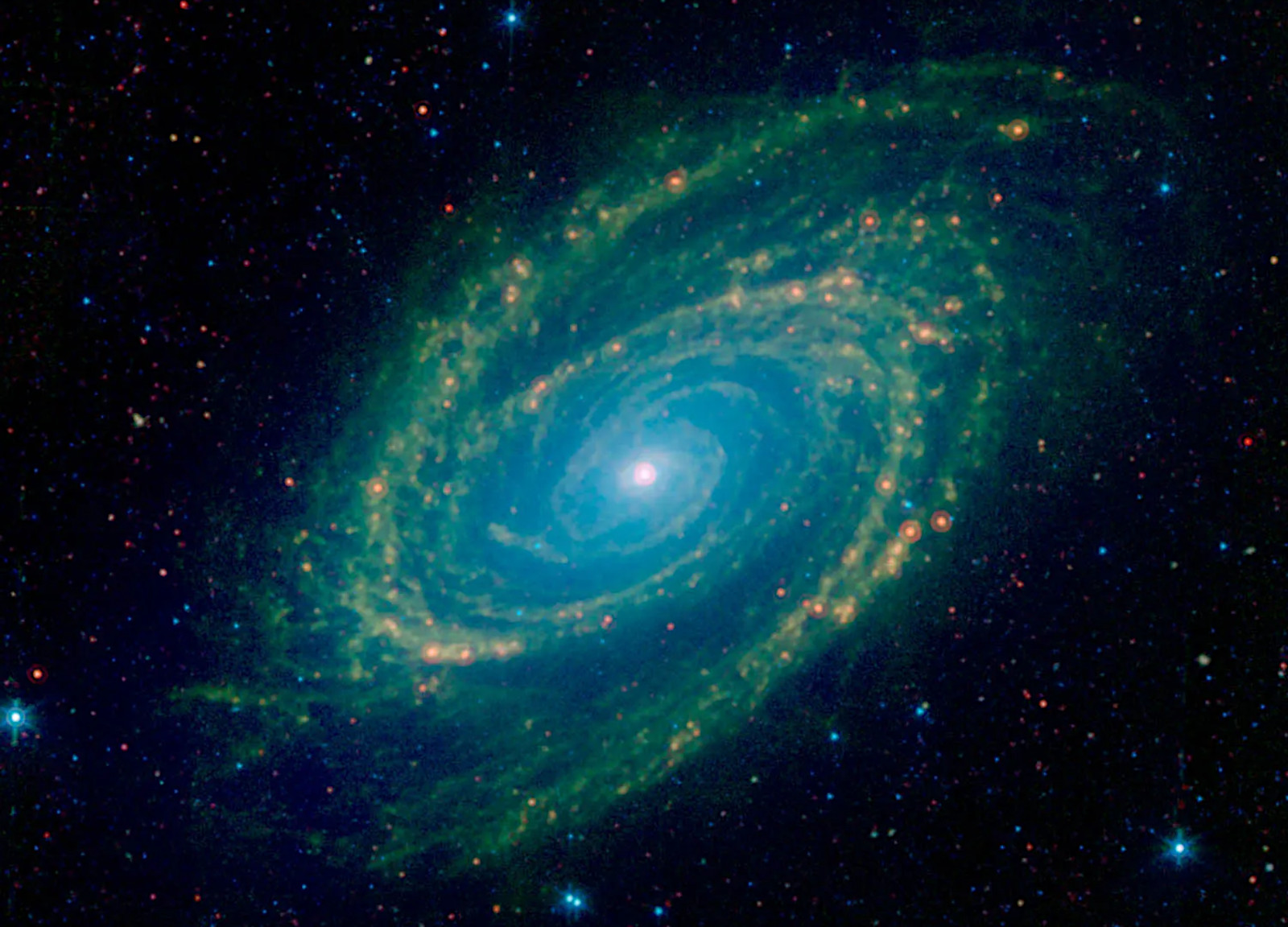
In the early phase of the young, expanding universe, the primordial atoms of hydrogen, some helium, and traces of lithium were present in strings and clumps. These structures go back to the very earliest times. The cosmic microwave background hints at such structures very early on, and on the most enormous scales of astronomy they also put in an appearance. Strings and clusters of galaxies are visible everywhere, with vast voids between them where there seems to be nothing at all.

Gravity, although it’s by far the weakest of the fundamental fields, acts over enormous distances. Because of this, the tiniest fluctuations in density in the early universe have become the very largest structures we are aware of. Galaxies and clusters of galaxies began as truly enormous volumes of tenuous gas. And just as tiny density fluctuations became concentrations and voids, so imperceptible movements became enormous swirls, rotations and flows under the relentless action of gravity. Loose accumulations became ever tighter concentrations; gentle drifting became powerful vortices.

This happened at every conceivable scale. When a volume of gas is compressed by its own gravity, it doesn’t remain spherical. Rotation of the mass increases as the material is pulled together and the end result is inevitably a disk rotating slowly at the outer edge, but ever faster towards the centre. This is how proto-galaxies formed. And within those proto-galaxies, the same process on a far smaller scale allowed stars to form – but that’s another story.

For now, just ponder the fact that galaxy clusters and galaxies are emergent features given the gravitational field that permeates the universe and sufficiently large amounts of gas.

See also:

< Combining atoms | Index | First generation star formation >

In the beginning – a field

The properties of the universe itself (whatever they may have been) seem to have resulted in the emergence of four fields, each with its own properties.

Part 2 of a series – Emergence

Emergence – an introduction | Index | Combining atoms >

Fields underlie everything we’re familiar with in the universe in which we live. We know nothing about the universe at the time it began, though we know a surprising amount about the universe just a tiny fraction of a second after that beginning.

No, I’m not writing about a field with hedges around it, but a field as defined and understood by physicists. The first thing to exist in our universe was a field, quite possibly just a single field (or so I like to imagine). This is the second article on the topic of emergence, and you’ll see why later.

Various kinds of field (from Wikimedia Commons)

So let’s begin by thinking about the nature of a field. Physicists talk about several different fields – a gravitational field for example. In 1865 James Clerk Maxwell published ‘A Dynamical Theory of the Electromagnetic Field’ in which he explained that magnetism, electricity and light are all functions of a field. Fields are not particles, or forces (though they can and do give rise to these). Instead, a field permeates all of space. Right now you are exposed to the gravitational field and you are being acted on by the sun, the moon and the earth (and everything else in the universe). The pull these objects exert on you are in proportion to your mass and the mass of the distant object (let’s say the Sun) and by the distance between you. The strongest pull and the only one you will be aware of is the pull of the Earth, you’ll certainly notice it if you trip and fall over, or if you drop something. The Moon is not as massive as the Earth and is far away, so has much less pull. The Sun is much more massive than the Earth, but it’s also far, far more distant, and therefore pulls on you much less than the Earth does. These rules apply to every object in the universe, there is gravitational attraction between you and your cat (if you have one) also there’s gravitational attraction between you and the Andromeda galaxy. These attractions are very tiny as neither you nor the cat have much mass, and the Andromeda galaxy is exceedingly far away.

All of this can be quantified and a mathematical formula exists so that, given the masses of two objects and the distance between them, it’s easy to calculate the strength of the attraction.

So, where does emergence come in?

We don’t know how the universe began, or why, but we do know more or less when – almost 13.8 billion years ago. When the universe was still very new (if it makes sense to talk about time at all in the first picosecond (a billionth of a second), the still very tiny universe was filled by the gravitational field (as it still is today). This field became distinct from other fields repeatedly as the universe grew, giving rise to the electromagnetic field, then the weak field, and finally the strong field.

This represents the earliest event we might describe as emergence. The properties of the universe itself (whatever they may have been) seem to have resulted in the emergence of four fields, each with its own properties, four things that were not originally present. There’s probably little more to say about any of this, and the way I’ve portrayed it is speculative. But given these four fields, further steps of emergence can be discerned rather more clearly. And that’s something we’ll look at in another part of this series.

See also:
Part 2 of a series – Emergence

Emergence – an introduction | Index | Combining atoms >