First generation Star formation

Our Sun is a typical, smallish star, it has been around for some five billion years so far and probably has about another five billion years to go. No need to panic, the Sun is middle aged! Steady as you go.

Artist’s impression of early stars (Wikimedia)

Part 4 of a series – Emergence

< From gas and gravity to galaxies | Index | No later posts >

RequiresExtensive cold gas clouds
Results inStars producing elements up to iron, gas giant planets
EnablesNovae, Supernovae

Two features of the birth of a star system are important here, matter and energy. The first stars formed from the gradual collapse of clouds of cold gas consisting mainly of hydrogen with some helium and a trace of lithium. Gravity slowly pulls a gas cloud into an ever-shrinking volume, and slow, drifting motions lead to increasing rates of rotation as this shrinkage proceeds. Compression of gases always results in heating, so over a long period of time, a diffuse cloud of cold gas becomes a rotating mass of increasingly hot gas.

Sufficient collapse eventually causes the internal pressure and temperature to reach a critical point at which nuclear fusion becomes not just possible, but inevitable, and conditions then settle to a point where the fusion energy dramatically increases the core temperature and pressure, pushing outwards more and more strongly until the the gravitational collapse is stopped. The rotating, hot mass is a young star, converting hydrogen to helium.

Over time it settles down more and more to a stable state, though this lasts for a limited time, basically until no further hydrogen fusion is possible because there is insufficient hydrogen remaining. The length of time of that stable state is related to the mass of the star. Small, light stars process their hydrogen slowly. Large, very massive stars burn through their supply much faster. Although they have a great deal more to begin with, the temperatures and pressures at the centre are much higher so there is a faster reaction in a larger volume of core. That’s why large stars run out of fuel faster than small ones. These earliest stars are called Population III stars by astronomers, it seems they were usually very large and therefore short-lived.

Our Sun is much more recent, a typical, smallish star, it has been around for some five billion years so far and probably has about another five billion years to go. No need to panic, the Sun is middle aged! Steady as you go.

Eventually, as the hydrogen is used up, energy production falls and gravity can no longer be resisted, so the star shrinks and heats up further. As the internal temperatures and pressures increase, the star shrinks until the temperature at the core is sufficient to fuse helium. Once again, further gravitational collapse is halted by increasing core temperatures and this lasts until the helium supply is exhausted. Through a whole series of similar steps the star creates heavier and heavier elements all the way up to iron, but fusing atoms of iron absorbs energy so gravity wins out in the end. Small stars slowly cool and eventually become inactive and unchanging. Particularly large stars have a different fate.

We’ll consider those details in a future article.

See also:

< From gas and gravity to galaxies | Index | No later posts >
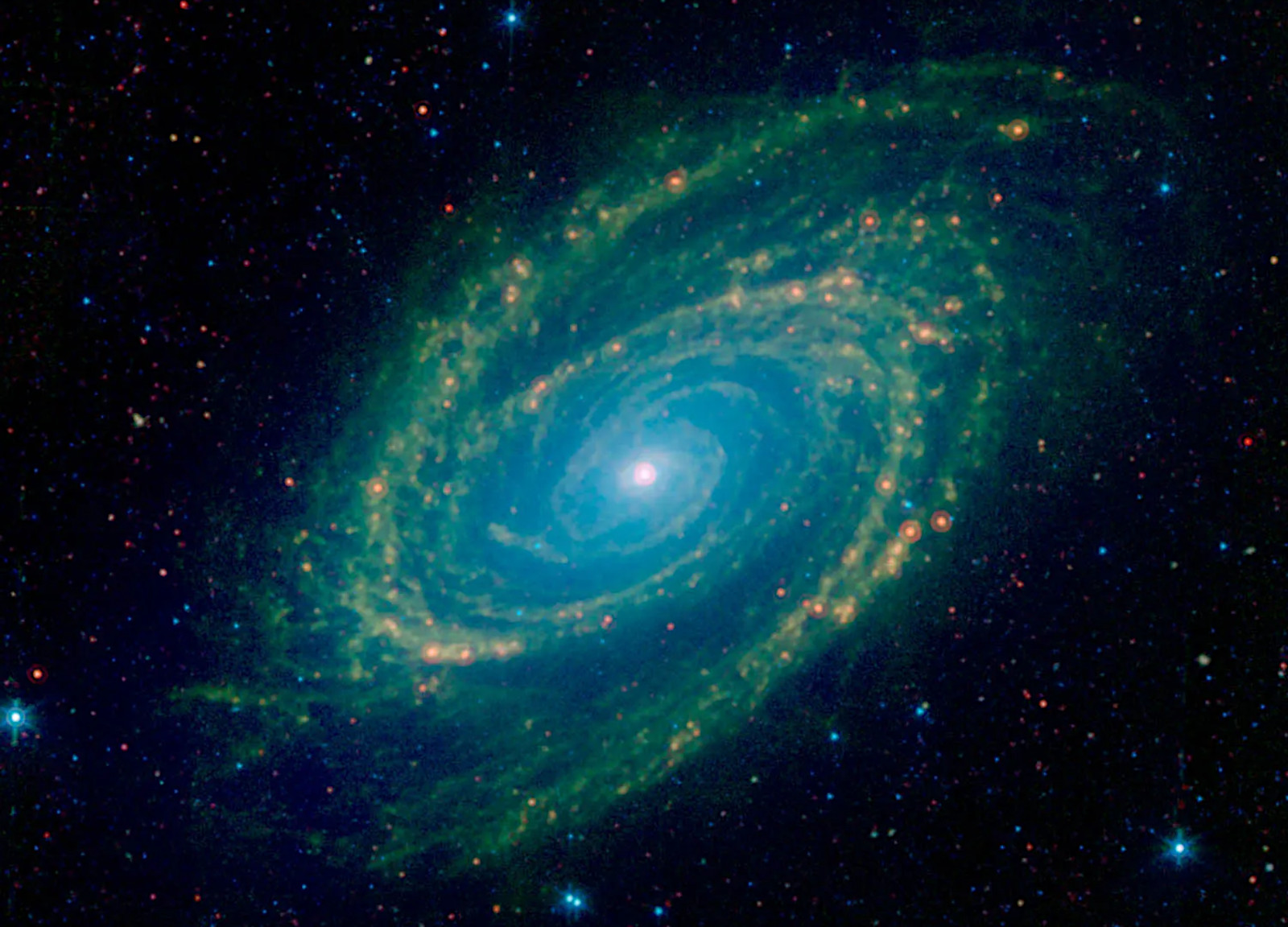
From gas and gravity to galaxies

The tiniest fluctuations in density in the early universe have become the very largest structures we are aware of.

Part 4 of a series – Emergence

< Combining atoms | Index | First generation star formation >

Click for full size
(NASA image)

In the early phase of the young, expanding universe, the primordial atoms of hydrogen, some helium, and traces of lithium were present in strings and clumps. These structures go back to the very earliest times. The cosmic microwave background hints at such structures very early on, and on the most enormous scales of astronomy they also put in an appearance. Strings and clusters of galaxies are visible everywhere, with vast voids between them where there seems to be nothing at all.

Gravity, although it’s by far the weakest of the fundamental fields, acts over enormous distances. Because of this, the tiniest fluctuations in density in the early universe have become the very largest structures we are aware of. Galaxies and clusters of galaxies began as truly enormous volumes of tenuous gas. And just as tiny density fluctuations became concentrations and voids, so imperceptible movements became enormous swirls, rotations and flows under the relentless action of gravity. Loose accumulations became ever tighter concentrations; gentle drifting became powerful vortices.

This happened at every conceivable scale. When a volume of gas is compressed by its own gravity, it doesn’t remain spherical. Rotation of the mass increases as the material is pulled together and the end result is inevitably a disk rotating slowly at the outer edge, but ever faster towards the centre. This is how proto-galaxies formed. And within those proto-galaxies, the same process on a far smaller scale allowed stars to form – but that’s another story.

For now, just ponder the fact that galaxy clusters and galaxies are emergent features given the gravitational field that permeates the universe and sufficiently large amounts of gas.

See also:

< Combining atoms | Index | First generation star formation >

Combining atoms

Atoms began emerging very early in the formation of the universe, perhaps 18 000 years after the origin.

Part 3 of a series – Emergence

< In the beginning – A field | Index | From gas and gravity to galaxies >

A hydrogen atom

Here’s a simple diagram of a hydrogen atom. The little black ball is the nucleus, a proton, 10 000 times smaller than the atom as a whole, the white part represents an electron, spread out like a cloud around the nucleus. The proton and the electron were once thought of as fundamental particles that had no underlying structure. For the electron that remains true. The proton on the other hand consists of three quarks, but for the purposes of chemistry we can still think of it as ‘fundamental’.

A hydrogen atom can react with other atoms in quite specific ways. New and more complex behaviour emerges as atoms combine. Here are some of those emergent properties:

A molecule of methane, four hydrogens attached to a carbon atom
  • Two atoms of hydrogen can combine as a molecule of hydrogen, a gas that can become explosive when mixed with air.
  • Two hydrogen atoms and an oxygen atom can combine as a water molecule. Everyone knows that pure water is safe to drink.
  • Four hydrogens and a carbon atom can combine as a molecule of methane gas. This is the domestic gas that we use for cooking and for heating our homes. Methane is also a powerful greenhouse gas, contributing to global heating.
  • Three hydrogens and a nitrogen atom can combine as a molecule of ammonia, a poisonous gas that dissolves readily in water.
  • Two hydrogens and a suphur atom can combine as a molecule of hydrogen suphide, a gas that smells like rotten eggs.

There are many other molecules that include hydrogen.

Protons, and similar particles called neutrons can combine in larger numbers to make heavier and larger nuclei surrounded by much larger clouds of electrons (we’re leaving out a great deal of detail here). Together, these are the various chemical elements; there are more than 100 different kinds. Sodium, oxygen, phosphorus, chlorine, nitrogen, lead, iron, gold, sulphur, copper, tin and so on.

Chemistry

So – Take 100 different atoms and combine them together in various ways and you can clearly see that many, many different molecules are possible. Imagine 100 different kinds of Lego bricks and you begin to see the range of possibilities. There are rules of chemistry that restrict the combinations that can form, but even allowing for those rules, the number of possible molecules is huge . Here are some examples.

  • Sulphuric acid – two hydrogens, a sulphur, and four oxygen atoms
  • Table salt – one sodium and one chlorine atom
  • Bleach – two chlorine atoms
  • Laughing gas – two nitrogens and two oxygen atoms

We see chemistry appearing as soon as we have atoms. Chemistry just isn’t there in the world of subatomic particles like protons, neutrons and electrons. Like every object you can think of, we are made of atoms in complex chemical combinations so it’s quite hard for us to imagine a universe without chemistry. And atoms began emerging very early in the formation of the universe, perhaps 18 000 years after the origin. Chemistry started around 370 000 years as the universe continued to cool and atoms were able to begin combining ever more freely. At first hydrogen, helium and a small amount of lithium were the only elements available, all the others up to iron formed inside stars, while exploding stars (supernovae) generated the heavier elements and scattered these and the lighter elements far and wide. Once that had happened, perhaps 500 million years ago, the full range of atoms were available and chemistry took off in earnest.

Atoms are emergent, beginning to form once the universe became cool enough. And chemistry emerges given the presence of atoms and even lower temperatures. Could atoms and chemistry have been predicted given the presence and behaviour of subatomic particles? Perhaps. But it would have taken a real genius, a physicist with great foresight and imagination. But physicists are made of atoms and complex chemistry – so the real answer must be ‘no’!

That’s the thing about emergence – new kinds of objects and new processes ’emerge’ when the materials and conditions to do so exist. Sometimes emergence is rapid, even sudden. But as we shall see in a future post, sometimes it’s very slow indeed, or long delayed even after the possibility of emergence has existed for a very long time. Chemistry emerged quickly once atoms and low enough temperatures became available. So the opportunity was ‘slow’ to occur, but the emergence was immediate thereafter. We can think of these things separately – emergence opportunity, emergence delay, and emergence rate.

See also:

< In the beginning – A field | Index | From gas and gravity to galaxies >