What’s in an image? Sometimes quite a lot, more than meets the eye. I’m posting an image every few days.
Click to enlarge
Here’s something you may never have seen, unless you’re a farmer or a vet – a calf suckling from its mother. When we lived in St Neots, there was a footpath running past our back gate in Eaton Ford and running very straight to the churchyard of St Mary’s in Eaton Socon. The path led past a large field, Bedfordia Meadows, and sometimes cows were kept in this field.
On one particular day in 2012 I was using the footpath and this cow and her calf were close up against the fence. I was able to take the photo without even stepping off the path. I’ve been working my way through my photos from July 2012 recently, looking for images for articles like this one. And it seemed to me that many of you might like to see this moment from a summer’s day 13 years ago.
For the cow and the calf this is a matter of life and death. Without the mother’s milk a new-born calf would not survive long. Milk contains the water and all the nutrients needed for the calf to grow and become capable of drinking water and eating grass for itself. In the wild, like all mammals, the cow would stop producing milk once the calf stopped needing it. But domesticated cattle have been bred to produce milk for much longer and a cow would quickly be in pain and in danger of serious infection if not regularly milked twice a day.
Mammals provide milk, birds lay eggs
Both dinosaurs and mammals developed from early reptiles. At the time of the Cretaceous extinctions caused by the impact of the famous asteroid, when all the large dinosaurs died out, there had long been early mammals and some of the smaller kinds survived. One branch of the dinosaurs survived as well and we are all familiar with them, they are called birds! A number of small reptiles and amphibia survived too so today we have toads and frogs as well as crocodiles, alligators, lizards and the snakes. But most air-breathing vertebrates in the world today are either mammals providing milk to their young, or the egg-laying birds.
If you enjoyed this or found it useful, please like, comment, and share below. (If you don’t see those links, click the article’s title above the main photo and they will appear.) Send a link to friends who might enjoy the article or benefit from it – Thanks! My material is free to reuse (see conditions), but a coffee is always welcome and encourages me to write more often!
Once it was realised that a letter could be coded as any other letter except itself, even this tiny clue could help point the cryptographers in the right direction.
What’s in an image? Sometimes quite a lot, more than meets the eye. I’m posting an image every few days.
Click to enlarge
Why is this old computer enigmatic? Some of you will know, some might guess correctly, others may have no idea. I took the photo in July 2012 at the Museum of Computing at Bletchley Park where highly secret work was done during the Second World War to break the German Enigma code as well as other enemy codes and ciphers.
This is a working replica of the famous Colossus computers used to crack those very difficult codes. And computer power alone couldn’t do it, it required clever minds to look for little hints that could make the ‘unbreakable’ code breakable. As an example, once it was realised that a letter could be coded as any letter other than itself, even this tiny clue could help point the cryptographers in the right direction. And there were always cribs that could help, the knowlege that a particular operator always began with the same phrase was an enormous help.
No original Colossus machines exist, after the war ended, Churchill gave strict orders that they should all be dismantled and the parts broken into small pieces.
The idea behind Colossus was the brainwave of Alan Turing, a mathematical genius who worked at Bletchly Park during the war. The Bombe that preceded it was originally designed and built by Polish engineers. Turing and his team designed and built a British version, physically different but doing the same job.
CSO (then based at Bletchly, now at GCHQ) intercepted the coded messages, while teams produced the German plain text, translated it into English and passed it to the British government and military planners.
If you enjoyed this or found it useful, please like, comment, and share below. (If you don’t see those links, click the article’s title above the main photo and they will appear.) Send a link to friends who might enjoy the article or benefit from it – Thanks! My material is free to reuse (see conditions), but a coffee is always welcome and encourages me to write more often!
Notes from bygone years – Lots of past Septembers Hint: Click on the thumbnails for larger images.
A year ago
I didn’t post to my blog in September 2022, so here’s an extract from my journal for 8th instead. We were on holiday in Wales along with Donna’s Mum, brother Paul and his wife Vanessa. It was an eventful day.
We drove into Tenby and unexpectedly bumped into our friends Simon and Carol! None of us had any idea we would be in Tenby that day, our friends live in Yorkshire!
At lunchtime I saw reports on my phone mentioning that the Queen’s doctors were concerned about her health. Later in the day her death was announced and it seemed very strange that Prince Charles was now King Charles III. I wrote in my journal:
[Elizabeth II] had such a long reign (the longest of any British Monarch) and she leaves King Charles III as the most aged new Monarch ever. She did her job extraordinarily well. It comes as something of a shock to be writing these words on this day in my journal. It’s a day that seemed always to be delayed and would never actually arrive – yet here it is.
Back in our holiday home in Llantissilio, we watched the news and caught up with some of the details of the day. There was also startling news from Ukraine with Russian forces abandoning a large region in Kherson and retreating in disorder in an even larger region near Kharkiv.
In September 2021 I wrote about a new song from a musician I know, Sarah Reynolds. The theme of the song is that when we seem to be facing defeat and are struggling just to hang on, hope may not be as far off as we imagine.
Take a look at the original post and listen to the song, ‘Wilderness’.
In September 2018 we were on holiday with the family in Switzerland. I wrote a blog post about walking the bisses (irrigation streams). It was a fascinating day. Here’s a link to my post.
In September 2013 I wrote about my project ‘Cruising the Gospel’.
The idea was to help and encourage people to read through the biblical books of Matthew, Mark, Luke and John, considering what we can learn about Jesus and about ourselves as we read. Anyone can follow along, reading and pondering small, manageable chunks along the way. (Read the original article)
On 29th September 2008 I wrote to Elon Musk and SpaceX to congratulate them. Why? Because the previous day had seen them launch their Falcon I rocket successfully – after three consecutive failures! Read my blog post and message.
In September 2003 we visited my parents in Cirencester. Dad had just bought Mum a battery-powered cat that ‘purred’ when you stroked it. Mum loved having a cat, but Dad felt that at their age they shouldn’t have another one after the previous cat died. The pretend ‘cat’ was an amusing compensation, but I don’t think Mum was very convinced!
In September 1998 we were looking forward a few weeks to a relaxing holiday in Fetiye, Turkey. I’d been to Istanbul briefly on a school trip in December 1964, but I had never been to any other part of the country. A week on the Mediterranean coast sounded great and we hoped the weather would be kind.
In September 1993 I was working as the Microcomputing Manager at Long Ashton Research Station near Bristol. Part of my job involved networking PCs, here’s a message I sent asking for help. Click the image for a larger view.
Notice the ASCII art (text characters used to make larger ‘text’ or images, and the way a reply uses > characters to mark quoted text. All very primitive, all time consuming, and none of it necessary any more.
The 10th September was Judy’s birthday, and in 1988 Debbie and Beth made her a birthday meal in the evening. It was quite a spread as you can see if you click on the thumbnail.
The family records are blank in September 1978, the month that Debbie turned 3½. But on the world scene there were some significant events. Menachem Begin and Anwar Sadat discussed peace and signed the Camp David Accords, and 122 rioters died in Tehran when the Shah’s troops opened fire.
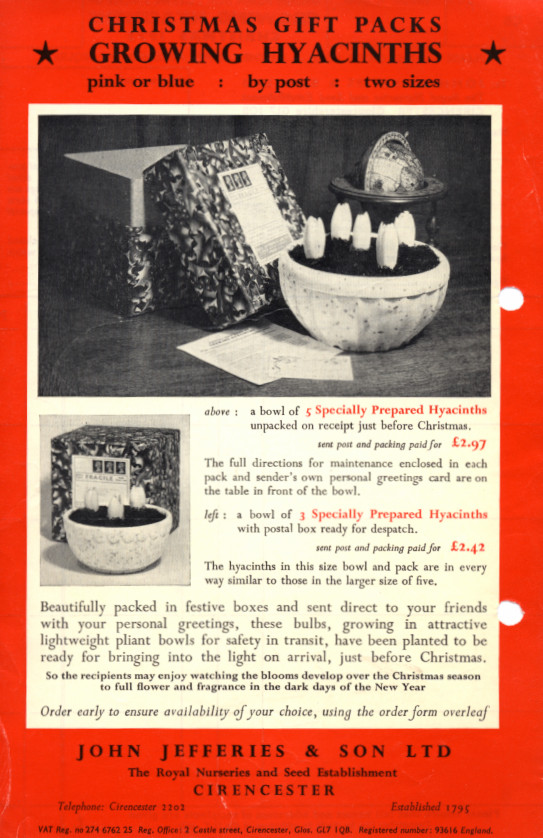
In late 1973 John Jefferies & Son in Cirencester were preparing their Christmas hyacinth brochure, perhaps in September.
This would be issued later, mailed out to regular customers and available in their shop (now Vodafone) in the Market Place. The bulbs were grown in the dark in the basement of the Tower Street warehouse; the building still exists, converted into flats next to Minerva Court.
In September 1968 I was about to begin my third year as a student at the University of Bath. It was a sandwich course so required four years to allow for industrial placements.
In September 1963 I began my 5th year at Cirencester Grammar School. This was an important year for me and my school friends, with O level mock exams after Christmas and the real O levels to face in June.
In September 1958 I began my final year at Junior School. This would be the year of the important 11-plus exams that would decide whether we would go to the Grammar School in Victoria Road or to the Secondary Modern at Deerpark.
In September 1953 I’d been five for a month or so and I it was time to began my first ever school term. I went to Querns School, and was unhappy when my Mum left me on the first day. I cried later when the teacher told us that we would stop to eat elevenses. This was not a word I knew, and I heard it as ‘lemonses’. What I did know was that lemons are very sharp and I did not want to eat one!
The pupil’s entrance was along the little lane at the side of the school, shown in the photo. I remember walking up and down that lane very clearly indeed.
In September 1948 I was in my second month of life, and Mum and Dad celebrated their first wedding anniversary. It seems they didn’t waste a whole lot of time! I would have been getting my arms and eyes under better control by this time. Dad was busy with C&DMAC (a model aircraft club). His maternal grandmother’s second husband died on 19th, Dad always knew him as ‘Gramp’.
In September 1943 Dad shot a lot of starlings, apparently. He heard that he’d passed his School Certificate successfully, was active in the ATC, and had a busy social life.
It can write essays, explain more or less anything you might ask, it can even pass many written exams on all kinds of topics
If you’ve been paying attention to the technology scene recently, you cannot fail to have heard of ChatGPT. What is it? Quite simply it’s a chatbot, a type and read interface for version 3.5 of the GPT engine developed by Open AI.
If all that sounds confusing, a chatbot is artificial intelligence (AI) software, in this case presented as a webpage, where you can have a conversation with a computer program. You type in a question and the chatbot sends a reply. Repeated questions and replies form a conversation, in ChatGPT’s case a remarkably smooth, almost ‘human’ experience.
If you haven’t yet tried it, then you really should. It’s free and very easy to use. I encourage you to visit chat.openai.com, sign up for a free account, and type a question. There are no rules about what you can and cannot type; ChatGPT is accomplished at understanding ordinary language and gives good, conversational replies.
Assuming you tried it out and have found your way back to my blog post, I’d like to explain a bit more about it. ChatGPT was released as a website at the end of November in 2022 and has grown in popularity very, very fast. If you tried it out for yourself, I’m sure you will understand why. It’s compelling, it can write essays, explain more or less anything you might ask, it can even pass many written exams on all kinds of topics. And version 4.0 of the engine is already available as a paid option and is far more capable. It can take images as input as well as text and has, for example, built a working website based on a sketch and a description of what the website should do. That is little short of astounding!
The company, Open AI, was created to work on artificial intelligence with safety very much in mind. Sometimes, ChatGPT generates false answers; that can be an issue but it is not deliberate. What if more advanced AI became able to reason as people do, what if it started to think and develop it’s own goals, and what if its intellect became faster and more nimble than our own? Could we prevent it from taking over? Would it be benign, or might it become hostile? Would we be able to control it? These are serious issues. We need to think these things through now, before it becomes too late.
I don’t want to be alarmist, and AI as we currently experience it is far from becoming a threat. It may prove useful in many ways and we’ll see that begin to happen very soon. But we’ll need to manage it in ways that prevent it helping people do bad things. We don’t want such technology to enhance criminal activity, for example. So there’s a great deal to consider right now, and the need for that will only increase as AI systems become more and more capable. For more on this I recommend Sean Carroll’s podcast episode 230, linked below.
I’m going to close this blog post at this point, but I’ll be back soon with a sort of interview with ChatGPT. I’ll ask some questions, let the software answer, and publish the conversation.
Meanwhile, have some ChatGPT conversations for yourself and see what you think.




 Journeys of Heart and Mind

