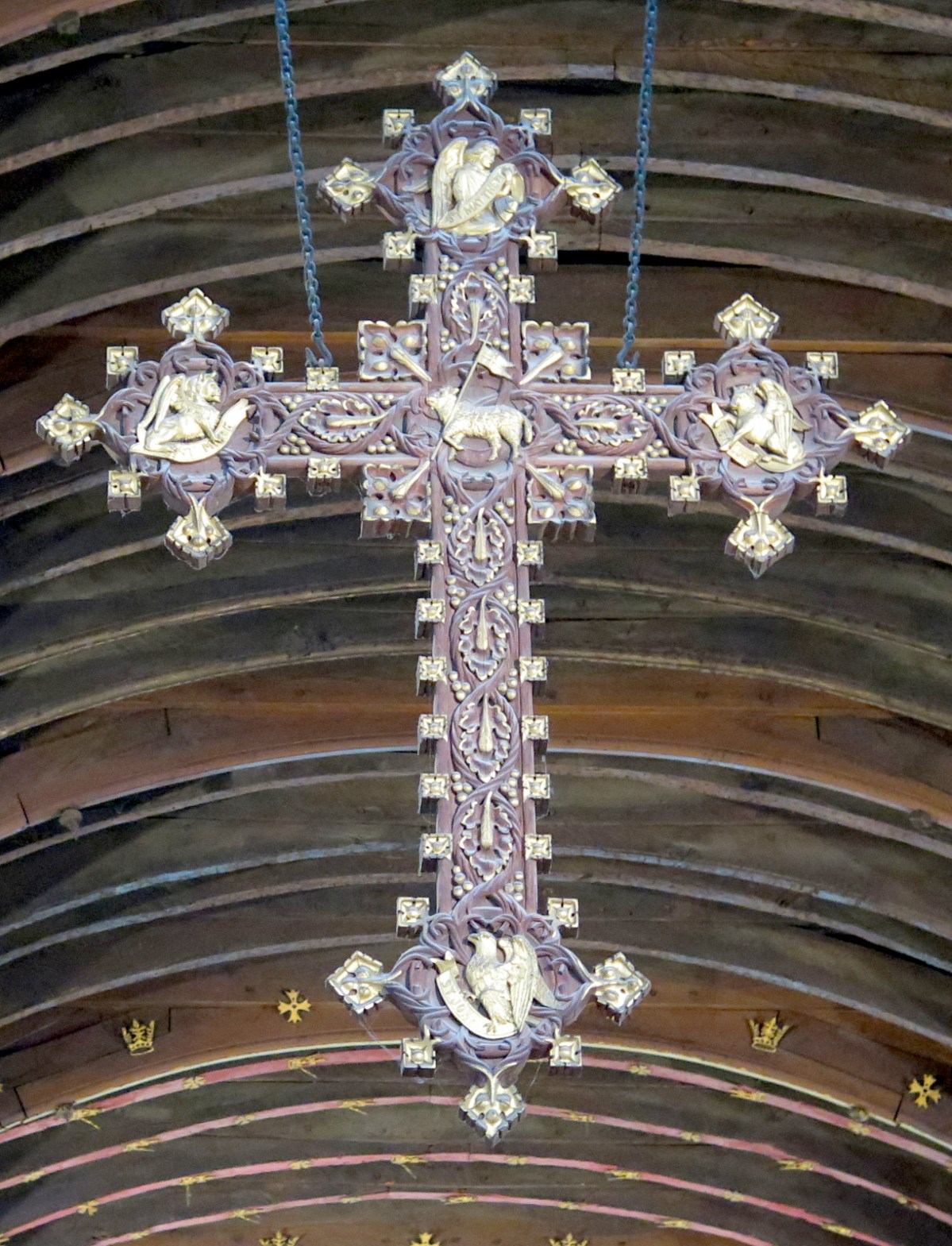
This great cross hangs from the high ceiling between the nave and the chancel of Cirencester Parish Church of St John Baptist.

This cross was carved and carefully gilded by craftsmen from Cirencester’s past. It hangs on stout iron chains from the heavy timbers of the chancel roof and for centuries has been the focal point for worshippers sitting in the pews of the nave. At first glance it almost seems to have been studded with jewels, but in fact it’s plain wood with gilded ornamentation.
In the centre of the cross is a lamb carrying a banner marked with the cross of St George. This lamb represents Jesus, the sacrificial ‘lamb of God’. At the top of the upright timber is a winged St Matthew, author of Matthew’s Gospel, at the extreme left of the cross beam is St Mark portrayed as a winged lion and at the right hand end St Luke as a winged ox wearing a crown. Right at the bottom of the upright timber is St John, shown here as an eagle.
More about those images
The lamb with the banner of St. George represents the Agnus Dei (the Lamb of God), symbolising Jesus Christ, and later iconography mixes symbols of sacrifice and victory. Jesus Christ was seen as both sacrificial (the lamb) and a victorious king (the banner).
The winged man represents St. Matthew because his gospel emphasises Christ’s human nature. His account begins with a genealogy of Jesus’ descent from Abraham highlighting his human, earthly origins. The winged aspect signifies divine inspiration of the gospel message and the angelic wings refer to Matthew’s task as a messenger of God’s word.
St. Mark is shown as a winged lion because his gospel starts with the roaring voice of John the Baptist in the wilderness, (roaring like a lion) while the wings refer to the four winged creatures described in the books of Ezekiel and Revelation. The lion represents the strength of Mark’s message and the resurrection of Christ, the wings speak of the four evangelists being guardians of the throne of God.
St. Luke the Evangelist is traditionally symbolized by a winged ox (or bull or calf). The symbol is derived from the four living creatures in the Book of Ezekiel and Revelation, which early Christian tradition associated with the four Gospel writers. The ox was chosen for St. Luke because it was an animal of sacrifice in the Old Testament, representing the sacrificial aspect of Jesus’ ministry, which Luke emphasizes in his Gospel by beginning with the priestly duties of Zechariah. The wings signify that the Gospel message is to be spread throughout the world.
St. John is shown as an eagle because it’s his symbol as one of the four evangelists. His gospel is seen as soaring into theological heights, also true of his visionary writings in the Book of Revelation. And the eagle is associated with divine power, heavenly vision, and spiritual insight as seen in the book of Revelation.
These medieval traditions are all very well, but the carved, gilded cross is also a distraction from the dreadful truth that a wooden cross was an instrument of torture and death. It’s easy to get wrapped up in traditions and forget that Jesus died to provide the opportunity for us to turn back from the brink. The heavy timbers to which Jesus was nailed to die were not ornate or gilded, and there were no traditions portrayed on them. Jesus (Yeshua, Isa) came in simplicity offering a simple opportunity and sharing simple truth. You don’t need a degree in history or theology to follow him, just an open, willing mind and a light touch from his spirit of love and truth.
In that vein, here’s something I add every year, I’ll offer it up to you again now. The UK is a rich mix of people from many cultural backgrounds. That’s why the title is not ‘Christmas Greetings’. Please accept the greetings and replace the word ‘Season’ with whatever you like. If you’re Hindu you could choose Pancha Ganapati, or Jewish friends might go with Hannukah in December, if you’re Muslim you might look forward to the start of the holy month of Rajab; Buddhists might consider Bodhi Day, and there are more groups of people I haven’t mentioned specifically. But whatever you celebrate, please take my greetings as a blessing for the whole of next year – spring, summer, autumn and winter. I’m not here to press you into a new and different tradition. I’m here to dismiss tradition in its entirety and offer love, peace and grace in its place. The teachings of Jesus are simple and there are thoughts about them throughout the articles on this website.
PS – If you like the photo, click the thumbnail for the full size version. Print it out, put it in a frame and hang it on the wall. Give a copy to friends if you think they’d like it; or send them a link to this message.
Other years
2025, 2024, 2023, 2022, 2021, 2020
2019, 2018, 2017, 2016
See also:
- Cirencester Parish Church – Wikipedia





 Journeys of Heart and Mind