What’s in an image? Sometimes quite a lot, more than meets the eye. I’m posting an image every few days.
Click to enlarge
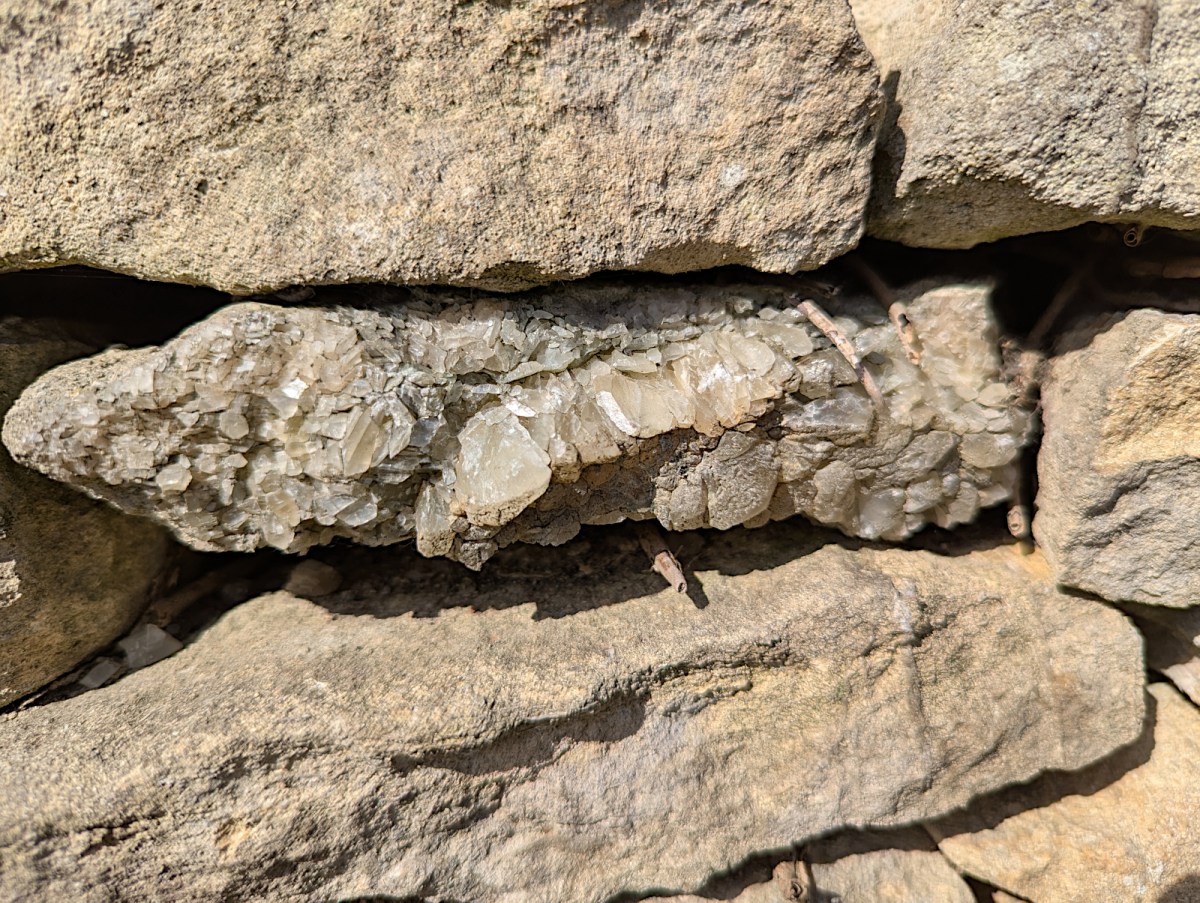
There’s a long stretch of dry stone Cotswold wall along the western edge of the Gloucester Road between Cirencester and Stratton. Walking along the footpath one day I was surprised to see the crystalline inclusions featured in this photo. The crystals look to me like a form of quartz (six-sided columns with six-faced prisms at both ends).
This might be part of a geode fractured open while quarrying the stone. There’s a small chance that the other side of the geode exists elsewhere in the same wall or in some other structure built around the same time. It seems that quartz geodes are not unusual in Oolitic limestone deposits. When they are stained purple purple the crystals are known as amethyst. The formation in the photo shows no hint of colour at all. The deposit must have formed from a particularly pure solution of quartz.
If you enjoyed this or found it useful, please like, comment, and share below. (If you don’t see those links, click the article’s title above the main photo and they will appear.) Send a link to friends who might enjoy the article or benefit from it – Thanks! My material is free to reuse (see conditions), but a coffee is always welcome and encourages me to write more often!
What’s in an image? Sometimes quite a lot, more than meets the eye. I’m posting an image every few days.
Click to enlarge
The land now occupied by Watermoor House and St Michael’s Park may once have been common land. But early large scale Ordnance Survey maps mark a much larger area, including that now occupied by the house and park, as a large nursery. It might have been owned at one time by Richard Gregory who was a Cirencester nurseryman in the 1790s.
The business (and probably the land) passed into the hands of John Jefferies at least by the early 1800s, and it seems that Randolph Mullings, a local solicitor, bought a substantial piece of it in order to build a large house in its own grounds. The details remain unknown, but Gregory, Jefferies and Mullings were known to one another, and Jefferies worked as a manager for Gregory on the nurseries. Gregory lost much of his money by providing surety for a friend’s loan, and Mullings advised Jefferies to continue managing the business and wait to see how things would work out.
Having acquired part of the land, Mullings engaged the architect William Jay to design the building; Watermoor House was constructed to Jay’s plan around 1827 in the Greek Revival style; and the garden and park were added to complete the property. The house is now grade II listed.
At some point Watermoor House became a private school until it closed in the 1950s or 60s. It may have had some other function following this, but today it is a residential care home.
I’ve cobbled this tale together from limited sources that may or may not be reliable. There are also many gaps. It would be good if the story could be properly researched by someone with the time and skills to undertake it.
If you enjoyed this or found it useful, please like, comment, and share below. (If you don’t see those links, click the article’s title above the main photo and they will appear.) Send a link to friends who might enjoy the article or benefit from it – Thanks! My material is free to reuse (see conditions), but a coffee is always welcome and encourages me to write more often!
What’s in an image? Sometimes quite a lot, more than meets the eye. I’m posting an image every few days.
Click to enlarge
At the top of the image you can see the rears of buildings on Cecily Hill in Cirencester. Their gardens contain the trunks and foliage of mature trees just beyond the wall. The wall separates those gardens from the water channel and may have been built specifically for that purpose. Some of the tree branches have grown across the top of the wall.
Near the base of the wall is a distinct line, brown below and much paler above. I think the brown part of the wall is often underwater. The water flow is strongly seasonal, high in wintertime and much, much lower in the summer. The River Churn divides at the Gloucester Road bridge, only a kilometre from this point. The major branch follows the outside of the Roman city wall and usually continues to flow all year round. But the branch in the photo is fed from the outflow of the long, narrow, supply pound for Barton Mill and this in turn is fed from the main flow of the River Churn. The water flows in the town are complex, this section is often known as Gumstool Brook, but it might also be regarded as a diverted part of the Churn.
The pipework at the bottom of this wall was there in the 1950s and 60s when I was a child. Most of it was hidden then by a low wall topped with flagstones, but today much of the structure has fallen away exposing the glazed pipes. Out of the photo a little further to the left, the water disappears underground, running south of Coxwell Street and reappearing at the surface further west in the Abbey Grounds.
It’s good to know that the Town Council and the Friends of Gumstool Brook are looking into ways of improving the flow of this watercourse by adjusting the sluice management rules. We might see the water flowing properly all summer in 2026.
If you enjoyed this or found it useful, please like, comment, and share below. (If you don’t see those links, click the article’s title above the main photo and they will appear.) Send a link to friends who might enjoy the article or benefit from it – Thanks! My material is free to reuse (see conditions), but a coffee is always welcome and encourages me to write more often!
What’s in an image? Sometimes quite a lot, more than meets the eye. I’m posting an image every few days.
Click to enlarge
This boat, seen here on the Gloucester and Sharpness Canal, is based at Saul Junction in Frampton on Severn. It might look like a tourist boat available for hire by the public, but it serves a different and entirely charitable purpose. Two similar (but not identical) special boats were built to provide opportunities for disabled or seriously ill people to experience a day on the canal for free. And for those that want to, they are also given the chance to explore the boat, see how it all works, hold the steering gear and so forth. The boats are designed for wheelchair access too. Check the See also link below for details and photos from the Willow Trust website.
I love to see examples of effort and resources being expended by enthusastic teams to greatly benefit those who need and deserve help. Every one of us can see the need for support of this sort, though not all are able or willing to provide it. But every single person in the world can do something positive to help others one way or another. It might be as simple as a kind word at the right moment, or a helping hand to steady someone losing their balance, or even just a smile. All it takes is an open eye, an attentive ear, and a willing mind.
If you are a wealthy person you might give thousands of pounds towards maintenance and fuel costs for these boats; if you have some spare time but no money, you might give time and energy to help with tidying and cleaning a boat between trips or helping in other practical ways. No matter what we do or do not possess, there’s always something we can offer.
It’s about contributing something, anything, in a world that’s not always fair or kind. And there are so many considerate, helpful organisations out there – everyone can find worthy opportunities in every town and most villages around the globe; even where there’s no local group or organisation, there will be many local opportunities to find and fill a need of some kind.
If you enjoyed this or found it useful, please like, comment, and share below. (If you don’t see those links, click the article’s title above the main photo and they will appear.) Send a link to friends who might enjoy the article or benefit from it – Thanks! My material is free to reuse (see conditions), but a coffee is always welcome and encourages me to write more often!
Orchids grow wild here in the UK, they’re not as showy as many of the tropical ones, and the flowers are far smaller, but they are still beautiful plants.
What’s in an image? Sometimes quite a lot, more than meets the eye. I’m posting an image every few days.
Click to enlarge
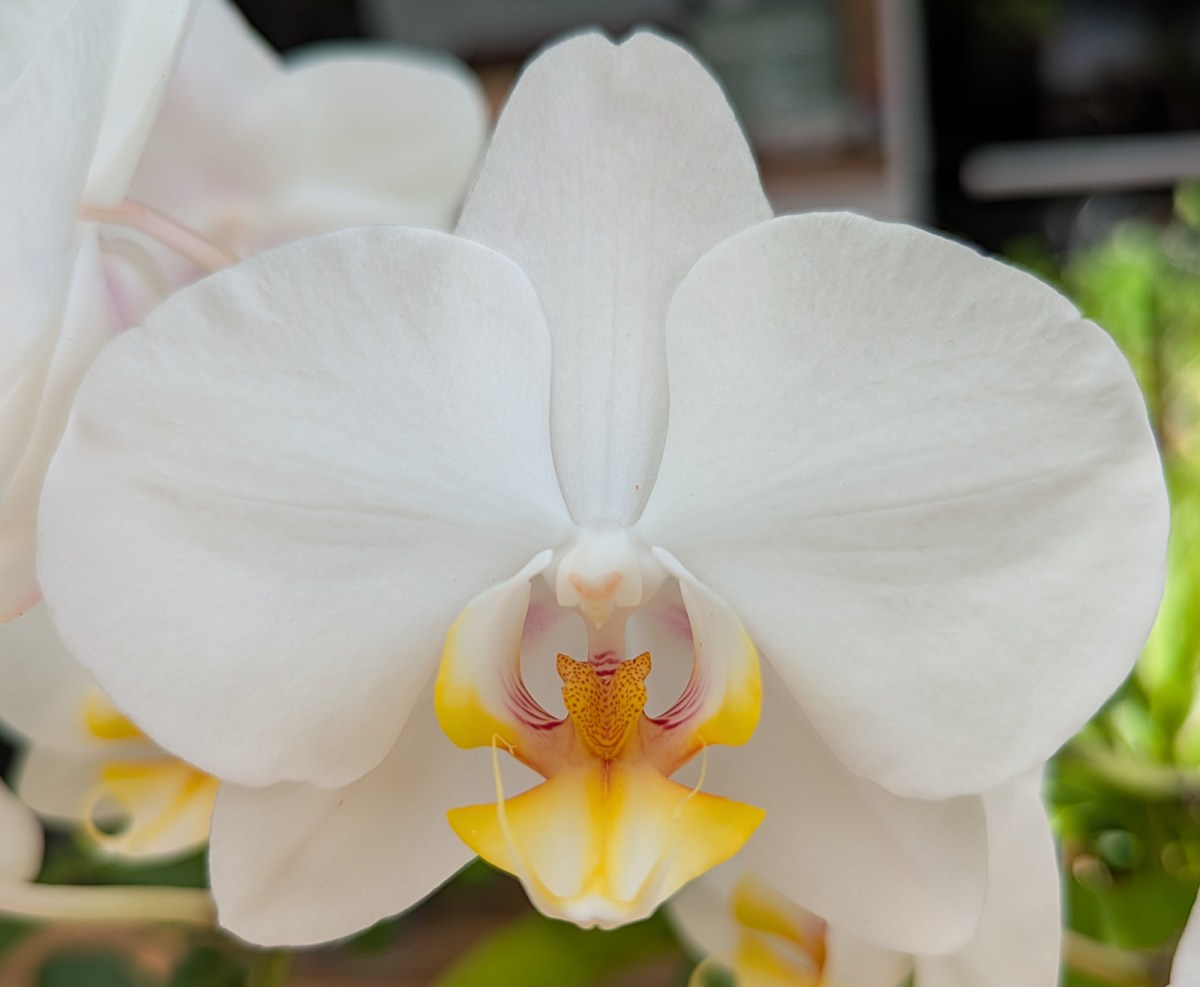
Orchids produce such beautiful flowers, often in great abundance, and they last for months if protected from too much heat and strong sun. This lovely, white Phalaenopsis flowers every year for us, but this year it had a bad plague of scale insect on the backs of the petals and on the leaves.
Scale insects are not hard to deal with as they can be wiped off with a soft tissue moistened with methylated spirit. Or even just wiped away gently with your finger. But you have to be persistent because you need to remove all the adults and then keep on removing the smaller insects until you have broken their reproductive cycle.
Orchids grow wild here in the UK, they’re not as showy as many of the tropical ones, and the flowers are far smaller, but they are still beautiful plants. Some orchids have flowers that mimic insects such as bees, butterflies, and flies. The insects are attracted to the flowers, and sometimes even attempt to mate with them; they act as pollinators, spreading the orchid pollen from one flower to another and so helping the orchid produce viable seed.
If you enjoyed this or found it useful, please like, comment, and share below. (If you don’t see those links, click the article’s title above the main photo and they will appear.) Send a link to friends who might enjoy the article or benefit from it – Thanks! My material is free to reuse (see conditions), but a coffee is always welcome and encourages me to write more often!
Like all dogs, Marple and Maizi spend a lot of time asleep. They sleep at night of course, just like we do; but they also sleep after meals, after walks, and any time they fancy during the day.
What’s in an image? Sometimes quite a lot, more than meets the eye. I’m posting an image every few days.
Click to enlarge
Here’s a five-year-old photo of my brother-in-law Paul’s dog, one of a pair of black Labradors, lovely, soppy, friendly creatures. This one is Marple, I think, though it’s hard to tell them apart without seeing both at the same time – if not Marple, she is Maizi.
Like all dogs, Marple and Maizi spend a lot of time asleep. They sleep at night of course, just like we do; but they also sleep after meals, after walks, and any time they fancy during the day. Apart from doing what they are told they have no responsibilities, no chores, no planning or organising, but plenty of time to rest. And like all carnivores, they mostly want to find something to eat and then rest until hunger pangs set in again. It’s a dog’s life!
Now five years older, at 14-years-old, they sleep even more than before.
Paul and his wife Vanessa live in Weston-super-Mare, a seaside town with a wonderfully long and wide beach and some fine woodland on a hill. Needless to say, Marple and Maizi have always loved visiting both the beach and the woodland. And it’s in those environments that I’ve seen some of the special closeness of interaction between human and dog; the throw, chase, catch, bring back, drop process for example, redone over and over and over again!
The close interaction between people and dogs developed a very long time ago, in his book, ‘Sapiens’, Yuval Noah Harari writes:
We have incontrovertible evidence of domesticated dogs from about 15,000 years ago. They may have joined the human pack thousands of years earlier. Dogs were used for hunting and fighting, and as an alarm system against wild beasts and human intruders. With the passing of generations, the two species co-evolved to communicate well with each other. Dogs that were most attentive to the needs and feelings of their human companions got extra care and food, and were more likely to survive.
Labradors possibly take this cooperative union further than almost any other breed. The bond between dog and owner can be really close. It’s been my privilege to see that very clearly with Paul, his wife Vanessa, and their dogs Maizi and Marple.
If you enjoyed this or found it useful, please like, comment, and share below. (If you don’t see those links, click the article’s title above the main photo and they will appear.) Send a link to friends who might enjoy the article or benefit from it – Thanks! My material is free to reuse (see conditions), but a coffee is always welcome and encourages me to write more often!
Notice how every part is sized precisely for the task it performs. The main stem is stout and sturdy, the stems that spring from it are much smaller and each one carries a number of flowers.
What’s in an image? Sometimes quite a lot, more than meets the eye. I’m posting an image every few days.
Click to enlarge
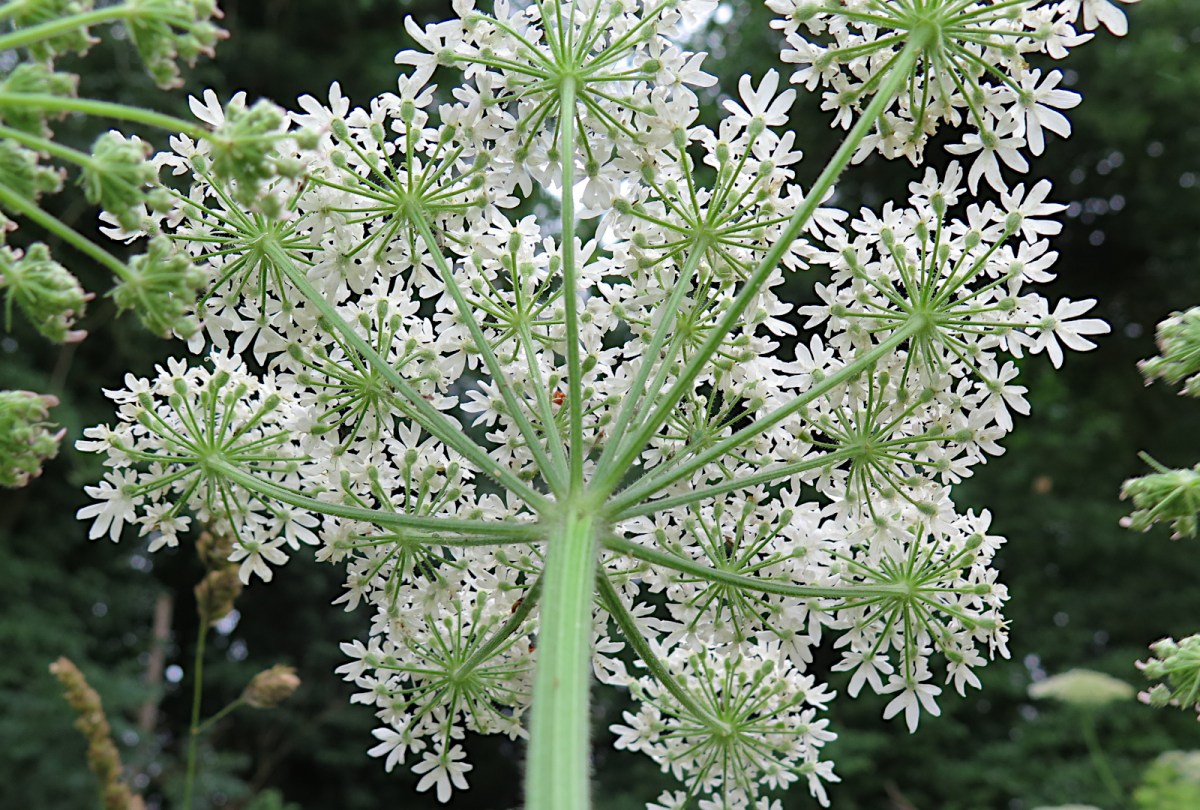
This photo was taken at a different time and place from the previous Umbellifer image, but the structure of this flower is very similar to the previous one. The main difference is that this time we’re viewing it from below. This reveals the exquisite architecture of an umbel.
Notice how every part is sized precisely for the task it performs. The main stem is stout and sturdy, the stems that spring from it are much smaller and each one carries a number of flowers. Those flower stalks in turn are smaller yet, and each one carries a single, tiny flower. It’s exactly how an engineer might design something, each part as large and strong as it needs to be, but no more. Why and how? Well, in the case the engineer, because lightness means less material, less mass, and therefore lower cost. Failure will be unusual because the forces will have been calculated and the values increased just a little to ensure safety.
Your car is designed this way, it could be designed and built to survive a collision with little or no damage, but it would be unaffordable because of the high cost of the extra material required, and it would consume much more fuel because of its high mass. That’s why you drive a car when travelling, not a tank!
The same argument applies to plant structures. The umbel could be made to survive a hurricane, but it would demand much more photosynthesis to provide the cullulose and other materials required to make it tough enough to survive such powerful winds. That’s why coconut palms have far stronger stems than the umbellifer! Living things are not designed by engineers, they adjust to their environment little by little over many generations by a trial and error system we call evolution.
Sometimes people say, ‘It’s only a theory’, meaning that something is a bit shaky and not to be trusted. That is to misunderstand what scientists mean by the word ‘theory’. In everyday use the word has a sense of an untested idea, something you just dreamed up as a way to explain something – might be wrong, might be right. Scientists have a word for that, but the word is not ‘theory’ – it’s ‘hypothesis’. In science, a theory is something so well tested as to be essentially unrejectable. Evolution is a theory in that sense, like the theories of relativity or quantum physics or plate tectonics. Theories have almost no room left for argument.
You can’t believe in evolution, it’s not a matter of faith but of overwhelming evidence. Following Jesus, as I and many others do, is based on faith, and I write about that too on Journeys of heart and mind.
You might be surprised to learn that engineers sometimes use evolution to design things like aircraft wings. The software to do that makes a long series of small tweaks to an initial design and calculates which changes improve performance. And this process is repeated many times enabling the final result to be stronger, lighter and more effective. An aircraft wing (or other structure) created in this way is not designed with paper and pencil or with CAD in the normal way, it evolves.
If you enjoyed this or found it useful, please like, comment, and share below. (If you don’t see those links, click the article’s title above the main photo and they will appear.) Send a link to friends who might enjoy the article or benefit from it – Thanks! My material is free to reuse (see conditions), but a coffee is always welcome and encourages me to write more often!
What’s in an image? Sometimes quite a lot, more than meets the eye. I’m posting an image every few days.
Click to enlarge
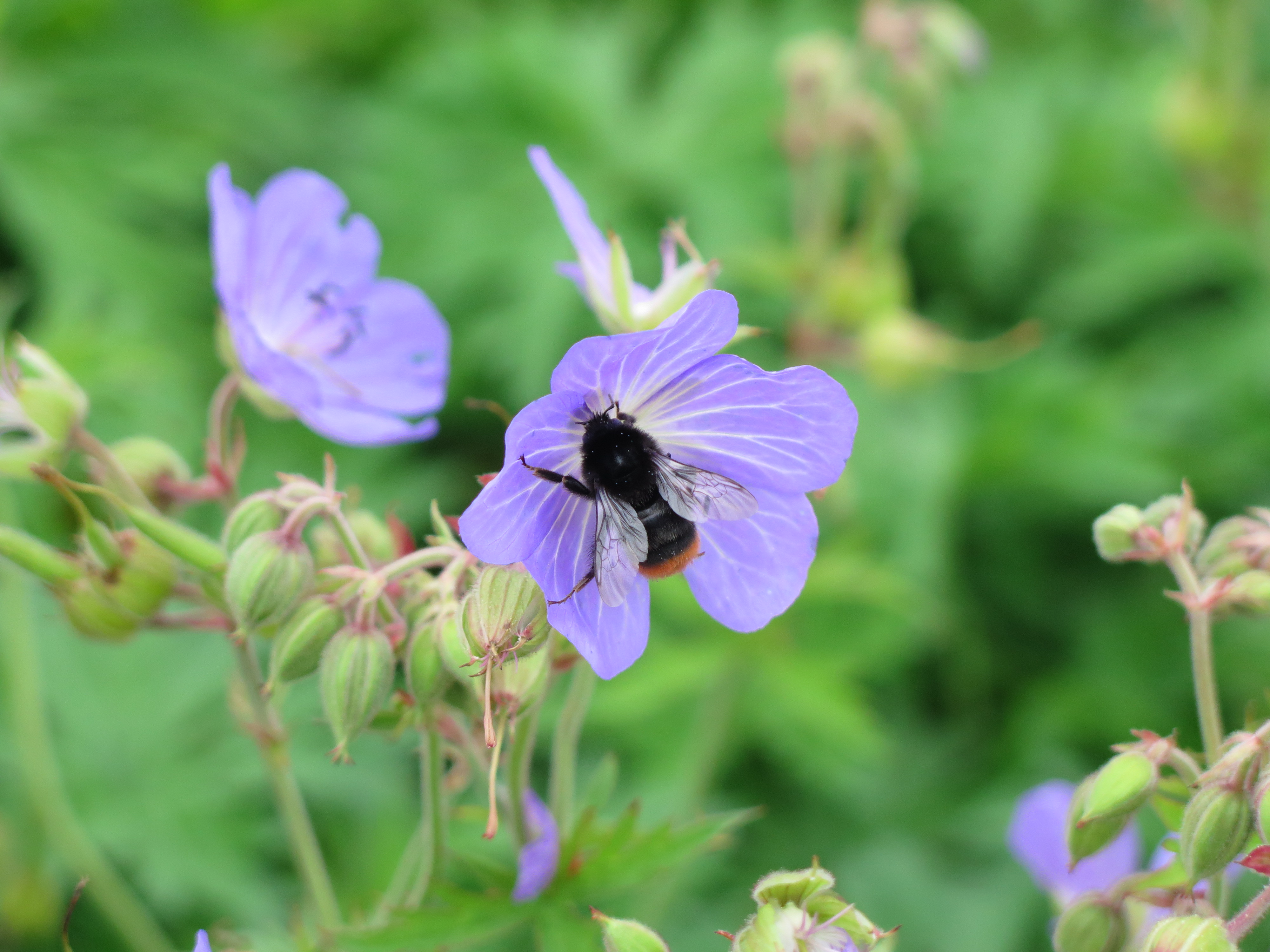
Here’s a bumble bee busy collecting nectar from a meadow cranesbill flower in a field margin just a brief walk from my home. The cranesbills are wild geraniums, close relatives of the pelargoniums; both genera are widely grown as decorative plants in pots or garden borders.
The photo is sharp enough when enlarged that you can see individual pollen grains on the bee’s black, furry body. Click the thumbnail image and stretch it to full size, then look for little white dots on the bee, those are the pollen grains.
Mutual benefit
The bees and flowering plants co-evolved, ancestors of both succeeded best in the presence of the other. Presumably the bee ancestors fed on the pollen of wind pollinated plants, incidentally transferring pollen more efficiently than the wind. And plants that provided sugary solutions and flagged this with colourful leaves near the nectar and pollen source were more successful than those that did not. After a while the insect and plant species were locked into a mutually beneficial relationship. Flowers are wonderfully adapted to attract bees and supply them with energy and a protein source to feed to their larvae. Bees are wonderfully adapted to collect and store nectar and pollen while moving some pollen grains from one flower to another.
If you enjoyed this or found it useful, please like, comment, and share below. (If you don’t see those links, click the article’s title above the main photo and they will appear.) Send a link to friends who might enjoy the article or benefit from it – Thanks! My material is free to reuse (see conditions), but a coffee is always welcome and encourages me to write more often!
What’s in an image? Sometimes quite a lot, more than meets the eye. I’m posting an image every few days.
Click to enlarge
This is a flower head of cow parsley or one of its relatives, a wild plant that grows extensively in Britain on untrimmed grass verges, along hedgerows, and in similar places. It’s a member of the carrot family, the Apiaceae ( until 2011, Umbelliferae), the word ‘umbellifer’ is related to ‘umbrella’ and you can probably see why!
The umbellifers are an interesting group of plants, including carrot, parsnip, celery, parsley, dill, fennel, coriander and many more. Cow parsley, like the others listed here, is safe to eat – but be very careful; hemlock looks much like cow parsley and is deadly poisonous. The infamous giant hogweed is another harmful umbellifer.
It was a hemlock extract that the Greek philosopher Socrates was required to drink following a guilty verdict in Athens.
If you enjoyed this or found it useful, please like, comment, and share below. (If you don’t see those links, click the article’s title above the main photo and they will appear.) Send a link to friends who might enjoy the article or benefit from it – Thanks! My material is free to reuse (see conditions), but a coffee is always welcome and encourages me to write more often!








 Journeys of Heart and Mind