What’s in an image? Sometimes quite a lot, more than meets the eye. I’m posting an image every day or so.
Click to enlarge
Most English villages had a piece of common land where any villager could graze sheep or cattle, but the coming of field enclosures from the late Middle Ages onwards, reduced or removed many of these open spaces.
This one in Siddington, near Cirencester must be one of the smallest, if not the very tiniest! It would be very difficult to graze sheep or cattle here! (I suspect it was rather larger in the 1800’s.) Some very large commons remain in other parts of the Cotswolds, notably near Stroud at Minchinhampton, Rodborough and Selsey Commons.
If you enjoyed this or found it useful, please like, comment, and share below. (If you don’t see those links, click the article’s title above the main photo and they will appear.) Send a link to friends who might enjoy the article or benefit from it – Thanks! My material is free to reuse (see conditions), but a coffee is always welcome and encourages me to write more often!
What’s in an image? Sometimes quite a lot, more than meets the eye. I’m posting an image every day or so.
Click to enlarge
For some time I’ve been walking sections of the Cotswold Canals as and when I have an opportunity and the inclination. Yesterday I walked a section that included the famous Sapperton Tunnel.
Tunnel construction started in 1784 by digging vertical shafts down from the hilltop at intervals along the line of the future canal, and then tunnelling in both directions towards adjacent shafts, hopefully meeting halfway and repeating the process until the tunnel was completed in 1789.
The photo shows where one of these twenty-five vertical shafts was cut. The spoil from digging was scattered all around and no attempt was made to cart it away; and that accounts for the mound. And as it was not possible to cultivate the mound, trees have grown over the years. So the wooded mounds are now very visible features of the landscape.
If you enjoyed this or found it useful, please like, comment, and share below. (If you don’t see those links, click the article’s title above the main photo and they will appear.) Send a link to friends who might enjoy the article or benefit from it – Thanks! My material is free to reuse (see conditions), but a coffee is always welcome and encourages me to write more often!
The faded warm colour of the sky, the stark blackness of the skeletal trees, and rising mist make a scene I just had to capture. I had only my phone with me, but for wide-field, distant views that’s good enough.
What’s in an image? Sometimes quite a lot, more than meets the eye. I’m posting an image every day or so.
Click to enlarge
This photo was taken from the Gloucester Road, between Cirencester and the village of Stratton a mile to the north. It was the 15th of January 2025, at nearly five in the evening. The sun had already set so the air was cooling after a mild day with good sunshine and the moist air above the grass in the fields was condensing as mist.
The faded warm colour of the sky, the stark blackness of the skeletal trees, and rising mist make a scene I just had to capture. I had only my phone with me, but for wide-field, distant views that’s good enough. There’s a hint of mystery here too, we can only guess what might be hidden in the most misty areas.
And I couldn’t help thinking about the parallels with people. Before birth we are hidden, like the darkness before the dawn (you need to imagine a country dawn, not a city dawn, no streetlights, no artificial light). After birth we are visible to all and we change, growing in size, growing in knowledge, growing too in wisdom – hopefully. Most of our life is lived in the full light of day. We have a job, we raise a family, we interact with others as friends, or family, or perhaps sometimes even as enemies.
Lives, like days, begin, run their course, and then become evening. In the evening of life, the pace slows, there are memories that may be well-defined, or sometimes, like the mist, our memories hide things from us. The light fades, and when we die we enter darkness like the night.
Or do we? People have discussed what happens after death, every generation that has lived has wondered about this. Some people are certain that the darkness of death is the end of all sensation. And they are right, of course. But might there be other possibilities? Every generation has also held untestable ideas. Is there a God? If so, what is he/she like? Answers to untestable questions are not wrong, they are just not capable of being tested.
It has always seemed quite sensible to me to live my life as if what I do matters during the night of my life as well as during its day. But also, the teaching of Jesus is very logically sound, not testable but also, as far as I can see, internally coherent and free of self contradiction. That quality amazes me, I believe his claims to be true, testable or not. He has convinced me. Maybe he has convinced you too, or maybe not. We have that freedom, and we cannot persuade one another using the scientific approach, good as that is for studying more measurable and therefore testable matters.
If you enjoyed this or found it useful, please like, comment, and share below. (If you don’t see those links, click the article’s title above the main photo and they will appear.) Send a link to friends who might enjoy the article or benefit from it – Thanks! My material is free to reuse (see conditions), but a coffee is always welcome and encourages me to write more often!
The rest of the week we might have left-over meat from Sunday, often minced and made into cottage pie or shepherd’s pie. And we had non-meat days in the week as well, perhaps macaroni cheese, or kippers. or baked beans on toast, or cod.
What’s in an image? Sometimes quite a lot, more than meets the eye. I’m posting an image every day or so.
Click to enlarge
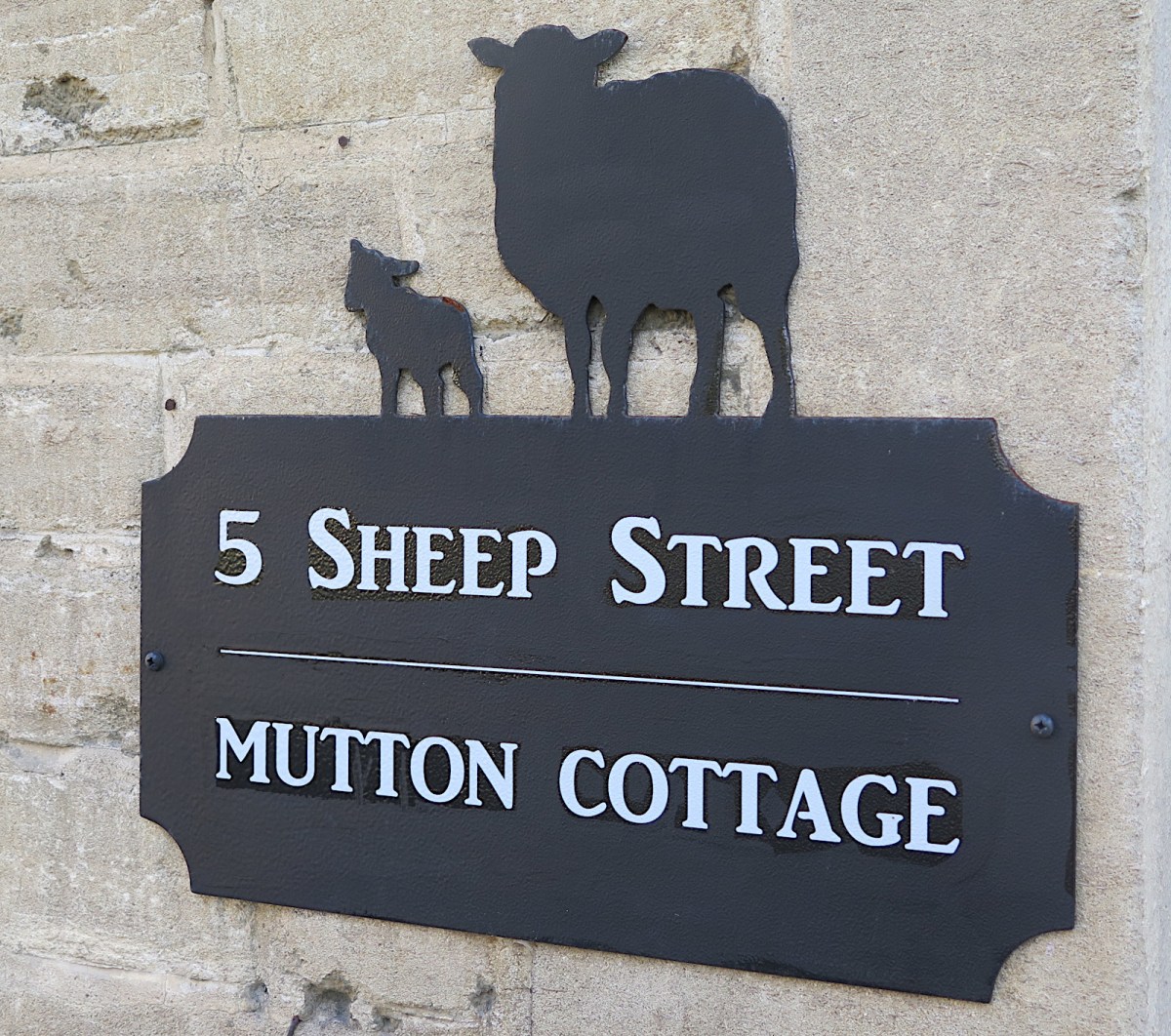
As a child I remember that we had a joint of meat on Sunday. And we usually had a fried breakfast on Sunday too, bacon, egg, fried bread, and perhaps a sausage as well. Sunday was a good day, a day to look forward to! The Sunday joint was sometimes mutton, sometimes pork, and just now and again, beef. But hardly ever chicken because chicken was too expensive. I also recall whale meat on at least one occasion. The rest of the week we might have left-over meat from Sunday, often minced and made into cottage pie or shepherd’s pie. And we had non-meat days in the week as well, perhaps macaroni cheese, or kippers. or baked beans on toast, or cod.
Today’s photo is from a house entrance in Cirencester’s Sheep Street. The house is not really a cottage at all. Hand sawn stone (known as ashlar) was an expensive material, so a genuine cottage would have probably have been built of undressed Cotswold stone straight from the quarry. Mutton (sometimes on a Sunday) is the meat of a mature sheep, tougher than lamb and needing more cooking time.
Why these references to sheep?
That’s easy to answer if you know something about the history of the Cotswolds! The land in this region is very good for farming sheep and in Medieval times wool was much in demand throughout Europe. Woollen cloth was still a major industry in early Victorian times, and the wealth created from the sale of unprocessed wool and woollen fabrics paid for many fine churches and merchant’s houses in towns across the region. Cirencester was no different, the famous Parish Church of St John the Baptist was built on wool money, and the many merchants’ houses in the centre of the town were funded in the same way. One of them, in Coxwell Street, still has its counting house attached.
That explains the references to sheep. You’ll find others, there’s the ‘Wool Market’, the ‘Fleece Hotel and Restaurant’, and Shepherd’s Way to name just three.
If you enjoyed this or found it useful, please like, comment, and share below. (If you don’t see those links, click the article’s title above the main photo and they will appear.) Send a link to friends who might enjoy the article or benefit from it – Thanks! My material is free to reuse (see conditions), but a coffee is always welcome and encourages me to write more often!
What’s in an image? Sometimes quite a lot, more than meets the eye. I’m posting an image every day or so.
Click to enlarge
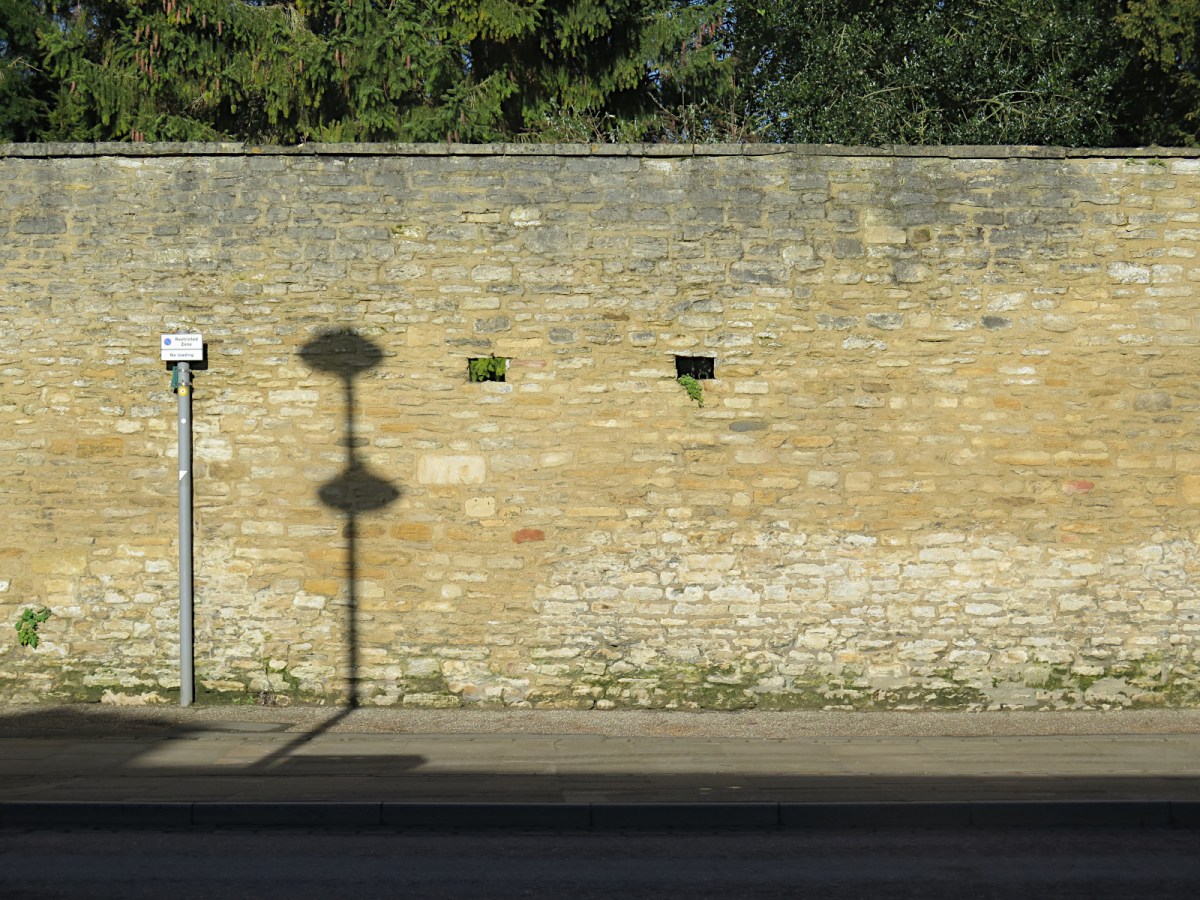
Some of you might know what these two, rectangular holes are for, but many might not. Holes like these can be found all around Cirencester, usually along the main roads leading into or out of the town.
They date back to the dark days of World War Two when Britain faced invasion by German forces. The invasion never took place because Germany was unable to defeat the RAF and air dominance was essential before the invasion fleet could be launched.
The holes in these walls, if you haven’t already guessed, are sniper or machine gun positions to enable the defenders to fire on German forces from behind the temporary safety of masonry. One round from a German tank would been more than enough to destroy the wall, of course.
When I was young, nobody took the trouble to fill these holes again, but these days they’re probably protected as historical curiosities. A reminder if one is needed, that war can come visiting at short notice (as in Ukraine) and that no nation should assume it will always be safe.
If you enjoyed this or found it useful, please like, comment, and share below. (If you don’t see those links, click the article’s title above the main photo and they will appear.) Send a link to friends who might enjoy the article or benefit from it – Thanks! My material is free to reuse (see conditions), but a coffee is always welcome and encourages me to write more often!
Much of the old tree would have survived for while, so the new shoot was shaded and would have grown out at an angle, attracted towards the light. Since then, the new growth has itself become a mature tree.
What’s in an image? Sometimes quite a lot, more than meets the eye. I’m posting an image every day or so.
Click to enlarge
I spotted this old tree when we visited Blenheim Palace today. It’s probably an ancient oak though I didn’t get close enough to check with certainty.
The thickest part, the lumpy-looking base is the remaining stump, all that remains of the original tree that would have grown from an acorn many hundreds of years ago. That tree was a sapling, then a youthful, vigorously growing tree; eventually if became a mature, majestic oak. But then the rot would have set in – literally. Holes made by a woodpecker, or damage from a storm cracking off a branch, gave access to unprotected wood beneath the bark. Insects may have burrowed into the wood, and eventually fungal spores would have germinated and started the decay process in earnest.
The weakened tree would have lost its vigour and been reduced to a hollow stump and failing branches. But finally, a new shoot must have appeared near the base and formed new, young growth. Much of the old tree would have survived for while, so the new shoot was shaded and would have grown out at an angle, attracted towards the light. Since then, the new growth has itself become a mature tree.
Another possibility is that a branch of the original tree survived, and with the other branches missing, grew into the shape we now see. A careful examination of the tree might reveal the truth. But however this curious old tree survived, it certainly has an unusual story to tell!
Donna and I enjoyed our day at Blenheim and will visit again from time to time this year as the seasons roll by. I’ll probably write about the place again.
If you enjoyed this or found it useful, please like, comment, and share below. (If you don’t see those links, click the article’s title above the main photo and they will appear.) Send a link to friends who might enjoy the article or benefit from it – Thanks! My material is free to reuse (see conditions), but a coffee is always welcome and encourages me to write more often!
What’s in an image? Sometimes quite a lot, more than meets the eye. I’m posting an image every day or so.
Click to enlarge
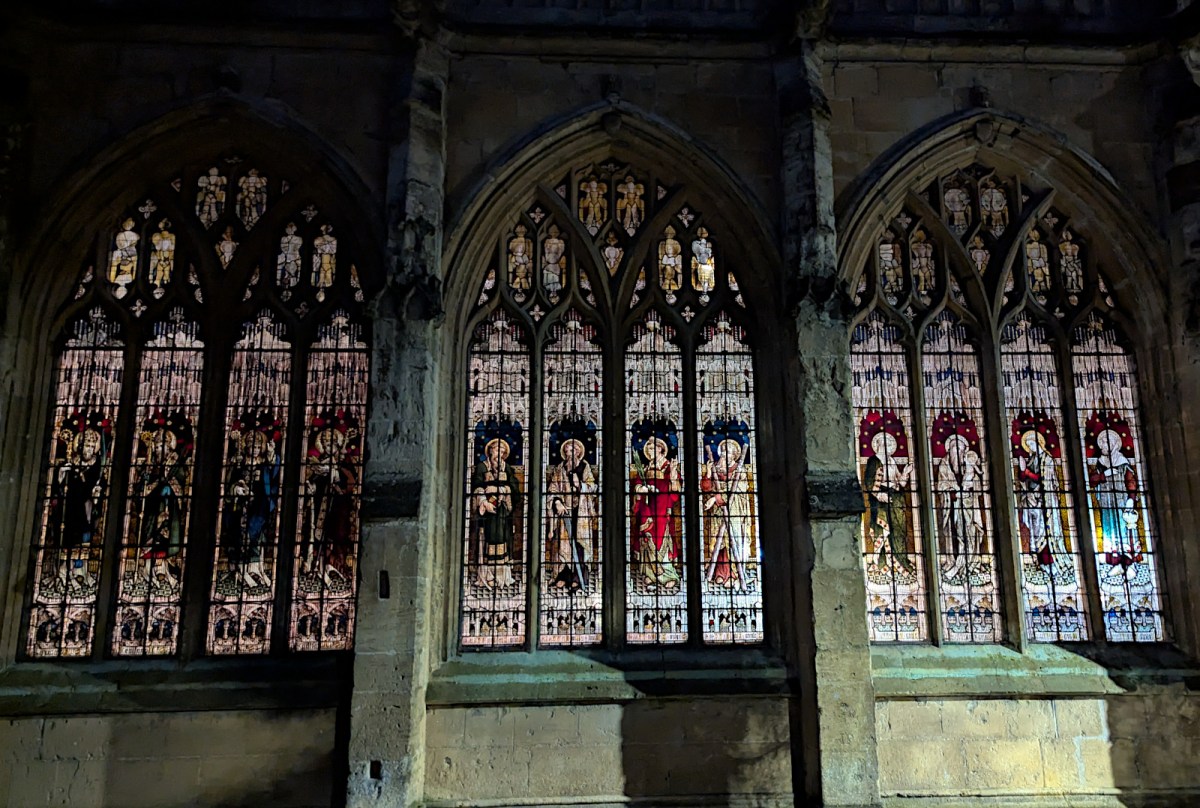
These windows are inside-out. They are stained-glass, and part of Cirencester’s Parish Church. When they were built, the idea was that they would look impressive from the interior in a world without anything much brighter than a candle or an oil lamp. Illuminated in daylight and seen from within a relatively dark building, they would have been amazing – and they still are.
But in this photo, taken from outside the church after dark, the relatively bright, modern lighting inside shows up the windows very nicely. The makers could hardly have imagined them being seen in this way!
If you enjoyed this or found it useful, please like, comment, and share below. (If you don’t see those links, click the article’s title above the main photo and they will appear.) Send a link to friends who might enjoy the article or benefit from it – Thanks! My material is free to reuse (see conditions), but a coffee is always welcome and encourages me to write more often!
As mobile phones became more affordable and widely available the need for phone boxes vanished. This one was never removed and stands forgotten by the pavement, more or less unnoticed, draped in cobwebs, laden with layers of dust.
Image 136 – What’s in an image? Sometimes quite a lot, more than meets the eye. I’m posting an image every day or so.
Click to enlarge
Stone Age?
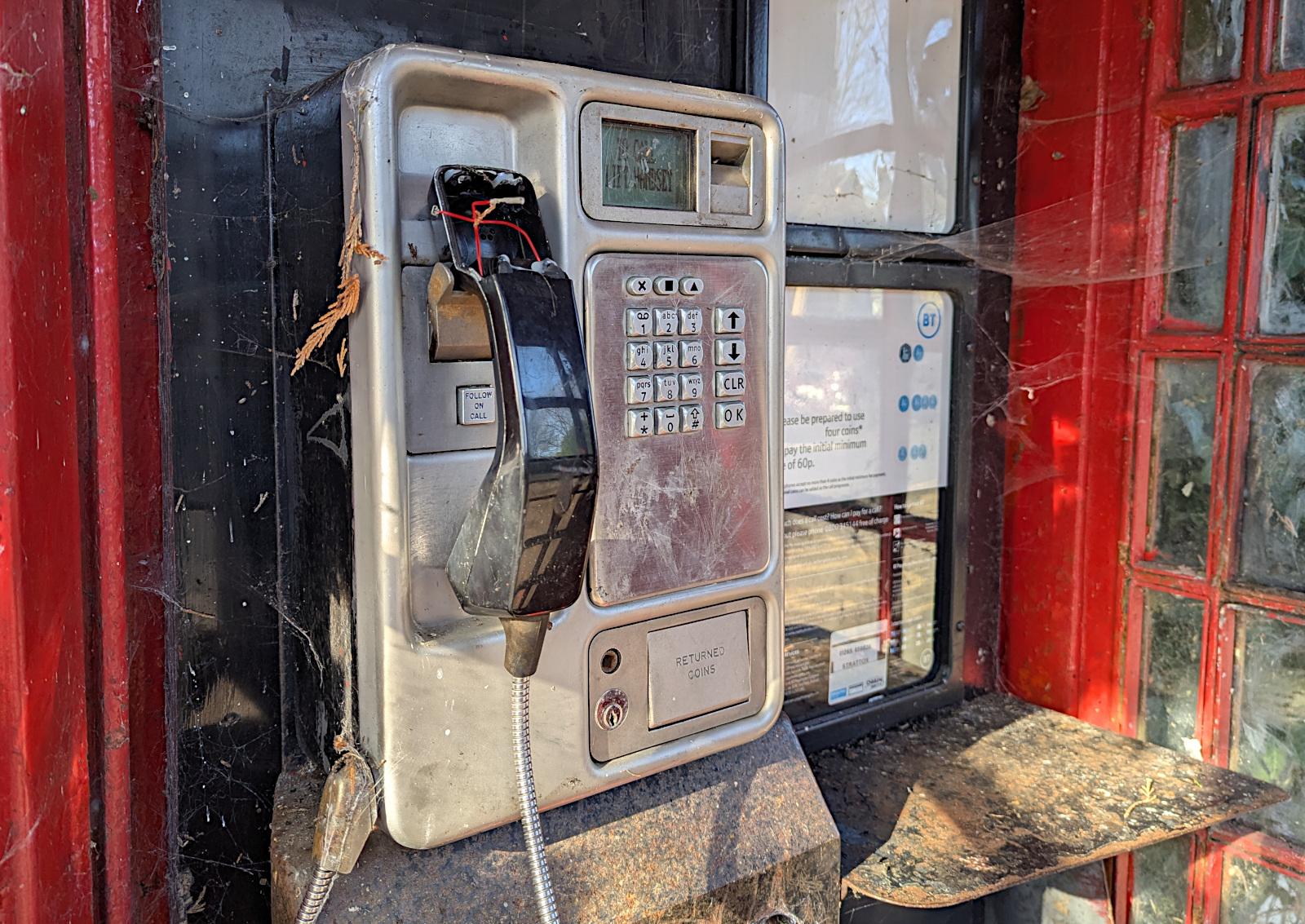
Well – Stone Age in terms of communications technology! A long time ago, way, way back in the 1980s, telephone kiosks like this one were widespread in the UK. You can see the red paint for which these phone boxes were so famous.
This particular box stands at the junction of the Gloucester Road and the Cheltenham Road in Stratton, where we live. It must have been quite busy when it was first installed. I well remember standing waiting at a box like this, sometimes there might even have been a queue of three or four people waiting to make a call.
And I remember the standard phone box smell as well. There was always a certain degree of dampness about them, often mixed with stale tobacco smoke. There was a little shelf containing a local residential directory and a yellow pages with business numbers and adverts.
This example of the British Telecom (BT) phone box has seen better days. It was converted with up-to-date equipment that must have replaced the original, black, bakelite handset with its black, enamelled, steel coin-box with Button A and Button B. But as mobile phones became more affordable and widely available the need for phone boxes vanished. This one was never removed and stands forgotten by the pavement, more or less unnoticed, draped in cobwebs, laden with layers of dust.
If you enjoyed this or found it useful, please like, comment, and share below. (If you don’t see those links, click the article’s title above the main photo and they will appear.) Send a link to friends who might enjoy the article or benefit from it – Thanks! My material is free to reuse (see conditions), but a coffee is always welcome and encourages me to write more often!
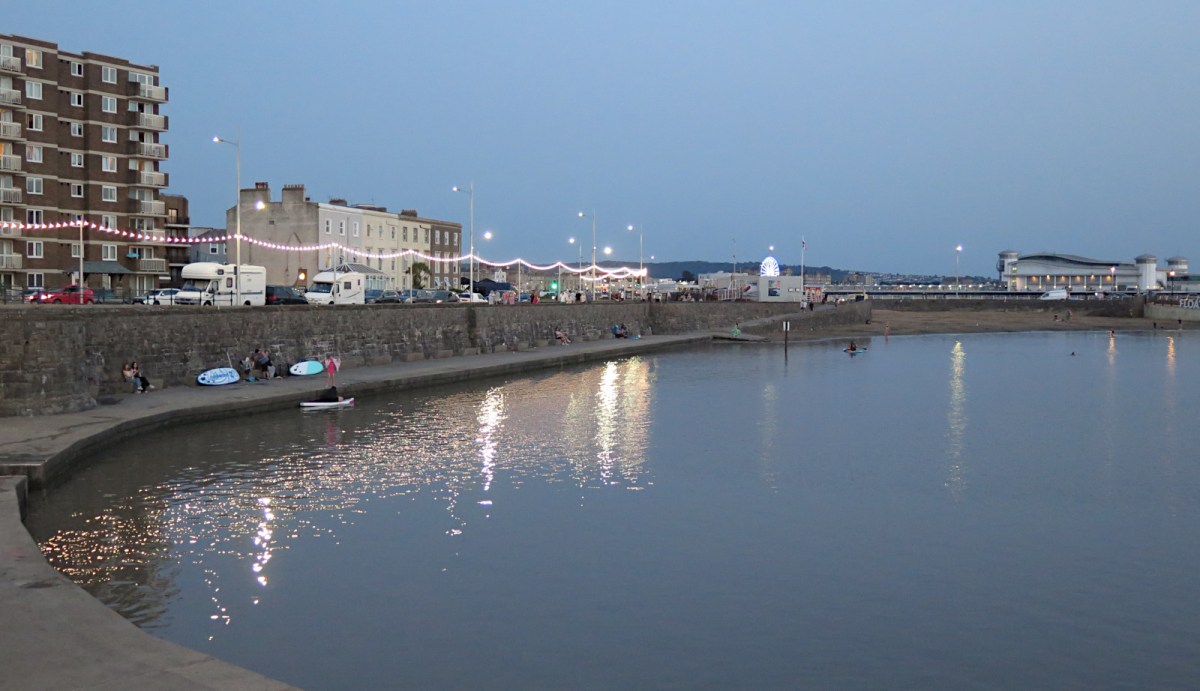
The Marine Lake was built in the 1920s and has just been dredged and refurbished. It’s free to use, and within the lake the tide never goes out, but on every high tide some of the water is replaced to keep it clean.
Image 135 – What’s in an image? Sometimes quite a lot, more than meets the eye. I’m posting an image every day or so.
Click to enlarge
This is one of the jewels of Weston-super-Mare – The Marine Lake. One feature of the coastline here is that it has one of the highest tidal ranges in the world (14.5 m), second only to the Bay of Fundy in Canada, I believe. The beach is very gently shelving as well, so at low tide the sea retreats between two and a half and 3 kilometres!
The Marine Lake was built in the 1920s and has just been dredged and refurbished. It’s free to use, and within the lake the tide never goes out, but on every high tide some of the water is replaced to keep it clean. It’s also large enough for a lot of people to use it at the same time, and it includes a large, sandy beach above the waterline. It’s also right in the heart of busy part of town, with plenty of cafes and restaurants, shops, the big wheel, the pier and much more just a stroll away.
My photo was taken late in the evening after sunset in September so there are few people using the Marine Lake. But believe me, in the middle of the afternoon on a sunny day in July it would be quite crowded. There’s a very long and wide sandy beach stretching north and south of Weston pier, and many people use that for sunbathing or making sandcastles regardless of the state of the tide.
The Marine lake is a marvellous feature. Without it, Weston would not seem like Weston at all!
If you enjoyed this or found it useful, please like, comment, and share below. (If you don’t see those links, click the article’s title above the main photo and they will appear.) Send a link to friends who might enjoy the article or benefit from it – Thanks! My material is free to reuse (see conditions), but a coffee is always welcome and encourages me to write more often!
We all make new friends right through our lives, don’t we? And that’s good. But our old friends, even if we hardly keep in touch, always have a special place in our hearts and minds.
Image 134 – What’s in an image? Sometimes quite a lot, more than meets the eye. I’m posting an image every day or so.
Donna and I are on the right in this selfie, our friends Tony and Faith are there on the left. Donna and I have been married nearly 27 years now and Tony was my best man, but he and I go back a lot further than that.
I moved to Yatton way back in 1975 with my first wife, Judy. Yatton is a large village between Bristol and Weston-super-Mare, and two of the first local people we got to know were Tony and Faith. They became great friends and we were deeply involved in exciting times of rapid and informal church growth in and around the village. Two other local friends, Paul and Jenny, were part of that too and the six of us became close. Later, things moved on and we drifted apart a bit, but we began meeting very frequently again when Judy became ill with cancer. She died at the and of 1995.
We all make new friends right through our lives, don’t we? And that’s good. But our old friends, even if we hardly keep in touch, always have a special place in our hearts and minds. Shared experiences are never forgotten and can always be re-lived in our minds. The gratitude and joy are permanent, the bond remains, those things don’t depend on seeing a person recently or regularly.
I have precious friends all over the globe. I’m really bad at keeping in touch, but I’ll name a few places – Cirencester, Florida, Germany, New Zealand, Nottingham, Stamford, St Neots, Sweden, Texas, and many other places in the UK, of course. And I have other good friends I have yet to meet! Electronic forms of conversation make that entirely possible.
If you enjoyed this or found it useful, please like, comment, and share below. (If you don’t see those links, click the article’s title above the main photo and they will appear.) Send a link to friends who might enjoy the article or benefit from it – Thanks! My material is free to reuse (see conditions), but a coffee is always welcome and encourages me to write more often!








 Journeys of Heart and Mind