Helping a charity with lights

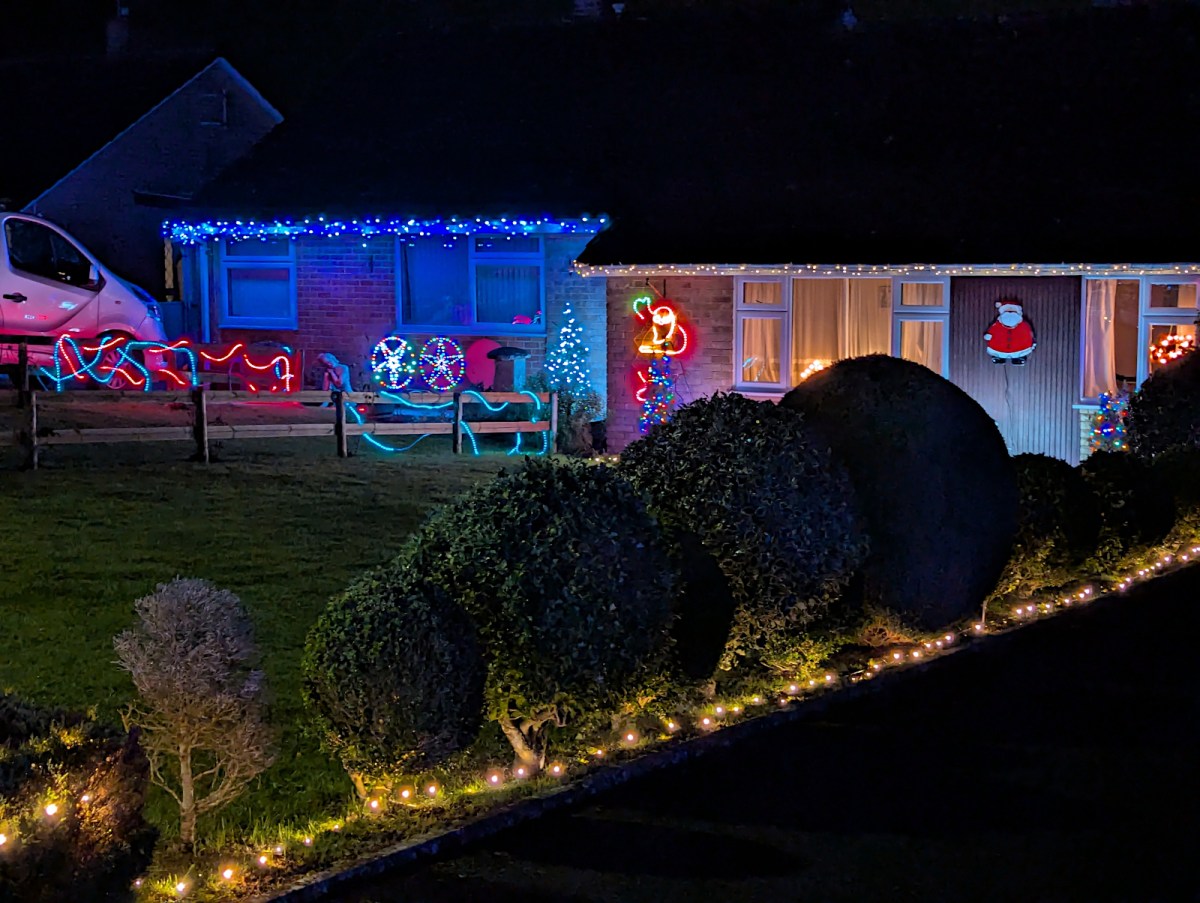
At Vale Road in Stratton on the northern edge of the Cotswold town of Cirencester, residents (and one in particular) put a lot of effort each year into decorating their homes and gardens with all sorts of coloured and illuminated decorations. And they invite the people who come to look to make a contribution to Macmillan Cancer Support.

< Previous | Index | Next >

Image of the day – 181

What’s in an image? Sometimes quite a lot, more than meets the eye. I’m posting an image every few days.

Click images to enlarge

People love Christmas lights and decorations, and people hate illness particularly if there’s no cure. So can Christmas lights help people with incurable illness? Yes they can! But…how?

Well, one way is to use the Christmas decorations to raise money for charity, and that’s what one street in Cirencester has been doing every year for some time now.
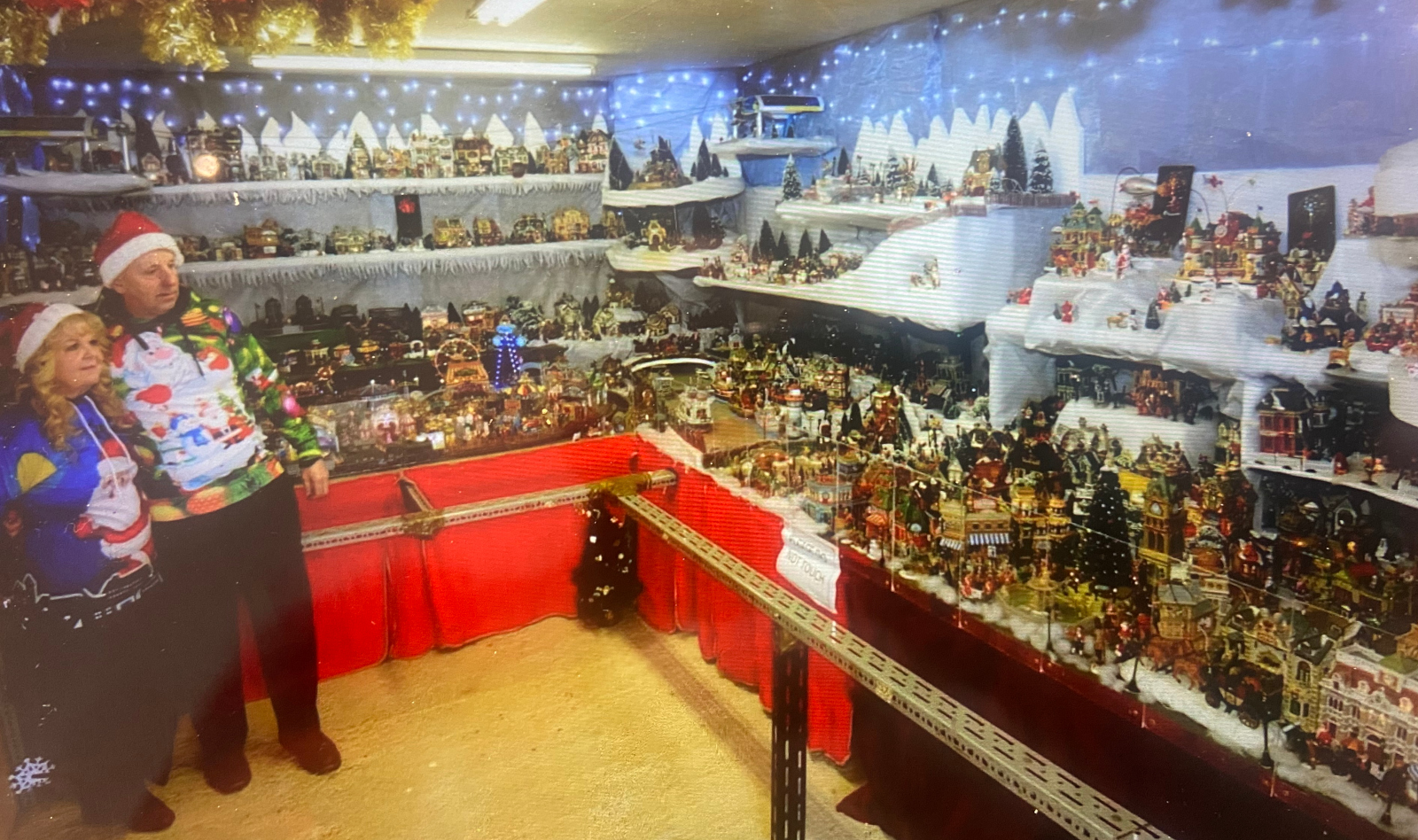
There’s more inside – a model village!

At Vale Road in Stratton on the northern edge of the Cotswold town of Cirencester, residents (and one in particular) put a lot of effort each year into decorating their homes and gardens with all sorts of coloured and illuminated decorations. And they invite the people who come to look to make a contribution to Macmillan Cancer Support. This charity provides care, help, nursing and support for cancer patients and their families right at the time when they need help most. They will help families care for a mum, a dad, or a grandparent at home.

The heart of the action

If you live in Cirencester or the local area, why not drive out to Vale Road and park in a nearby street like Vaisey Road, Tinglesfield or Park View? (But please don’t block any driveways or park near junctions.) Then walk the short distance to Vale Road. You can pay for a tour of the best of the lights, delight your children (or grandchildren), and help support a great cause all at the same time. What could be better than that?

See also:

< Previous | Index | Next >

Useful? Interesting?

If you enjoyed this or found it useful, please like, comment, and share below. My material is free to reuse (see conditions), but a coffee is always welcome!

You might also like:

Breakfast

Seeds are a good source of protein, healthy fats, fibre, vitamins, and minerals, helping to lower the risks of heart disease, stroke and cancer.

Today I’ll tell you about my breakfast – what I eat, when, and why. If you want to know more, read on…

What’s in it?

The bowl above was my breakfast today and it’s quite typical. Here’s what it contains:

  • First thing into the bowl is always a helping of my own oat-based breakfast mix. I’ll give you the recipe later in case you’d like to try it.
  • Next I add plenty of milk. Oats absorb water and swell so it’s good to provide enough liquid to support that. Usually I use oat milk, but sometimes semi-skimmed dairy milk or a mix of the two.
  • Fruit next. This time I chopped a small banana and added some grapes. Other favourites include blueberries, pear, and segments of satsuma.
  • The final ingredient is a helping of kefir over the fruit (similar to a thin yogurt).
Why those ingredients?

My base mix contains oats, dried fruit, seeds, and nuts. Oats help to control cholesterol, help with blood sugar levels, and support gut health. Dried fruit is a good source of fiber, vitamins, minerals, and antioxidants and may reduce the risk of heart disease and stroke. Seeds are a good source of protein, healthy fats, fibre, vitamins, and minerals, helping to lower the risks of heart disease, stroke and cancer. Nuts have similar benefits to seeds.

Milk is good, especially dairy milk, but oat milk is probably better for the planet. And kefir contains a range of microorganisms that are good for gut health.

Timing

I try to eat breakfast no earlier than 10:30 every morning, often later. I restrict my eating time each day, fasting from 20:30 in the evening until breakfast, so fasting for twelve hours or longer. This is called intermittent fasting, and it gives the gut microbes the time they need to clean up the gut before facing the next day’s meals. There are a number of benefits, perhaps including increased longevity.

Recipe for my base breakfast mix
  • 380 g of fruit and nut mix (I use Grapetree Luxury Fruit and Nut Mix*)
  • 60 g mixed seeds
  • 90 g granola (I use Bio & Me Super Seedy & Nutty*)
  • 800 g rolled oats (Ideally use organic oats as they are free of glyphosate residues)

This makes enough for a large container and lasts me for some time.

*It doesn’t matter which companies you buy from, of course; just try to avoid anything ultra-processed and with plenty of different healthy ingredients.

Final thoughts

This is just the pattern I normally follow for breakfast, but it’s important to be flexible about both what I eat and when. If it’s convenient to eat earlier I’m relaxed about breaking my intermittent fasting. If going on a journey, I might eat at 08:00 instead of 10:30. Sometimes Donna I and might have breakfast in town and I’ll choose a full English or whatever I want. And that’s OK, it’s a normal pattern, not an unbreakable commitment.

See also:

Useful? Interesting?

If you enjoyed this or found it useful, please like, comment, and share below. My material is free to reuse (see conditions), but a coffee is always welcome!

Seventeen Haiku on Covid

Covid in our land – Let’s be very close friends in – self isolation

< Previous | Index | Next >

Image 111 – What’s in an image? Sometimes quite a lot, more than meets the eye. I’m posting an image every day or so.

Enlarge
(Wikimedia)

A Haiku is a form of Japanese poetry consisting of three lines; the first provides a topic as a phrase (five syllables), then the second (seven syllables) and third (five syllables) form a sentence about the topic. Five, seven, and five is the basic structure of Haiku.

Back in the difficult early months of COVID-19 I began writing some Haiku about the outbreak, social distancing, the way community develops despite difficulties, and hope for the future. At the time I didn’t publish this poetry, but now I think I’d like to – so here they are.

Writing 17 of these little verses (5+7+5) makes a sort of Haiku of Haiku. Read them all if you like, but if you grow tired, skip to The whole story where something magical happens!

Five Haiku

Covid in our land
Let’s be very close friends in
self isolation

Social distancing
Two metres apart is safe
though hearts beat closer

Needing a helper
We’ll support one another
neighbour to neighbour

Encouragment comes
Find something to make us smile
sunbeam in a storm

Compose a poem
So write your best Haiku now
to lift people up

Seven more

Self isolation
A hug is far, far better
but really unsafe

Thinking of others
Ask everyone around you
can I pray for you?

The King of Heaven –
Jesus says to give others
more than they expect

Things my neighbour lacks
If I have an abundance
it’s on offer now

Anxiety gone
No fears brother or sister
what is mine is yours

Loving Tinglesfield
All the people living here
are filling my heart

More strength in numbers
Togetherness is good and
community wins

Final five

Hope among friends
This trouble will not last so
be patient and trust

Patience and waiting
Work for the day when it ends
and have fun later

An end to struggle
The virus is defeated
and it’s street party time

Time of rejoicing
Be loudly thankful and shout
but think of lost friends

Street community
You stood strong as a mountain
now laugh like a brook

The whole story

Now drop the first line of each verse (the ‘topic lines’) and collect up the rest, add a little spacing and punctuation to make prose. This is what you get:

Let’s be close friends in self isolation; two metres apart is safe, though hearts beat closer. We’ll support one another neighbour to neighbour, find something to make us smile – sunbeam in a storm! So write your best Haiku now to lift people up.

A hug is far, far better but really unsafe. Ask everyone around you, ‘Can I pray for you?’ Jesus says to give others more than they expect; if I have an abundance it’s on offer now, no fears brother or sister – what is mine is yours. All the people living here are filling my heart; togetherness is good and community wins.

This trouble will not last so be patient and trust, work for the day when it ends and have fun later. The virus is defeated and it’s street party time, be loudly thankful and shout – but think of lost friends. You stood strong as a mountain, now laugh like a brook!

See also:

< Previous | Index | Next >

Themed image collections

The links below will take you to the first post in each collection

Cirencester, Favourites, Irish holiday 2024, Roman villa

Useful? Interesting?

If you enjoyed this or found it useful, please like, comment, and share below. My material is free to reuse (see conditions), but a coffee is always welcome!

Churn flooding

Some buildings, like the lovely, old Cotswold stone house in the photo, were often built quite close to the area of flooding, choosing ground just high enough to stay dry.

< Previous | Index | Next >

Image 105 – What’s in an image? Sometimes quite a lot, more than meets the eye. I’m posting an image every day or so.

Larger view

This view of the Churn flowing through the village of Baunton, a little north-east of Cirencester, shows it spilling over its banks and spreading across a field; this is normal, winter-time behaviour for the Churn for much of its length. Rising near the top of the Cotswolds at Seven Springs south of Cheltenham, it has cut a winding valley running towards Cirencester, the southern half of which is liable to flood.

Some buildings, like the lovely, old, Cotswold stone house in the photo, were often built quite close to the area of flooding, choosing ground just high enough to stay dry. Many other buildings in villages like Baunton were built a little higher still.

Historically, the regularly flooded land would serve as summer grazing and provide a hay crop in late summer. In this way, cattle could be kept on the land with a stock of hay as supplementary feed when winter grazing on the hillsides was prevented by snowfall. Higher (and drier) land could provide other crops like barley and wheat.

South of Cirencester, the Churn joins the Thames at Cricklade, and the combined flood plain is quite extensive. North Meadow on the edge of Cricklade is bordered by the converging rivers and is famous for its huge colony of snakeshead fritillaries By the time the Thames reaches Lechlade, it is navigable all the way to London and out into the North Sea.

When: 23rd December 2023
Where: Baunton, Gloucestershire

See also:
Cirencester

For convenience, here’s a list of all the Cirencester area images:

A417 roadworks, Advent Market, Bishops Walk, Baunton, Canal 1, 2, Castle Street, Christmas lights 1, 2, Church 1, 2, 3, 4, 5, 6, Churn flood, Countryside, Fallen tree, Fleece, Gasworks, Gloucester Street, Hare 1, 2, Hospital, Market Place 1, Phoenix Fest, Riverside Walk, Stone plaque, Stratton Meadow, Tank traps, View, Wonky 1, 2, Yellow Iris

Themed image collections

The links below will take you to the first post in each collection

Cirencester, Favourites, Irish holiday 2024, Roman villa

< Previous | Index | Next >

Useful? Interesting?

If you enjoyed this or found it useful, please like, comment, and share below. My material is free to reuse (see conditions), but a coffee is always welcome!

Cirencester Hospital

The old house is still interesting on the inside, at least one beautifully oak-panelled room is now a patient waiting room, and gives a hint of how the house would have appeared in its heyday.

< Previous | Index | Next >

Image 104 – What’s in an image? Sometimes quite a lot, more than meets the eye. I’m posting an image every day or so.

Larger view

Cirencester had two hospitals in the 1950s. There was the Cirencester Memorial Hospital, the main part of which was demolished recently and is now one of the town’s car parks. And in 1948, the new NHS took over a large house near the Bull Ring (the town’s Roman Amphitheatre) and converted it internally as a maternity hospital – The Querns Maternity Hospital. Later, this was repurposed again as a general hospital and modern extensions were added. The Memorial Hospital closed.

The photo shows the rear view of the old house, you can see part of a modern extension on the extreme left. The old house is still interesting on the inside, at least one beautifully oak-panelled room is now a patient waiting room, and gives a hint of how the house would have appeared in its heyday.

I was born in this building when it was a maternity hospital, I was either the first or the second baby after the hospital opened in 1948.

Today, the NHS is struggling with insufficient funding and too few staff leading to long waiting times and impacting the wellbeing of patients, I hope the present government will be able to start correcting this, bringing the service back to full strength and effectiveness. That aside, the NHS remains a wonderful service for everyone who lives in the UK, a job it’s been doing for more than 70 years.

When: 9th January 2024
Where: Cirencester, Gloucestershire

Cirencester

For convenience, here’s a list of all the Cirencester area images:

A417 roadworks, Advent Market, Bishops Walk, Baunton, Canal 1, 2, Castle Street, Christmas lights 1, 2, Church 1, 2, 3, 4, 5, 6, Churn flood, Countryside, Fallen tree, Fleece, Gasworks, Gloucester Street, Hare 1, 2, Hospital, Market Place 1, Phoenix Fest, Riverside Walk, Stone plaque, Stratton Meadow, Tank traps, View, Wonky 1, 2, Yellow Iris

Themed image collections

The links below will take you to the first post in each collection

Cirencester, Favourites, Irish holiday 2024, Roman villa

< Previous | Index | Next >

Useful? Interesting?

If you enjoyed this or found it useful, please like, comment, and share below. My material is free to reuse (see conditions), but a coffee is always welcome!

Image of the day – 17

When you eat makes a huge difference to health, wellbeing, and even the length of your life.

< Previous | Index | Next >

What’s in an image? Sometimes quite a lot, more than meets the eye.

I’m posting an image every day (or as often as I can). A photo, an image from the internet, a diagram or a map. Whatever takes my fancy.

Fish and chips

Food! You can’t live without it, it provides the energy for all your conscious activities and also the energy to keep your body working – the brain, the liver, lungs, heart, kidneys, even the digestive tract that digests your food – all the organs need energy to do their various essential jobs that you rarely think about.

But also, too much food is bad for you, the wrong kind of food is bad for you, and when you eat it makes a huge difference to health, wellbeing, and even the length of your life.

There’s plenty of good advice out there, but many of us fail to follow it. If you haven’t thought about this very much, right now is a good time to start. Where to look? The UK’s NHS provides some good ideas. So too does ZOE. Maybe watch a ZOE video, pick one that seems interesting to you.

Food – Enjoy it, but rule it. Don’t let it rule you!

PS – Think about others too. If you can afford it, donate some items to your local foodbank (most supermarkets have donation points). And if you are unable to afford what you need, get along to a local foodbank and ask for help. The Trussell Trust is one of the big organisations, search for a local branch. Or search Google for other options.

Themed image collections

The links below will take you to the first post in each collection

Cirencester, Favourites, Irish holiday 2024, Roman villa

< Previous | Index | Next >

Useful? Interesting?

If you enjoyed this or found it useful, please like, comment, and share below. My material is free to reuse (see conditions), but a coffee is always welcome!

Blast from the past… 5

Do things when you can. Don’t wait, don’t hesitate, who knows what tomorrow might bring…

< Previous | Index | Next >

Notes from bygone years – A load of Aprils

A year ago

I didn’t post an article in April 2022, but Donna and I visited Weston-super-Mare and I spotted this fruit and vegetable shop in one of the back streets. There were strawberries here, but they’re not in season; there were pineapples but those don’t grow in the UK; there were pears that should be ready to pick in September or October. Almost nothing in this shop was grown locally. Why?

A traditional greengrocer’s shop

It’s lovely to have choices like this, but they come at a cost to the environment that we usually overlook. The solution lies in my pocket and yours; we should try to buy locally produced fruit and vegetables that are within a few weeks of being in season.

<Mar 2022 – May 2022>

Two years ago

No blog posts in April 2021 either, but on 4th April the weather was warm and bright and we enjoyed eating outside for the first time in 2021.

Eating outside on 4th April
Three days later!

But oh my word, look at the same table just three days later. Snow! The moral of this little story is plain, do things while you can. Don’t wait, don’t hesitate, who knows what tomorrow might bring…

<Mar 2021 – May 2021>

Five years ago

In April 2018 I had a bit of a rant about rescuing Britain from the dreadful mess it seemed to be in. I grumbled about the effects of Brexit, about poverty, the underfunded health service, an underfunded education system, the need for food-banks, the excessive cost of homes.

Read the article. Let me know if you think things have improved in the last five years.

<Mar 2021 – May 2021>

Ten years ago
A child leading? – Image from Wikimedia

In April 2013 I wrote about ‘Men, women and children‘. The topic really was leadership, and I stand by all I wrote at that time.

Can men lead in church? How about women, are they allowed to lead? And what about children? Perhaps it depends who you ask, there are different opinions and different traditions.

Read my post from ten years ago and let me know what your views are.

<Mar 2013 – May 2013>

Fifteen years ago
The ‘Sagrada Familia’

There was no article in April 2008. However, we had a holiday in Catalonia and visited Barcelona where we took a look at the famous Sagrada Familia with its amazing ‘biological’ shapes. What an astonishing place it it!

To learn more about this wonderful feat of design and engineering by the architect Antoni Gaudi, read the Wikipedia article.

<Mar 2013 – May 2008>

Twenty years ago

In April 2003, I wrote about a meeting at home. Father spoke to us about leadership, coincidentally I drew on what I’d learned in this meeting when I wrote the article mentioned in the ‘Ten years ago’ section above!

A firm foundation

We are weak, like freshly poured concrete; but Jesus is patient and knows we will become strong enough for the task he’s given us.

Twenty-five years ago

In April 1998, Donna and I were on our way home from our honeymoon in Florida, and I began a new job at Unilever’s Colworth Laboratory north of Bedford.

Thirty years ago

In April 1995 my first wife, Judy, was recovering from failed chemotherapy for bowel cancer metastases. Clearly this was not a great situation, but she was fitter than she had been since before her operation to remove the primary tumour. We began meeting again at home with friends in Yatton, near Bristol, where we lived. These were by far the best meetings with friends in Jesus’ presence that any of us had ever experienced. Awesome and hard to describe adequately.

Erm… I can’t count! That was not thirty years ago, it was twenty-eight years ago! Ah well, I’ll let it stand.

Thirty years ago

I’ll try again! In April 1993 Judy and I were living in Yatton with our daughters, and my Mum and Dad visited us on 15th. We drove into Bristol and looked around the covered market and The Galleries shopping centre.

< Previous | Index | Next >

Covid-19 risk assessment

It is humorous enough that you want to read it, yet it still helps to remind you of the real dangers

I love this, popularised on Twitter by Alice Roberts. It is humorous enough that you want to read it, yet it still helps to remind you of the real dangers, and makes you think about the fact that some risks are greater than others.

Covid-19 risk assessment chart

Brilliant! Stay in the green where possible, everyone.

Eradicating coronavirus

By determined and sustained action the virus can be confined and eliminated

There’s lots of good advice out there about combatting the Covid-19 disease as it continues to ramp up around the world. Official figures at the time of writing are ten million infected and half a million dead; the true figures are almost certainly far higher than that. But those numbers are rising daily – who knows where we’ll be this time next year.

A virtual model of the SARS-CoV-2 virus (image copyright Wikimedia)

There have been successes in eliminating human diseases in the past, smallpox in 1977, and polio (close to extinction but still persisting at low levels in Afghanistan and Pakistan). In both cases, progress was achieved by use of vaccines that provide lifetime immunity.

Is this possible for the SARS-CoV-2 virus that causes Covid-19? The simple answer is that we don’t know; many vaccine candidates are being developed, but it will be some time before we find out how effective they will be, nor do we yet know how long immunity might last.

A vaccine would help, but we do have some other ways to attempt eradication. Countries like New Zealand, South Korea, and Vietnam might give us a clue. By determined and sustained action the virus can be confined and eliminated so that only importing it from an external source can bring it back; we have seen this happen several times.

So here’s a strategy that is worth considering

  1. Use restrictions on movement and contact to reduce the size of the infection in a defined area. This has been done many times already in areas from whole nations to small districts. We know it works.
  2. Test and trace while cautiously lifting restrictions, re-imposing them quickly wherever there is a local resurgence.
  3. Once the defined area is free of virus, allow life to return to normal except for travel into the area. Use strict quarantine measures to contain new imports.
  4. When two or more adjacent areas achieve step 3, their common borders can be opened.

Such a strategy has the potential to rid larger and larger parts of the globe of Covid. Would it be easy to do? No, it would be hard work, costly and it would demand constant vigilence as well as coordination by a body like the World Health Organisation. And we won’t know if its possible unless we make the attempt. Would it be worth it? Almost certainly if we can get something like this agreed internationally and adequately funded. Less wealthy nations with limited health care resources would need monetary and practical help along the way. The economic costs of eradication would be very large, but the ongoing annual costs of living with Covid-19 will be larger still.

Maybe it’s too early to start a Covid-19 eradication programme, but it’s certainly time to begin conversations about one.