Lead with Your Heart is my favourite musically, Halfway Home contains my favourite lyrics, and if I’m allowed a third choice it would have to be The legend of Dram Fools or Whisky River just for the mad joy and fun of it!
My nephew, Gavin Landless, was in the UK recently for a visit with his partner, Donna. They came to catch up with various friends and relatives and came over to see me and my Donna at our home in Cirencester. Gavin’s Mum, Cindy (my sister), came with them.
I’ve always liked Gavin, it’s interesting to chat with him as we do have several shared interests, and it was great to meet Donna as well. While he was with us he handed me a CD. For quite some time, Gavin and his friend Bob have been writing their own music and lyrics and performing locally in the part of upstate New York where they live, Syracuse. It occurred to Gavin that they had enough songs for a CD, Bob agreed, and Gavin, who once had a professional role in music production, set to work. They employed other musicians to enlarge the instrumental range and the CD, Dram Fools was released and seems to be doing well. It deserves to!
They try to define their style, writing on the website:
Think vocal-driven R&B-jazz-pop-Celtic-alternative and you’ll have, well, still no idea really. So it’s better to just follow them, listen to a few tracks, and find your favorite song!
So perhaps I’ll simply say that it’s hard to decide which is my favourite song because they are all really, really good. But I have to pick one or two, don’t I? – Lead with Your Heart is my favourite musically, Halfway Home contains my favourite lyrics, and if I’m allowed a third choice it would have to be The legend of Dram Fools or Whisky River just for the mad joy and fun of it!
Keep going Bob and Gavin, Dram Fools you may call yourselves, but you’ve got something good going here!
If you enjoyed this or found it useful, please like, comment, and share below. (If you don’t see those links, click the article’s title above the main photo and they will appear.) Send a link to friends who might enjoy the article or benefit from it – Thanks! My material is free to reuse (see conditions), but a coffee is always welcome and encourages me to write more often!
Unlike life, death is stable. It’s not often that you see a dead body come alive again. That would be resurrection, it’s not something that we expect to see happening regularly (or at all)!
I’m writing about these three topics in obedience to a prompting from the Holy Spirit. I need to say that at the outset. And I think I’m going to need to create two versions, one for people who are following Jesus, and another for people who have no idea what I’m talking about. I’m going get stuck right in, please bear with me; my hope and prayer is that there’ll be something here for everyone.
For those who have no idea
We all know what life is, or at least, we think we do. Life is a metastable state. Let’s define ‘metastable’ – Imagine a pencil lying near the centre of a table; if you push it a little it will move across the surface but it won’t fall over. It can’t! (unless you push it so far that it reaches beyond the edge of the table it is always fully supported on the table’s surface. That pencil is a stable object.
Now take the pencil and stand it up on it’s point. Let it go and it will fall over. A pencil standing on its point is unstable.
Now take the pencil and stand it on the table with its point uppermost. If the pencil has a good, flat end and the table surface is even and horizontal, you will be able to do this with a little care. Now push the pencil point sideways a tiny amount and then release it, it’ll wobble a bit but then remain standing and settle down. But push it beyond a certain amount and it will fall over. That’s metastable, the pencil can cope with a tiny movement, but push it too far and it’ll fall over.
Life is like that, it’s a metastable condition. Most of the time we live day after day as the weather changes, sometimes warmer, sometimes cooler, sometimes wet, sometimes dry. Put us in a place too hot, too cold, too dry (a desert), or too wet (an ocean) and we will die. Not immediately, perhaps, but push us too far, and like the point-up pencil, we’ll fall. Life is metastable. All of us will die eventually, if not of overheating or drowning, then eventually of old age. It’s not normal to live for ever.
Unlike life, death is stable. It’s not often that you see a dead body come alive again. That would be resurrection, it’s not something that we expect to see happening regularly (or at all)!
That’s about all there is to say to the ‘No idea’ group.
For those following Jesus (or might like to)
Jesus had some really interesting things to say about life. He reminded people that life is metastable, but without using that term. He claimed that there is a different kind of life, a spiritual life parallel to biological life, a life that is stable rather than metastable, a life that has the potential to be stable as either permanent life or permanent death. And he further explained that we can choose either permanent condition.
These claims don’t make sense, do they? I’ve stated them as simply and straightforwardly as I can. I should add that these deep truths cannot be grasped by intellect or understood by logic. They are, I suspect, completely distinct from the physical world and from the rationality of mind and brain. These things are unmeasurable and indescribable, available only through faith, hope, and love.
So if you want to explore further, faith, hope and love are the tools you will need to do so. Faith is a mysterious idea, quite hard to pin down or explain. Hope is something we all have, though perhaps we all hope for slightly different things. But love is the most important and the strongest of the three, it’s the one key you truly need to unlock resurrection (a return to life) and to grasp the enormous benefit of permanent life and the desperate state of permanent death. So take love as the starting point. If you are new to all this, Henry Drummond is a good guide and companion on the exciting journey that lies ahead.
If you enjoyed this or found it useful, please like, comment, and share below. (If you don’t see those links, click the article’s title above the main photo and they will appear.) Send a link to friends who might enjoy the article or benefit from it – Thanks! My material is free to reuse (see conditions), but a coffee is always welcome and encourages me to write more often!
I was admitted and given a CT scan of my head. This seemed to show a very small, superficial bleed in the brain, but the detail was not well resolved so an MRI scan was also ordered.
Last Thursday, I was at home and Donna was at work tutoring maths GCSE or A level (she teaches both). I had the strangest experience. First, my left leg became weak and limp, then shortly afterwards I suffered numbness in parts of my left leg and left side of my head. It was a sensation exactly like the novocaine numbing induced by the dentist when they need to drill your teeth. Both the weakness and the numbness disappeared again after a few minutes and everything seemed normal again. About an hour later the weakness and numbness returned and resolved, once again within a few minutes. At this point I dialled 111 and after answering some questions they called an ambulance for me, thinking I might have had a temporary ischaemic attack (TIA). There were few ambulances available and the wait would be very long, so when Donna arrived home she drove to Gloucestershire Royal Hospital (GRH) and we went into A&E. After some basic tests – blood pressure, ECG, and answering some questions about my symptoms, I was admitted and given a CT scan of my head. This seemed to show a very small, superficial bleed in the brain, but the detail was not well resolved so an MRI scan was also ordered. I remained in hospital for further tests and a lot more thinking by the team looking after me.
An astonishing revelation
I was amazed to learn from the hospital specialists that I’d had an earlier, much more significant stroke on the left side of my brain, they pointed it out to me on the CT scan and it was clearly there. It might have occurred years or even decades ago and I’d known nothing about it! There was a significant region of damage but it had clearly had no effect that I was aware of at the time or since. The team also consider that I may have a couple of other, underlying conditions.
So now we know that my strange symptoms had something to do with a rather small bleed on the right side of my brain. The symptoms appeared in the left side of my body because of the curious fact that the right brain manages the left side of the body while the left brain manages the right side of the body. But the symptoms are not typical for this type of brain damage; nausea, vomiting and very painful headache are common, but I’ve had none of these effects, with sometimes a temporary, very mild headache after some (but not all) of the events so far. It seems that large strokes cause the classic symptoms, while tiny ones may result in episodic but minor issues like mine.
A knowledgable and helpful daughter
My daughter, Beth, just happens to be a Professor of Psychology at York University. Both she and the medical team here at GRH independently considered that my symptoms are atypical, but that small bleeds like mine cause episodic electrical activity that might explain my situation. The returning muscle weakness and the numbness are probably caused by the electrical activity, not by repeated subarachnoid haemorrhages. This makes a lot of sense to me. The consultant suggested that anti epilepsy drugs might suppress my symptoms as well, so we’re giving that a try. I had a small dose the evening and following morning before discharge from hospital with possible signs that it might be helping. They gave me a month’s supply to take home and after two weeks I can double the dose.
I’m home again now and starting to live a more normal life, though there are some things I can’t do now, like walking steadily for long periods of time, and driving the car.
Gallery Ward 1
I can’t finish without a word about the ward I am in and the other patients and the staff. Everyone has been so kind and helpful. The ward staff are kept very busy, taking regular blood pressure readings and responding to calls from the patients. There are only four beds in this bay of the ward, but lots of time spent on us every day.
The food is adequate, not cordon bleu, more like school meals I’d say, but hospital budgets are limited and the cloth has to be cut accordingly. I have no complaints whatsoever.
My three room mates are a mixed bag. R is in his nineties but the years rest lightly on him, he soldiers on and is really friendly, E across the other side of the ward, is hard to understand when he speaks, but is a really nice guy, incredibly fond of his daughter and grandson. They are regular visitors, his daughter is visibly distressed at times and clearly really fond of her Dad. It seems to me to be a great privilege to see these interactions. D is feeling sorry for himself and tends to become anxious and sometimes agitated if he doesn’t get the attention he thinks he needs. Like any community we’re a mixed bag, but it’s clear that we want the best for one another and want to be as encouraging as possible.
And finally, what a blessing the NHS is, one of the advantages of living in the UK, expert help when and where it’s needed, and paid for by the government through National Insurance payments and taxation.
If you enjoyed this or found it useful, please like, comment, and share below. (If you don’t see those links, click the article’s title above the main photo and they will appear.) Send a link to friends who might enjoy the article or benefit from it – Thanks! My material is free to reuse (see conditions), but a coffee is always welcome and encourages me to write more often!
Paul’s letter to the Ephesians has sometimes been described as the constitution of the church, but that’s not strictly correct. Paul didn’t write Ephesians to define what church is and is not, so it contains much more than the bare bones of a definition. Constitutions are (relatively) brief but very clearly lay out the essence and limits of something, be it an organisation like a business, a charity, or indeed a nation. They also spell out definitions of terms as well as the concept being defined, as clearly as possible. So if we want a constitution for the church, we must think in terms of something succinct, crystal clear, and complete but not providing unnecessary additional detail.
Why have a constitution?
The church has never truly had a constitution, some might argue it doesn’t need one. But recently I’ve begun to feel it does. Almost every denomination imposes customs and requirements on their adherents, over and above anything that Jesus taught. There are paid leaders and managers, forms of infant baptism, doctrine, so much encrusted over the basics. So much that can be seen as unnecessary when we compare it to the earliest forms of church or to what we learn from the New Testament. Some form of declarative constitution might bring much needed clarity to the confusion.
Over the centuries there have been repeated reforms and corrections, but generally these have resulted in yet more varieties of belief and practice. A constitution might help, we should at least make an attempt to form one.
So first of all, why would we even want a church constitution? There are probably as many definitions as there are denominations, and that’s quite a large number; a constitution provides clarity and a reference point. The Bible, and even just the New Testament is far too detailed to be a definition; yet it contains everything we need to know and does not support the additions and concretions of the last two millenia.
The essentials, but no more
What else can we say about constitutions in general? The key point, I think, is that a constitution should contain everything essential but nothing beyond that. A definition brings clarity and focus. Constitutions are usually amendable both for corrections and for additions or deletions. There is normally an agreed process for amending a constitution.
So where would we begin for the church? As always, we must begin with our source – Jesus himself.
A good start would be to state that church is defined by everything that Jesus is and does and teaches and by nothing beyond that. Having leaders of a particular flavour or style and how we name those leaders are not fundamental. Whether you have a priest, a vicar, a pastor, elders or deacons, those are all secondary features of church life and practice. They cannot form part of the definition.
Let’s begin by saying church is a group of people striving to follow Jesus. I don’t think we can start in any better way.
We’ll make that our primary clause.
Making a start
1 – Church is a group of people striving to follow Jesus.
Let’s check this statement. It’s a group so we’re defining the minimum size to be two. One person alone following Jesus therefore falls outside our definition. And another point in that first statement is that complete success in following Jesus is not an essential of church either, so two or more people doing their best to follow Jesus becomes our initial attempt at defining what church is. We can adjust our primary clause to make this explicit.
1 – Church is a group of two or more people striving to follow Jesus.
Perhaps we need to clarify the relationship between the people that make up church. They are a community, interacting with one another, and cooperating in following Jesus. Let’s add that in as well. And we need to include the idea of making progress, so…
1 – Church is a community of two or more people striving together to follow Jesus ever more closely.
Let’s add some support from the New Testament. Matthew 4:18-21 shows that people are chosen, called, and follow. Also, I now begin to see that there needs to be some statement before this one, declaring that Jesus is our source and foundation. So let’s renumber our clause as 2 to leave room for a new number 1 to be written later. So now we have…
2 – Church is a community of two or more people striving together to follow Jesus ever more closely. (Matthew 4:18-21)
I’ve linked to Bible Gateway for convenience. The link is not part of the constitution, but the Bible verses themselves are.
For now I’d like to adopt that as the first stab at a constitution for the church. We’ll need to expand it by adding further clauses later. Some of these additions will extend the definition while others will limit it. I plan to revisit this topic repeatedly. But for now I’d love to hear suggestions for improvement as well as objections to this initial statement. How should we extend it? What else do you think we should include? What should we leave out? What might future clauses cover?
If you enjoyed this or found it useful, please like, comment, and share below. (If you don’t see those links, click the article’s title above the main photo and they will appear.) Send a link to friends who might enjoy the article or benefit from it – Thanks! My material is free to reuse (see conditions), but a coffee is always welcome and encourages me to write more often!
This index brings together posts on the gradual process of spiritual development or spiritual formation during my life.
1 – Why did I leave the Anglican Church? – This set the pattern for me. It’s been a repeat pattern of deciding I was not where Father wanted me to be and exploring further with as open a mind as possible.
This index links to my ad hoc posts, they may be on more or less anything. These posts are reactions to something I have seen, read, or heard recently, things that I want to deal with individually and usually within a few days.
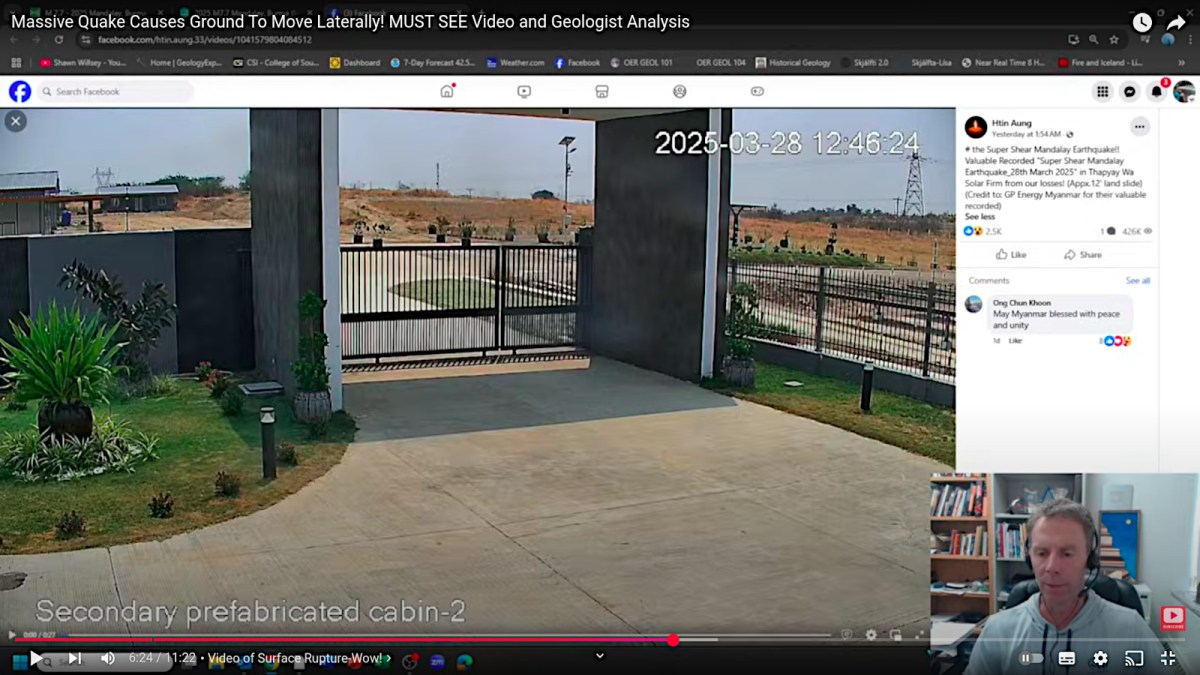
Here’s something very rare, in fact so far it’s unique; a tectonic plate movement caught on video!
The photo is a screen shot from my laptop, I was watching an astounding section of video from a security camera on a property in Thailand, a couple of hundred miles south of the damaging earthquake in Myanmar in March 2025. You may remember this being in the news at the time. Watch from the beginning if you want to see the entire thing (highly recommended). If you just want to see the earth move, skip to 6m 22s.
You’ll see the movement most clearly by watching the ground just outside the fence on the right hand side of the video, but there’s a great deal more to see if you listen to the narration.
In simple terms, the ground this side of the fence is supported on one tectonic plate, and the ground on the far side of the fence is supported on a different plate. The plates are slowly moving past one another but rocks are quite strong and lock in place, resisting the sliding motion. The stresses in the rocks increase year on year until they’re powerful enough to fracture even the strongest of materials. So at some point the underlying rock gives way and years and years of potential movement all occurs in a couple of seconds as the rocks move several metres all at once. And at that point, stresses slowly begin to build up again until many years later there’s another earthquake and another sliding motion releasing the stresses once again. And the cycle repeats over and over again.
I hope you enjoyed watching this video as much as I did!
If you enjoyed this or found it useful, please like, comment, and share below. (If you don’t see those links, click the article’s title above the main photo and they will appear.) Send a link to friends who might enjoy the article or benefit from it – Thanks! My material is free to reuse (see conditions), but a coffee is always welcome and encourages me to write more often!
We are to learn about love, fruitfulness, brokenness, restoration, and our place in this Universe, responsibility, culpability, truth, life and wisdom. We are to understand these things in our own lives, in one another, and also in and through Yahweh.
I recently listened to a podcast byTwo pastors in a pub (episode 55). I enjoyed the episode which was about the questions asked and statements sometimes made, to the effect that the presence of dinosaur remains in the fossil record demonstrates the Bible to be incorrect. All sorts of these points are examined and discussed during the podcast. But I think there’s a much more fundamental argument to be made – and it has nothing to do with dinosaurs.
The underlying questions, I believe, are:
‘What is the Bible for?’ That is, ‘What is it’s purpose?’
‘Why was it written?’
‘How was it written?’ and
‘How should I read it?’
What’s in a name?
The background to my answers to those questions is to say that I believe there’s a power of some kind invisible to us, external to the Universe yet responsible for its existence and its nature. We’ll come back to the questions soon, but first let’s go a bit further with the background.
Note first that there is no way I can prove this belief of mine to be true or false. It’s a matter of faith, not of proof and not of evidence. It’s simply something I believe to be true. The set of provable statements is limited to those within and about the Universe; this set does not, cannot, apply to anything exterior to the Universe.
I give this creating and sustaining Authority in which I believe, a name. I like to use the name ‘I am what I am’. It’s the name offered for use by Moses when he asked, ‘Who shall I say has sent me?’ In Hebrew, this enigmatic name is יהוה ie YHWH, the vowels being left out. It’s transliterated into English variously as ‘Yahweh’ or ‘Yahveh’, ‘Yahoveh’ or in the past frequently ‘Jehovah’.
You can read more about Moses and the name in Exodus 3.
Taking the trouble to use something akin to the name given to Moses makes it easier to think this through. A name implies a person; so let’s imagine this creating and sustaining authority as a person called Yahweh.
Back to the questions
What is the Bible for? What is its purpose?
First remember that this person called Yahweh is not here with us inside this Universe we inhabit. Yahweh is outside it, if I make something I cannot also be a part of the thing I made. Suppose I write a story and there are characters in my story, as the author I might want to communicate with the characters. I think that’s the simplest way to answer the question, ‘What’s the Bible for’. I suggest that it’s Yahweh’s way of communicating with us. By influencing people like Moses, but also many others down the long ages of history, Yahweh has encouraged them to write down accounts that explain so many things that we need to know. That is the purpose and function of the Bible. It’s a collection of writings from many times and places written by many different contributors, but all inspired by Yahweh’s character and nature. That inspiring process is so fundamental that we might even regard Yahweh as the author, working behind the scenes.
Why was it written?
If the Bible had not been written, we would know little or nothing about the author. The fact that Yahweh wants you and me and others to know is reason enough. We are to to learn about character, purpose and relationship in particular. We are to learn about love, fruitfulness, brokenness, restoration, and about our place in this Universe, responsibility, culpability, truth, life and wisdom. We are to understand these things in our own lives, in one another, and also in and through Yahweh.
There’s plenty of geography, poetry, history, story, wisdom and more in the Bible, yet it’s not a geography text, or a poetry text , or a history text. Instead, the Bible employs all these forms to put across the core message. When Jesus told the story of the good Samaritan, or the woman who lost a coin, they were not necessarily historical events or real people, the story was to clarify something deeper and far more important than mere, everyday fact. And everything in the Bible, including the Genesis creation account, is there for that kind of purpose. None of the accounts in the Bible is required to be true palaeontologically, that’s not their function. They are there to explain relationship, responsibility and a deeper kind of truth.
How was it written?
Little by little is one answer. The books of the Bible were written at different times, by the efforts of many diverse authors, and based both on the author’s knowledge of the ways and history of the times in which they lived, and on direct inspiration by Yahweh.
How should I read it?
As it was (and is) intended! Don’t go searching for scientific evidence, geographical facts, or historical analysis with supporting documentation. Expect to have flashes of understanding from time to time, particularly about the nature, purposes and character of Yahweh. Most importantly, try to understand Yahweh’s perspective in dealing with characters in stories both imagined and historical. And especially try to grasp and crystallise what you are being shown about yourself, particularly in terms of your relationships and attitudes to others and to Yahweh as well.
Dinosaurs
Given all of that, you should now be in a good place to see that dinosaurs in the fossil record contradict nothing in the Bible. There is good, geological and palaeontological evidence for creatures living on the land and in the oceans of Earth way back in the past. There’s good evidence too to show that they were reptiles and that some of them were very large. There’s further good evidence to reveal that they did not, after all, die out completely. One branch of the dinosaur line survived and gave rise to all the birds that still live in the world today.
But none of this in any way contradicts my personal faith in a power external to the Universe.
And finally
There’s just one more point to make. What I’ve written here is only the merest beginning. You’ll find more right here in Journeys of heart and mind. I suggest using the search box near the top of the right-hand column (you’ll have to scroll up to find it). Try searching for Yahweh or for Jesus. Alternatively begin with this post:
So, is Jesus the same person as Yahweh? I can only give you a weird answer – Yes, he is, and no he’s not! There’s a great deal more to be said about this, and I plan to write more soon. When I do, I’ll leave a link right here.
If you enjoyed this or found it useful, please like, comment, and share below. (If you don’t see those links, click the article’s title above the main photo and they will appear.) Send a link to friends who might enjoy the article or benefit from it – Thanks! My material is free to reuse (see conditions), but a coffee is always welcome and encourages me to write more often!
There was a pre-decimal British coin carrying a picture of a wren on the reverse, still in use when I was a small child. There were four farthings in a penny … or 960 of them in a British pound sterling.
So, what bird might that be? Why, the Jenny Wren of course. If you live in Britain you’ll probably be familiar with this old term.
My son-in-law, Paz, sent me a link to a wonderful video of a Eurasian wren singing. Because the video has been slowed down, the sound is lower-pitched but also stretched out in time. As a result you can hear far more of the detail in this small bird’s singing performance. It’s truly amazing! But don’t take my word for it, watch and listen for yourself…
Paz is always amusing with his choice of titles; this time his email to me was entitled ‘Trogloclanger’. This is a portmanteau from Troglodytes (the Latin genus and species name of this wren), and The Clangers – fictitious inhabitants of space who made a whistling noise and figured in children’s stories. (You probably don’t want to watch an episode of The Clangers – but just in case, here’s one.)
It’s worth mentioning the Wikipedia article on the Eurasian wren because it provides a lot of detail about this little bird, and was also the source of the photo. Learn more about the ornithology and etymology from Wikipedia. There’s a separate article about the family Troglodytidae in general. Almost all species of wren live in the Americas, or islands in the region.
There was a pre-decimal British coin carrying a picture of a wren on the reverse, still in use when I was a small child. There were four farthings in a penny (‘four’ and the ‘far’ in farthing are cognate) or 960 of them in a British pound sterling. So you’d need just over 9½ farthings to make a decimal penny – that’s inflation for you!
At the time many people supposed that the smallest British bird was chosen for the reverse of the smallest British coin. But that is not the case as the goldcrest is our smallest bird.
If you enjoyed this or found it useful, please like, comment, and share below. (If you don’t see those links, click the article’s title above the main photo and they will appear.) Send a link to friends who might enjoy the article or benefit from it – Thanks! My material is free to reuse (see conditions), but a coffee is always welcome and encourages me to write more often!




 Journeys of Heart and Mind


.jpg)
