From gas and gravity to galaxies

The tiniest fluctuations in density in the early universe have become the very largest structures we are aware of.

Part 4 of a series – Emergence

< Combining atoms | Index | First generation star formation >
Click for full size
(NASA image)

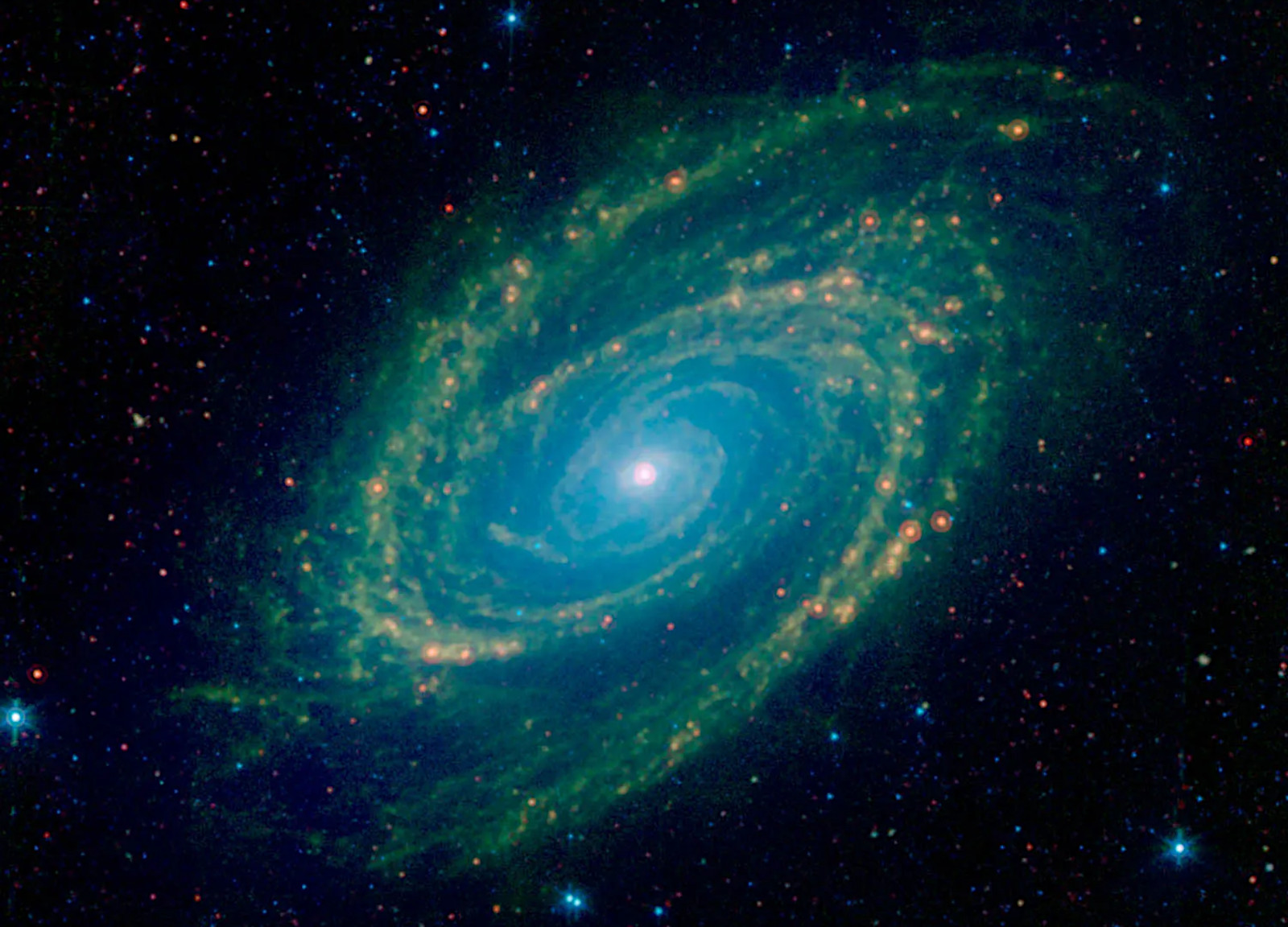
In the early phase of the young, expanding universe, the primordial atoms of hydrogen, some helium, and traces of lithium were present in strings and clumps. These structures go back to the very earliest times. The cosmic microwave background hints at such structures very early on, and on the most enormous scales of astronomy they also put in an appearance. Strings and clusters of galaxies are visible everywhere, with vast voids between them where there seems to be nothing at all.

Gravity, although it’s by far the weakest of the fundamental fields, acts over enormous distances. Because of this, the tiniest fluctuations in density in the early universe have become the very largest structures we are aware of. Galaxies and clusters of galaxies began as truly enormous volumes of tenuous gas. And just as tiny density fluctuations became concentrations and voids, so imperceptible movements became enormous swirls, rotations and flows under the relentless action of gravity. Loose accumulations became ever tighter concentrations; gentle drifting became powerful vortices.

This happened at every conceivable scale. When a volume of gas is compressed by its own gravity, it doesn’t remain spherical. Rotation of the mass increases as the material is pulled together and the end result is inevitably a disk rotating slowly at the outer edge, but ever faster towards the centre. This is how proto-galaxies formed. And within those proto-galaxies, the same process on a far smaller scale allowed stars to form – but that’s another story.

For now, just ponder the fact that galaxy clusters and galaxies are emergent features given the gravitational field that permeates the universe and sufficiently large amounts of gas.

See also:

< Combining atoms | Index | First generation star formation >

Image of the day – 63

Hares have become something of a feature in the town. Recently the hare tradition has spread to the Cotswolds more generally too.

< Previous | Index | Next >

What’s in an image? Sometimes quite a lot, more than meets the eye.

I’m posting an image every two days (or as often as I can). A photo, an image from the internet, a diagram or a map. Whatever takes my fancy.

The photo shows one of a number of beautifully painted hares around the town. This example stands at the southern end of Riverside Walk where it joins Thomas Street.

A hare featured in a Roman mosaic floor discovered just inside the eastern city wall, part of a very impressive town house. The hare mosaic is now in the Corinium Museum and hares have become something of a feature in the town. Recently the hare tradition has spread to the Cotswolds more generally too.

The mosaic was covered over by an underfloor heating system and a new floor laid on top. The new floor did not survive, but the old floor did, protected as it was by the stonework laid above it.

You might like to watch this video about the hare mosaic, published by the Museum.

See also:
Cirencester

For convenience, here’s a list of all the Cirencester area images:

A417 roadworks, Advent Market, Bishops Walk, Baunton, Canal 1, 2, Castle Street, Christmas lights 1, 2, Church 1, 2, 3, 4, 5, 6, Churn flood, Countryside, Fallen tree, Fleece, Gasworks, Gloucester Street, Hare 1, 2, Hospital, Market Place 1, Phoenix Fest, Riverside Walk, Stone plaque, Stratton Meadow, Tank traps, View, Wonky 1, 2, Yellow Iris

Themed image collections

The links below will take you to the first post in each collection

Cirencester, Favourites, Irish holiday 2024, Roman villa

< Previous | Index | Next >

Useful? Interesting?

If you enjoyed this or found it useful, please like, comment, and share below. (If you don’t see those links, click the article’s title above the main photo and they will appear.) Send a link to friends who might enjoy the article or benefit from it – Thanks! My material is free to reuse (see conditions), but a coffee is always welcome and encourages me to write more often!