< Previous | Index | Next >
What’s in an image? Sometimes quite a lot, more than meets the eye.
I’m posting an image every two days (or as often as I can). A photo, an image from the internet, a diagram or a map. Whatever takes my fancy.
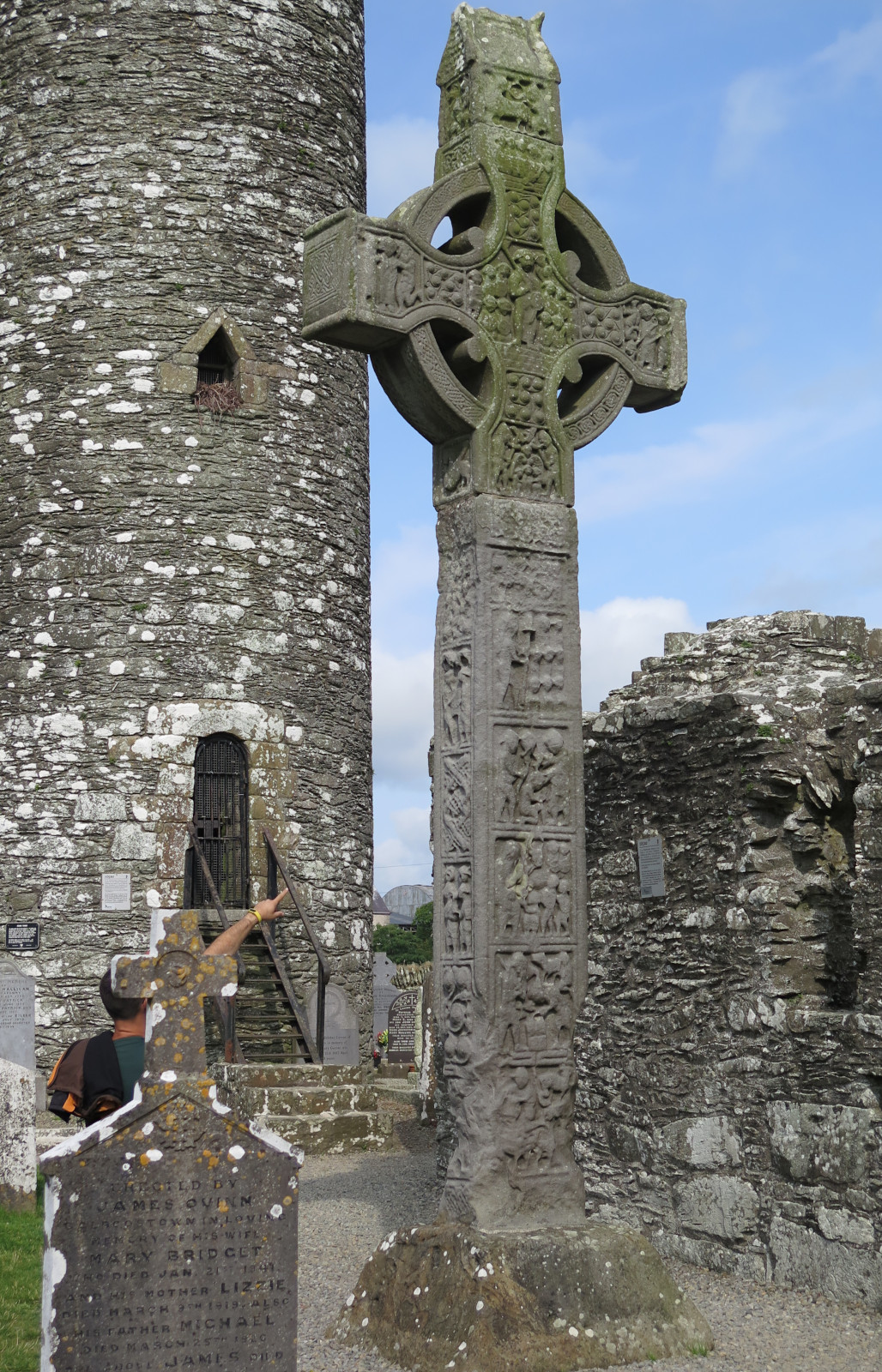
Irish monasteries had a number of features not found (or rarely found) in other parts of the British Isles. The round towers are one example, there are one or two in Scotland and the Isle of Man, but nowhere else outside Ireland. Stone high crosses are another example. These are found throughout the British Isles and parts of France. The ruined monastery of Monasterboice has a round tower similar to the one at Glendalough, but is particularly noted for several outstanding high crosses, one of these features in my photo.
The crosses are usually carved with traditional Celtic patterns, but often they have panels containing carved pictures that illustrate a story, perhaps a Bible story. They were clearly important to the people and communities that took so much care and effort to create them, and they are one of many strong reminders of the Celtic, and particularly the Irish Christian traditions that were significantly different in many ways from the later, Catholic traditions coming into south-eastern England in Saxon times.
The Catholic Church brought initially to Kent from the Continent introduced a hierarchical style, with church officials under the Pope, and fixed orders of service. The Celtic church that had developed from early, pre-Catholic traditions in Roman Britain, was based more on travelling teachers (often missionary monks) who were more flexible in style, without strict rules. They often took little with them but their learning, and depended on the people they taught to support them on their journeys.
Which of these two styles do you think followed the teachings of Jesus most closely?
Images from our Irish holiday 2024
For convenience, here’s a list of all the Irish holiday images:
28th Jul – Welsh Botanic Garden, Robin, Fishguard
29th Jul – Wicklow Mts, Glendalough, Powerscourt, Rose, Greystones
30th Jul – Liffey, Temple Bar, St Patrick’s Cathedral
31st Jul – Newgrange, Battle of the Boyne
1st Aug – Monasterboice, Mourne, Thrift, Window
2nd Aug – Spelga Dam, Hydrangea, Pipework, Lough Neagh
3rd Aug – Coagh, Springhill, Portrush
4th Aug – Beach at Portrush
5th Aug – Giant’s Causeway, Carrick-a-Rede, Portrush
Themed image collections
The links below will take you to the first post in each collection
Cirencester, Favourites, Irish holiday 2024, Roman villa
< Previous | Index | Next >
Useful? Interesting?
If you enjoyed this or found it useful, please like, comment, and share below. (If you don’t see those links, click the article’s title above the main photo and they will appear.) Send a link to friends who might enjoy the article or benefit from it – Thanks! My material is free to reuse (see conditions), but a coffee is always welcome and encourages me to write more often! 
Share this:


Fascinating insights you bring aCross here, Chris. Considering the differences between the Catholic and Celtic models, the Celtic one is the one I get the impression is closer to the model lived out by Christ and the apostles.
LikeLiked by 1 person
Yes, I agree with you about that, Chris. The Celtic church was ‘healthy’ in ways that some of us are only now beginning to recover. I’m sure it wasn’t perfect, but it had many things right. I wonder if early Catholicism developed in a hierarchical way partly because the later Roman emperors seized on church as a political ploy – ‘This is the official state religion, the old pagan religions are now illegal’. The promise of eternal life after death in the here and now would have been a popular idea, and an Emperor might benefit by making that official.
LikeLike