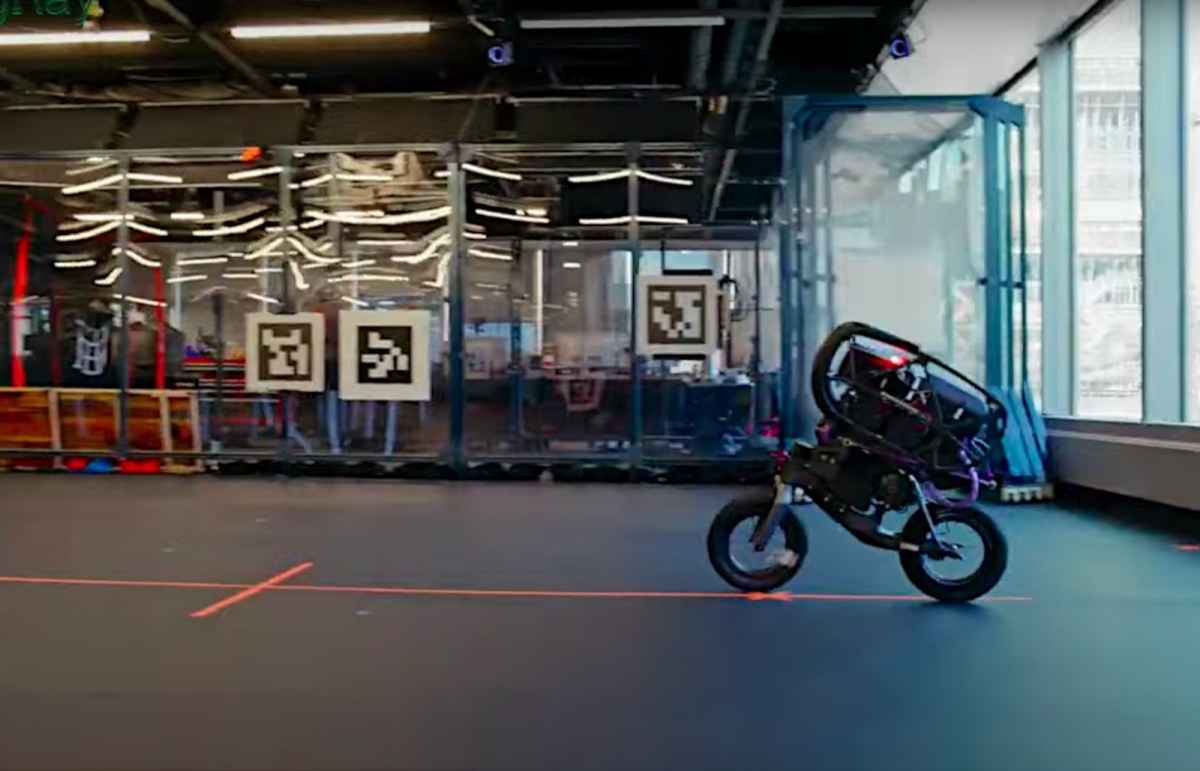
Bike balancing robot

It may become possible to train a robot by simply showing it a task and correcting it when it makes mistakes. This would be far quicker than having to program the actions in the traditional way.

Institute of Astronomy, Cambridge (Wikimedia)

Science and technology – 6

< Previous | Index | Next >

Click to enlarge

Here’s a robot doing the kinds of things well-programmed robots can do. You might think nothing of it, we’ve all seen videos of robots dancing, jumping and performing difficult tasks and manipulations. But this bike-balancer is a bit different. It has an AI system with a feedback mechanism that learns how to balance better and better with practice. This is how all animals with nervous systems learn new behaviours and improve their performance at practical tasks and skills. It’s still nowhere near Artificial General Intelligence (AGI) but it might be a small step along the way.

With this achievement under their belts, the developers will undoubtedly try the same method to develop robots that can handle tasks like juggling, sorting items, removing incorrect objects from a moving belt, or bolting two items together using a spanner. It may become possible to train a robot by simply showing it a task and correcting it when it makes mistakes. This would be far quicker than having to program the actions in the traditional way. It would probably be impossible to know how the robot makes decisions on the best movements to get a particular job done, but that’s true with training people to do jobs too. Very often, the how is not important providing the result is reliable and effective.

See also:

< Previous | Index | Next >

Useful? Interesting?

If you enjoyed this or found it useful, please like, comment, and share below. My material is free to reuse (see conditions), but a coffee is always welcome!

You might also like:

A bird called Jenny

There was a pre-decimal British coin carrying a picture of a wren on the reverse, still in use when I was a small child. There were four farthings in a penny … or 960 of them in a British pound sterling.

European wren (Wikimedia)

ad hoc post – 1

< Previous | Index | Next >

Click to enlarge (Wikimedia)

So, what bird might that be? Why, the Jenny Wren of course. If you live in Britain you’ll probably be familiar with this old term.

My son-in-law, Paz, sent me a link to a wonderful video of a Eurasian wren singing. Because the video has been slowed down, the sound is lower-pitched but also stretched out in time. As a result you can hear far more of the detail in this small bird’s singing performance. It’s truly amazing! But don’t take my word for it, watch and listen for yourself…

Paz is always amusing with his choice of titles; this time his email to me was entitled ‘Trogloclanger’. This is a portmanteau from Troglodytes (the Latin genus and species name of this wren), and The Clangers – fictitious inhabitants of space who made a whistling noise and figured in children’s stories. (You probably don’t want to watch an episode of The Clangers – but just in case, here’s one.)

It’s worth mentioning the Wikipedia article on the Eurasian wren because it provides a lot of detail about this little bird, and was also the source of the photo. Learn more about the ornithology and etymology from Wikipedia. There’s a separate article about the family Troglodytidae in general. Almost all species of wren live in the Americas, or islands in the region.

Farthing (Wikimedia)

There was a pre-decimal British coin carrying a picture of a wren on the reverse, still in use when I was a small child. There were four farthings in a penny (‘four’ and the ‘far’ in farthing are cognate) or 960 of them in a British pound sterling. So you’d need just over 9½ farthings to make a decimal penny – that’s inflation for you!

At the time many people supposed that the smallest British bird was chosen for the reverse of the smallest British coin. But that is not the case as the goldcrest is our smallest bird.

See also:

< Previous | Index | Next >

Useful? Interesting?

If you enjoyed this or found it useful, please like, comment, and share below. My material is free to reuse (see conditions), but a coffee is always welcome!

You might also like:

Evidence of life? Perhaps…

If the discovery bears up under closer scrutiny (and I think that’s quite likely), it will go down as one of those great discoveries in the history of astronomy and science generally.

Institute of Astronomy, Cambridge (Wikimedia)

Science and technology – 5

< Previous | Index | Next >

Cambridge IoA
(Wikimedia)

There have been rumours of life found on other planets circling other stars, sometimes presented on YouTube or elsewhere as amazing or even terrifying discoveries. But they were just sensationalist rumours. But now, for the first time, here’s something a bit more credible.

Watch the video below from Cambridge University, this is a brief presentation by Professor Nikku Madhusudhan on the probable discovery of a biomarker molecule DMS in a planetary system. Further work at Cambridge and elsewhere will throw more light on this soon, And yes, the pun was intended in this case!

It’s definitely exciting news, but I must emphasise that further checking and more data is essential. But if the discovery bears up under closer scrutiny (and I think that’s quite likely), it will go down as one of those great discoveries in the history of astronomy and science generally.

< Previous | Index | Next >

Useful? Interesting?

If you enjoyed this or found it useful, please like, comment, and share below. My material is free to reuse (see conditions), but a coffee is always welcome!