Christopher Dryden, who writes at Life with CD always creates great posts, closely focusing on sharing, expanding on and interpreting Biblical themes and passages.
His work is always worth reading. He calls us back to the truth at its deepest heart. Do take a look.
We can be sure there’s trouble ahead and we can imagine some of the long term issues. The authors of this article are putting out a broad warning and setting out the probable longer term dangers.
Recommended – 2
In this series I recommend articles or other work I’ve seen that I really like and want to share with my readers.
Click to enlarge
A quick summary follows, but I encourage you to read the original with its much deeper analysis.
It’s very difficult to analyse the long-term effects of actions that began only three months ago, and may continue for some time; we can only guess how long this process will last and what new forms it might take in future months or years. It’s as if the captain of a large vessel had ordered a hard turn to starboard and the crew was scrambling to put the order into effect. With the ship’s rudder now clearly turning and signs of a change in course, what can possibly be concluded?
The ship will start to lean a little, some loose objects will slide around, these immediate effects are predictable. But what about the longer term? Will there be a catastrophic collision with another ship? Will we run aground? It’s clear there are dangers but it’s too soon to make detailed predictions.
That’s the situation US science finds itself in today. We can be sure there’s trouble ahead and we can imagine some of the long term issues. The authors of this article are putting out a broad warning and setting out the probable longer term dangers.
Damage caused by the Trump administration, science-policy experts warn, could set the United States back for decades. “So many of the damaging impacts are going to be extremely difficult to reverse and are going to take a very long time to recover from,” says John Holdren, a science adviser to former US president Barack Obama.
The authors begin by summarising what’s been done in the first three months and pointing out that it’s just a start; cuts of up to half seem likely. Reader surveys by Nature show well over 90% are troubled by the cuts.
About half the US science budget goes on defence-related programs and more than a quarter on health. The cuts are being presented as necessary to combat waste, corruption and propaganda, but no evidence has been offered to back up these claims. An assumption is being made that private sector research will shoulder the burden, though that is most unlikely for fundamental studies.
Another aspect of budget cuts is the resulting loss of skilled and knowledgeable staff, an immediate loss that will take a long time to rebuild. Indeed, the damage done in a few months will take decades to recover. It seems likely that Congress will be unable (or unwilling) to resist the probable budget cuts for 2026 and the situation is not likely to be alleviated by the various political demands being made of universities by the Trump administration. The USA seems already to be suffering loss of reputation and is less appealing for foreign scientists, not only are fewer international staff and students planning to work in the USA, but American scientists are starting to look abroad for work.
There are worries that other nations will advance beyond what the US can do in years ahead, and putting broken US science together again will be very difficult and expensive to achieve.
The article also contains helpful links for additional reading on the topics discussed.
If you enjoyed this or found it useful, please like, comment, and share below. (If you don’t see those links, click the article’s title above the main photo and they will appear.) Send a link to friends who might enjoy the article or benefit from it – Thanks! My material is free to reuse (see conditions), but a coffee is always welcome and encourages me to write more often!
Our suffering for Christ is not wasted; it is a testimony of our allegiance to Him and a pathway to deeper intimacy with [him].
Recommended – 1
This is the first of what may become an occasional series in which I recommend creators and their creations when they produce things I really like and have found useful.
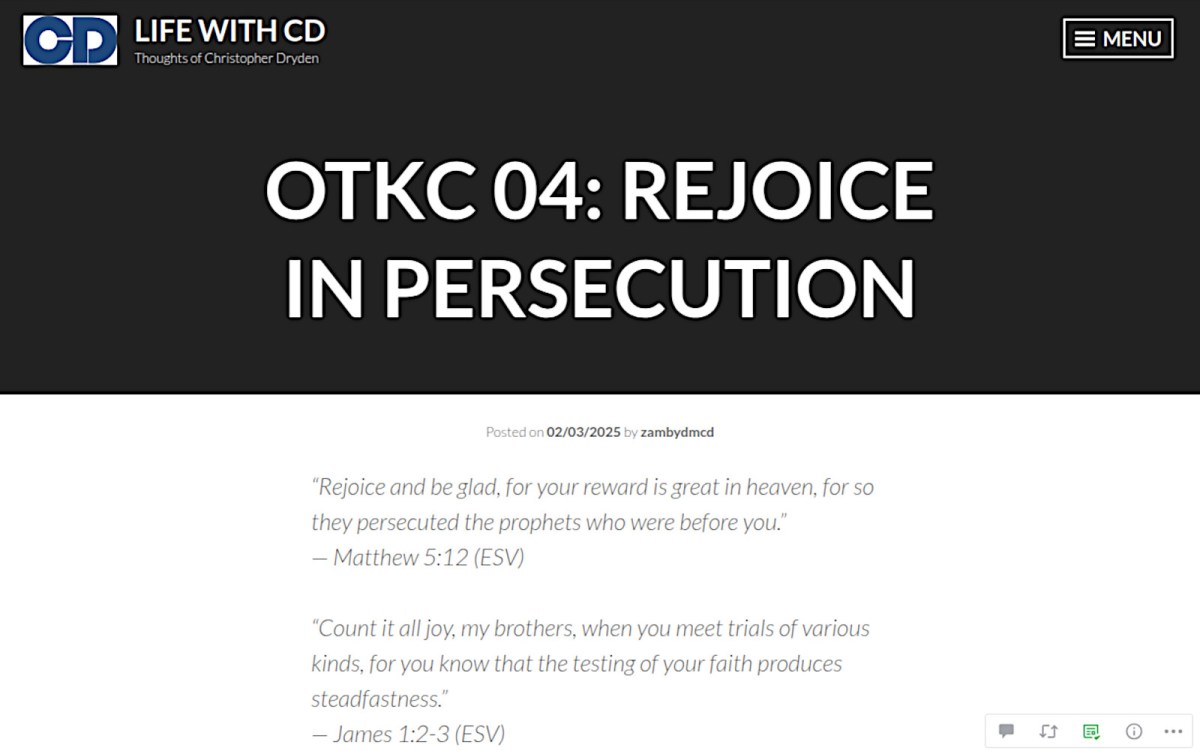
Today I’ve chosen an article by Chris Dryden who writes at ‘Life with CD’. Here’s a quote from his piece:
Rejoicing in persecution is not about denying pain or pretending hardship doesn’t hurt. It’s about lifting our eyes beyond the immediate struggle to see the eternal reward that awaits us. Our suffering for Christ is not wasted; it is a testimony of our allegiance to Him and a pathway to deeper intimacy with our Saviour.
It’s a useful read, in fact all of Chris’s articles are worth a look. For those of us attempting to live like Jesus, there’s a lot of thought-provoking stuff to read and consider here.
If you’re reading out of a more general interest you’ll still find much to value, perhaps as life lessons or just to understand why Jesus is a person of such long-standing interest to so many people.
If you enjoyed this or found it useful, please like, comment, and share below. (If you don’t see those links, click the article’s title above the main photo and they will appear.) Send a link to friends who might enjoy the article or benefit from it – Thanks! My material is free to reuse (see conditions), but a coffee is always welcome and encourages me to write more often!



 Journeys of Heart and Mind