Image of the day – 30

The furniture looks quite modern, built of finely polished timber and using pleasant fabrics, even scattered with cushions just like a modern home.

< Previous | Index | Next >

What’s in an image? Sometimes quite a lot, more than meets the eye.

I’m posting an image every day (or as often as I can). A photo, an image from the internet, a diagram or a map. Whatever takes my fancy.

A Roman dining room, ready for guests

This is fine dining, Roman-style! What you see here is the triclinium (dining-room) of a modern reconstruction of a small Roman villa. I took the photo at The Newt in Somerset where the reconstruction stands close to the site of the original villa and reproduces its ground plan.

The rooms are decorated in Late Romano-British style as the original was built towards the end of the Roman period here in the UK. It’s a small villa as the family lived in Londinium (London) or Corinium Dobbunorum (Cirencester) much of the time. The villa was a country retreat.

It’s a real treat to see this place, if you ever have a chance to visit – take it! It’s only open to members of The Newt and their guests, unfortunately, apart from school trips and other organised events. Because the Villa and its farming outbuildings are equipped and furnished much as they would have been in Roman times, there’s a real feeling that the family has gone out for a country walk and might be back at any moment.

I might share some more of my photos from the villa in coming days, giving my readers a chance to see the rooms and furnishings in context with one another. Here in the triclinium, notice the mosaic on the floor and the beautifully painted wall plaster. The furniture looks quite modern, built of finely polished timber and using pleasant fabrics, even scattered with cushions just like a modern home. Roman dining involved relaxing on couches, so there are no chairs. There was glass in the windows, a very expensive, top-end feature for a Roman home. And the villa had underfloor heating for the winter, with heated flues warming the walls as well.

Images of the Roman villa

For convenience, here’s a list of all the Roman villa images:

Ceiling, Desk, Dining room, Exterior1, Exterior2, Garden, Kitchen, Mosaic floor, Office, Sitting room

Themed image collections

The links below will take you to the first post in each collection

Cirencester, Favourites, Irish holiday 2024, Roman villa

< Previous | Index | Next >

Useful? Interesting?

If you enjoyed this or found it useful, please like, comment, and share below. (If you don’t see those links, click the article’s title above the main photo and they will appear.) Send a link to friends who might enjoy the article or benefit from it – Thanks! My material is free to reuse (see conditions), but a coffee is always welcome and encourages me to write more often!

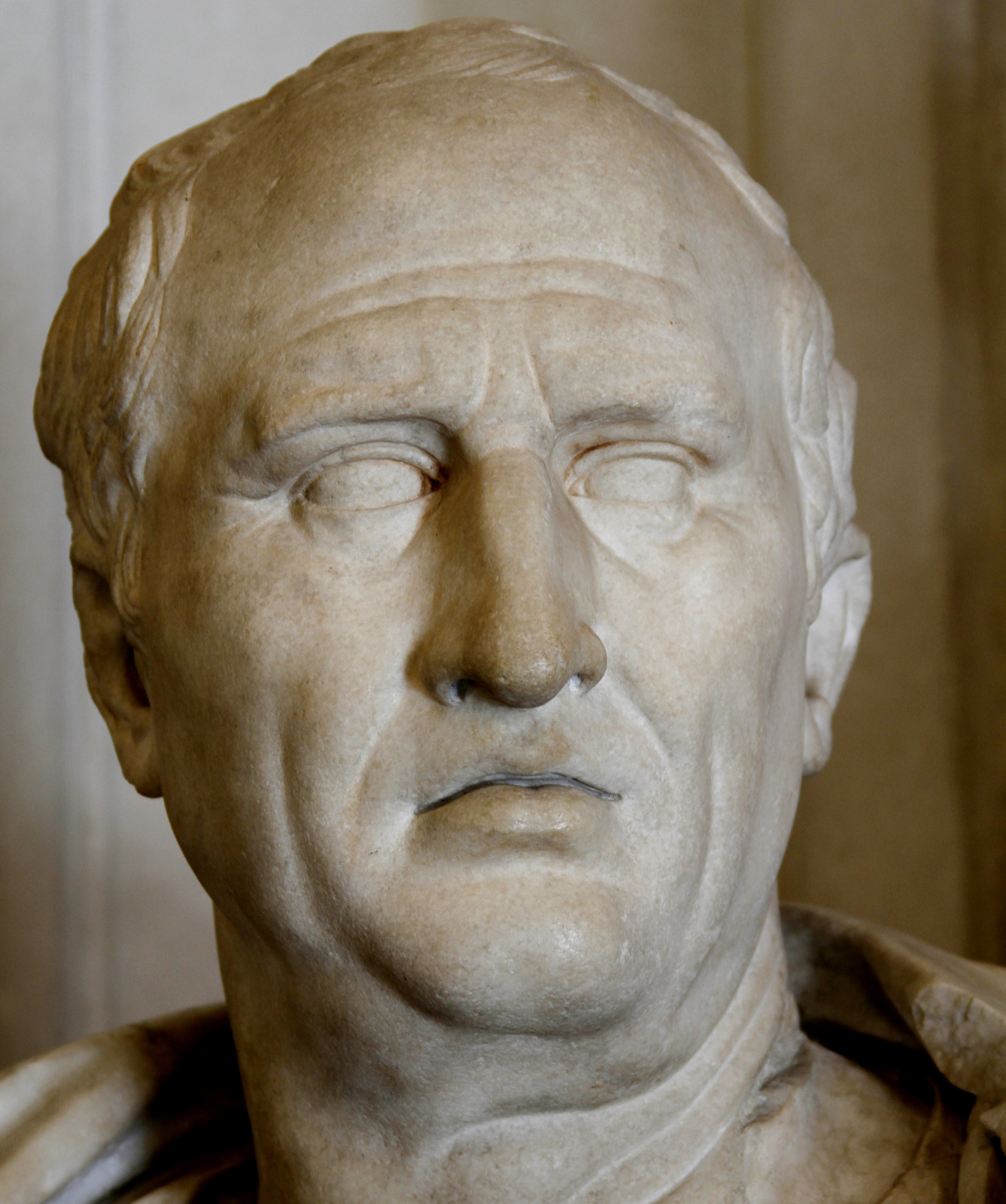
Cicero

If only the government had stood firm on the lines it was starting to follow! Instead of succumbing to creatures who were not seeking its reform at all, but its total obliteration.

Cicero (Mediawiki)

Below is a passage from Cicero’s work ‘On Duties’. We need a bit of background before I quote him. Cicero had been a lawyer, arguing cases for prosecution or defence, and he had a good deal of success in these endeavours. After a successful legal career he went into politics, working his way into the Senate, and then eventually being elected Consul.

But now the political process in Rome has changed, and instead of the Senate and other elected offices of state ruling Rome, the democratic element such as it was has been swept aside, first by a group of three and finally by the Dictatorship of Julius Caesar. Prior to this, a Dictator would be appointed for a limited time in case of great need. But now Caesar has taken the temporary role and made it permanent. (This brief summary leaves out a great deal, for more detail read the Wikipedia articles on Cicero and Caesar.)

The democracy of Senatorial Rome has ended. The dictatorship of Imperial Rome has begun. Cicero clearly understands the danger, and warns against it. Here is what he writes:

As long as our country was still governed by men it had voluntarily elected as its rulers, I was delighted to dedicate all my efforts and thoughts to national affairs. But when the entire government lay under the domination of a single individual, no one else but he any longer had the slightest opportunity to exert statesmanlike influence in any way whatever. Besides, I had lost the friends who had worked with me in the service of the State; and great men they were. When they were gone, I refused to give way to my distress – if I had not resisted by every possible means it would have overwhelmed me. Nor, on the other hand, did I just abandon myself to a life of pleasure; to do that would have been unworthy of an educated man.

If only the government had stood firm on the lines it was starting to follow! Instead of succumbing to creatures who were not seeking its reform at all, but its total obliteration. If things had gone better I should never have been devoting my attention to writing, as I am now. No, I would have been delivering public addresses, as I used to in the days when we still had a government: and if I wrote anything it would have been those speeches – just as I always wrote down and published my speeches after I had delivered them – it would not have been these essays I am engaged in now. Every scrap of my energy, attention and care used to go to politics. So when there was no such thing as politics any more, it was inevitable that my voice should be heard in the Forum and Senate no longer.

(The translation is from CICERO on the good life by Michael Grant.)

Does this sounds a little bit familiar? It should! We can identify democracies in our own times. Germany was a democracy before Adolf Hitler and the National Socialist Party seized power. Russia was a democracy under Boris Yeltsin until the presidency was transferred to a younger Vladimir Putin.

And what about the democracies of the USA and the UK today? They are still democracies for the time being, but how long will they last?

Adolf Hitler and Vladimir Putin came to power in democracies, but then tweaked the rules to give themselves additional powers and longer terms in office. Do we see the same kinds of manoeuvring by Donald Trump and the extreme right in the USA and by right wing politicians like Boris Johnson and Nigel Farage in the UK? So far, people like these have not been able to change electoral processes, but Trump has tried and so far failed, while Johnson and others may have used distortion and misrepresentation.

Intimidation and violence were used as levers of political change in Rome, and those methods are also being employed in our own day. Look at the words and actions of the far right across the world in recent years. We should all be concerned, some of today’s best and most moderate politicians have been elbowed aside – notably in USA’s Republican Party and the UK’s Conservative Party. And the same trend seems to exist everywhere in the wider West.

Just like Cicero, we should be alarmed, and careful, and work against the slide towards authoritarianism and power in the hands of individuals. A very great deal depends on the survival and flourishing of democratic government or we risk sliding into a new dark age of untempered authoritarianism.

Useful? Interesting?

If you enjoyed this or found it useful, please like, comment, and share below. (If you don’t see those links, click the article’s title above the main photo and they will appear.) Send a link to friends who might enjoy the article or benefit from it – Thanks! My material is free to reuse (see conditions), but a coffee is always welcome and encourages me to write more often!

Image of the day – 28

Similar tank traps have been used along the front lines by both sides in the ongoing Russian invasion of Ukraine.

< Previous | Index | Next >

What’s in an image? Sometimes quite a lot, more than meets the eye.

I’m posting an image every day (or as often as I can). A photo, an image from the internet, a diagram or a map. Whatever takes my fancy.

Tank traps

We have some history today. The river is the Churn and it runs in several different channels through the Cotswold town of Cirencester. On the bank you will notice three, large, concrete blocks; there’s also a fourth, partly hidden by the block on the left. The blocks were placed here during the Second World War to slow down German armour in the event that Britain was invaded. German failure to win the Battle of Britain in the air war prevented the invasion, but at the time the blocks were cast and put in place invasion remained a real threat.

The trees in the photo and the wall in the background are more recent than the blocks. The river bank led to an open field with the grounds and gardens of Abbey House beyond at that time, with the centre of the town on the other side of the gardens. The town would have been very vulnerable to attack from this direction.

Similar tank traps have been used along the front lines by both sides in the ongoing Russian invasion of Ukraine. The main difference is that modern, concrete traps are pyramidal (‘Dragon’s Teeth‘, not cubic. The sloping sides use less concrete and are more effective against tanks, but concrete cubes were also commonly used in the 1940s.

It pays to anticipate problems. But wars are rarely anticipated years in advance; political differences can boil over into actual conflict quite suddenly. And once they have started it can be very difficult to bring them to an end.

NOTE: These blocks can be seen from Grove Lane in Cirencester, quite close to the Norman Arch. From inside the Abbey Grounds, walk through the arch and turn right along the footpath for just a few yards. Look across the river, and there they are! A piece of Cirencester history that you can see for free.

< Previous | Index | Next >

Cirencester

For convenience, here’s a list of all the Cirencester area images:

A417 roadworks, Advent Market, Bishops Walk, Baunton, Canal 1, 2, Castle Street, Christmas lights 1, 2, Church 1, 2, 3, 4, 5, 6, Churn flood, Countryside, Fallen tree, Fleece, Gasworks, Gloucester Street, Hare 1, 2, Hospital, Market Place 1, Phoenix Fest, Riverside Walk, Stone plaque, Stratton Meadow, Tank traps, View, Wonky 1, 2, Yellow Iris

Themed image collections

The links below will take you to the first post in each collection

Cirencester, Favourites, Irish holiday 2024, Roman villa

Useful? Interesting?

If you enjoyed this or found it useful, please like, comment, and share below. (If you don’t see those links, click the article’s title above the main photo and they will appear.) Send a link to friends who might enjoy the article or benefit from it – Thanks! My material is free to reuse (see conditions), but a coffee is always welcome and encourages me to write more often!

Image of the day – 25

Even today…a wooden roof frame is constructed and then covered to form a roof. Good ideas tend to last a long time!

< Previous | Index | Next >

What’s in an image? Sometimes quite a lot, more than meets the eye.

I’m posting an image every day (or as often as I can). A photo, an image from the internet, a diagram or a map. Whatever takes my fancy.

Roof timbers

How would we manage without roof timbers? They are by far the most common form of support for tiles, slates, thatch, or any other waterproof roof covering. The roof timbers in the photo are a couple of hundred years old, but they’re not significantly different from Medieval or even Roman roof timbers. Even today, although the timbers are much slimmer and are pre-manufactured as truss structures, the principle remains that a wooden roof frame is constructed and then covered to form a roof. Good ideas tend to last a long time!

Is the same true for some of our institutions? From parliaments to town councils, from universities to infant schools, and from multinational corporations to village shops, many of the fundamental patterns are inherited from past generations. If it works well, why change it?

What other examples can you think of? But if you don’t want to ponder that question, just click on the image and enjoy those amazing roof timbers in more detail.

Themed image collections

The links below will take you to the first post in each collection

Cirencester, Favourites, Irish holiday 2024, Roman villa

< Previous | Index | Next >

Useful? Interesting?

If you enjoyed this or found it useful, please like, comment, and share below. (If you don’t see those links, click the article’s title above the main photo and they will appear.) Send a link to friends who might enjoy the article or benefit from it – Thanks! My material is free to reuse (see conditions), but a coffee is always welcome and encourages me to write more often!

Image of the day – 19

Agreement and mutual benefit are essential and beneficial in human societies, and are recognised as such worldwide.

< Previous | Index | Next >

What’s in an image? Sometimes quite a lot, more than meets the eye.

I’m posting an image every day (or as often as I can). A photo, an image from the internet, a diagram or a map. Whatever takes my fancy.

The junction of two canals in Stroud

This wooden carving marks the point where two canals meet in Stroud. The Stroudwater Canal to the right allowed Severn river boats (trows) to carry Welsh coal to Stroud to power the steam engines taking over from the less efficient water power in the late 18th and early 19th centuries.

The Thames and Severn Canal, opening a few years later, enabled the smaller London barges to make their way to and from Oxford and London to the east.

Cargoes would need to be unloaded from barges and reloaded on trows or vice versa to make the entire journey. But London barges were not suitable for the waves, winds and currents of the River Severn, while trows were too large for the locks and other facilities of the upper Thames.

Shaking hands is an interesting choice in a sculpture to signal agreement and mutual benefit. Agreement and mutual benefit are essential and helpful in human societies, and are recognised as such worldwide. When agreement and mutual benefit break down we have arguments, murders, violent demonstrations, and even wars. These are all social on some scale or other. How much better it would be to stop those behaviours and shake hands. But that’s not always possible, sadly.

There’s a saying that it takes two to have an argument. That’s true – but it also takes two to stop arguing and shake hands.

Themed image collections

The links below will take you to the first post in each collection

Cirencester, Favourites, Irish holiday 2024, Roman villa

< Previous | Index | Next >

Useful? Interesting?

If you enjoyed this or found it useful, please like, comment, and share below. (If you don’t see those links, click the article’s title above the main photo and they will appear.) Send a link to friends who might enjoy the article or benefit from it – Thanks! My material is free to reuse (see conditions), but a coffee is always welcome and encourages me to write more often!