< Previous | Index | Next >
Image of the day – 176
What’s in an image? Sometimes quite a lot, more than meets the eye. I’m posting an image every few days.

Sometimes we see things indirectly, and our brains are capable of retrieving far more information than you might at first think. It’s true of all our senses – hearing, touch, taste, smell and all the rest. The senses provide information but the brain makes much more of it all.
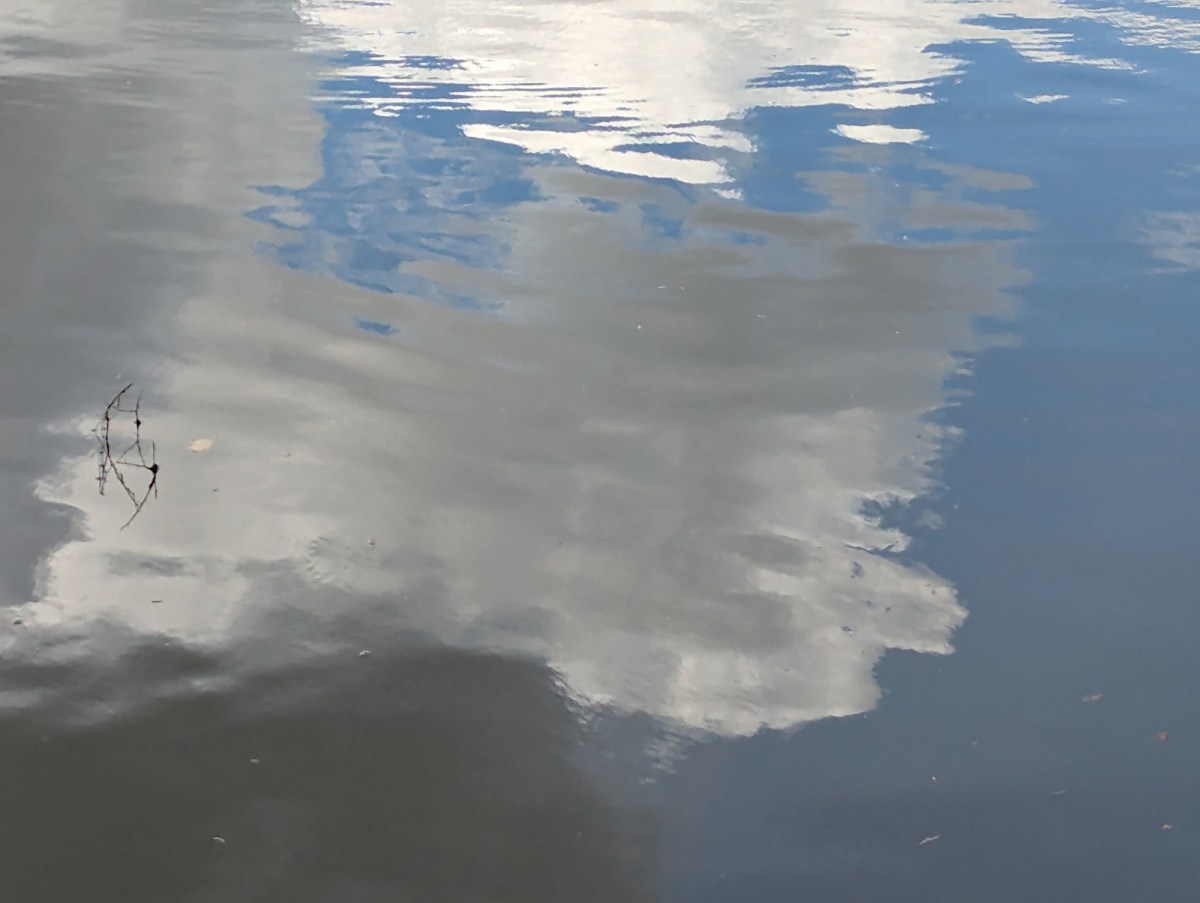
What do we see in this image? It’s just a pattern of coloured patches reflected from a water surface. That’s what the eye sees. But the brain tells us there are clouds in the sky above and there are ripples on the water. Then the brain compares this basic information with what it recalls from past experience and it can construct two narratives, one for the clouds and another for the water.
The clouds
There is a dark cloud and it’s the closest one to us, it threatens a shower of rain. A second image taken a few seconds later would be enough for the brain to decide the direction of movement of the cloud and predict whether the rain might fall here or somewhere else. Paler clouds, white clouds and blue sky suggest there’s some sunshine around as well so although there might be a brief shower, it won’t turn into ongoing steady rain. All of that from from a few colour patches.
The water
Because of the way the cloud reflections are distorted, the brain can infer the water is neither heavily disturbed not completely calm. Just from this image the brain understands there are ripples on the surface of the water and from past experience will also know that these ripples will be moving. The same brain will realise that there are two likely causes; either there is a light breeze blowing or perhaps a boat has passed recently. Once again, past knowledge in memory is necessary to arrive at these conclusions. There are some large ripples and, near the top of the image, some much smaller ones too. There was a small disturbance in the water further away as these small ripples seem to form an expanding circle of which we see only a small part.
Here and there things are floating on the water, small leaves, perhaps? If so, there must be trees nearby, perhaps with branches overhead. What a lot the brain can reconstruct on the basis of prior knowledge! And all of these conclusions come from some patches of colour in a still image. And what about the little sticks emerging from the water on the left-hand side? It’s the remains of vegetation of some kind. Was there a plant growing in the water? Did a strong wind break twigs off an overhead tree branch?
And one last point – it was not raining at the moment the photo was taken. The water would have been covered with dozens of circular disturbances if rain was falling. That’s a lot of information that your eyes and brain can glean from a single fragment of time trapped by my camera!
We are, as the Bible expresses it, fearfully and wonderfully made (Psalm 139:14).
See also:
- Brain – Wikipedia
- Eye – Wikipedia
- Visual perception – Wikipedia
< Previous | Index | Next >
Useful? Interesting?
If you enjoyed this or found it useful, please like, comment, and share below. (If you don’t see those links, click the article’s title above the main photo and they will appear.) Send a link to friends who might enjoy the article or benefit from it – Thanks! My material is free to reuse (see conditions), but a coffee is always welcome and encourages me to write more often! 
You might also like:
Share this:


 Journeys of Heart and Mind