
< Previous | Index | Next >
Image of the day – 164
What’s in an image? Sometimes quite a lot, more than meets the eye. I’m posting an image every few days.
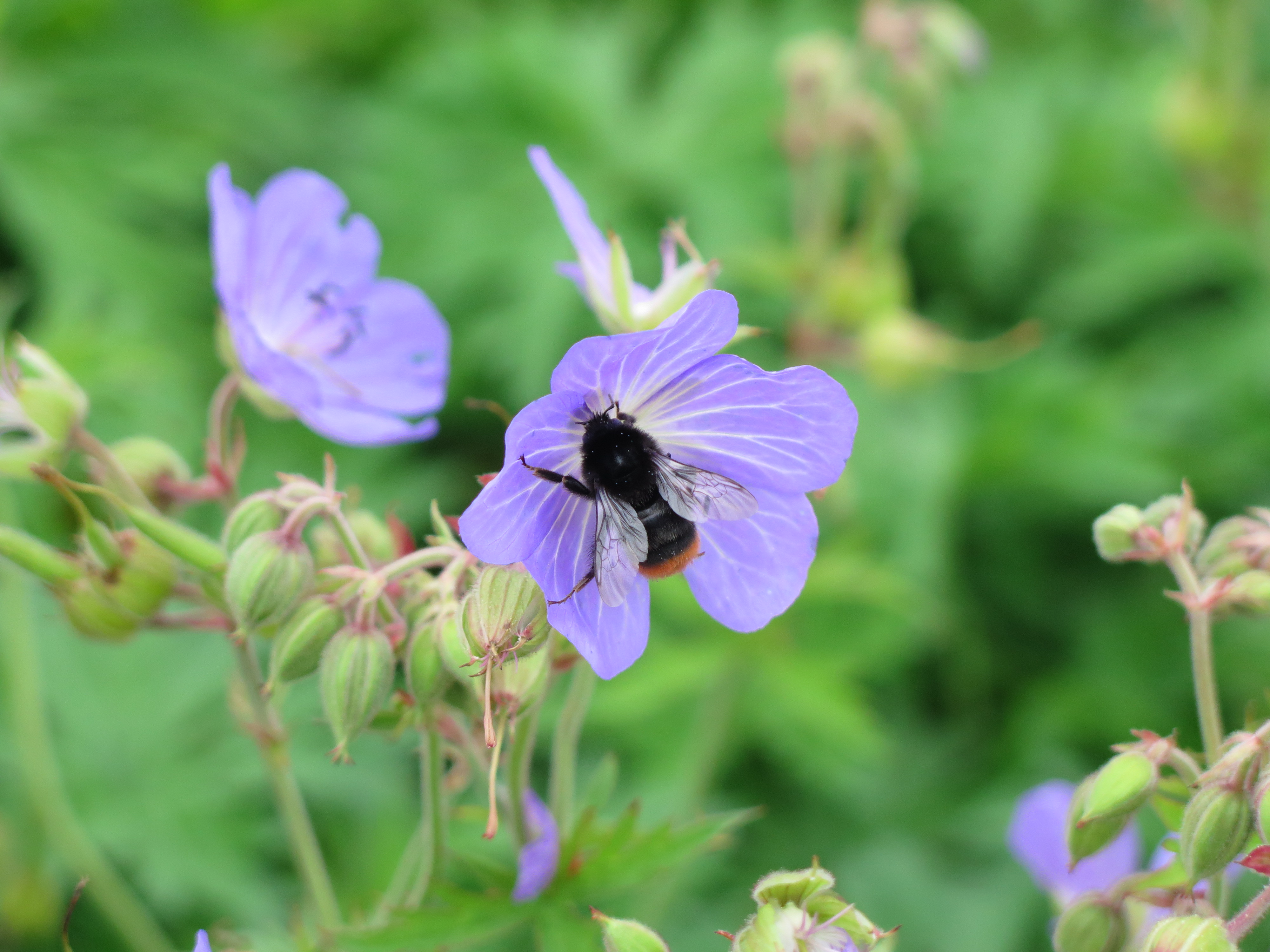
Here’s a bumble bee busy collecting nectar from a meadow cranesbill flower in a field margin just a brief walk from my home. The cranesbills are wild geraniums, close relatives of the pelargoniums; both genera are widely grown as decorative plants in pots or garden borders.
The photo is sharp enough when enlarged that you can see individual pollen grains on the bee’s black, furry body. Click the thumbnail image and stretch it to full size, then look for little white dots on the bee, those are the pollen grains.
Mutual benefit
The bees and flowering plants co-evolved, ancestors of both succeeded best in the presence of the other. Presumably the bee ancestors fed on the pollen of wind pollinated plants, incidentally transferring pollen more efficiently than the wind. And plants that provided sugary solutions and flagged this with colourful leaves near the nectar and pollen source were more successful than those that did not. After a while the insect and plant species were locked into a mutually beneficial relationship. Flowers are wonderfully adapted to attract bees and supply them with energy and a protein source to feed to their larvae. Bees are wonderfully adapted to collect and store nectar and pollen while moving some pollen grains from one flower to another.
See also:
- Coevolution – Wikipedia
- Bee – Wikipedia
- Flower – Wikipedia
- Insect pollination – Wikipedia
- Meadow cranesbill – Wikipedia
< Previous | Index | Next >
Useful? Interesting?
If you enjoyed this or found it useful, please like, comment, and share below. (If you don’t see those links, click the article’s title above the main photo and they will appear.) Send a link to friends who might enjoy the article or benefit from it – Thanks! My material is free to reuse (see conditions), but a coffee is always welcome and encourages me to write more often! 
You might also like:
Share this:


 Journeys of Heart and Mind