< Previous | Index | Next >
Image of the day – 149
What’s in an image? Sometimes quite a lot, more than meets the eye. I’m posting an image every few days.

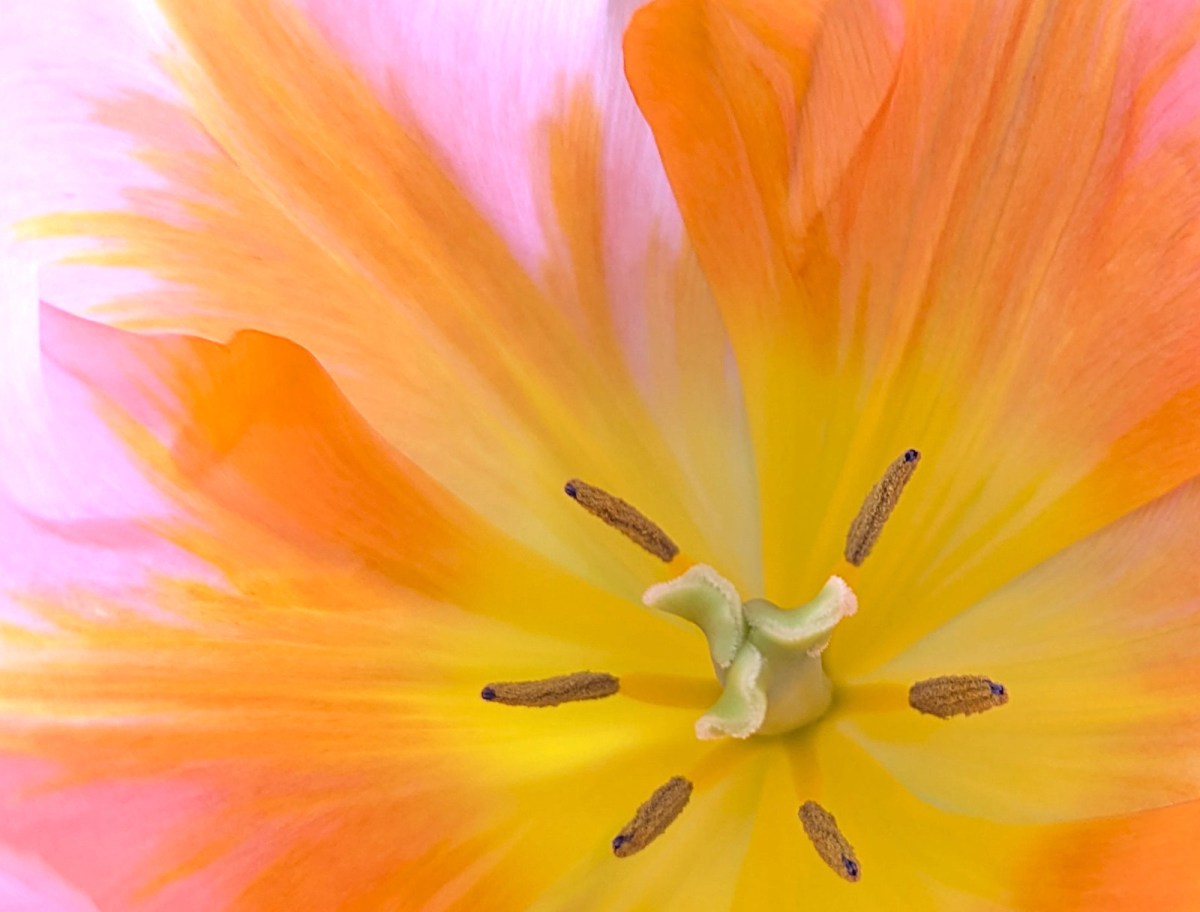
I have another flower image for you today. This one shows the centre of a tulip flower in more detail than you might normally see. I’ve placed the centre of the flower towards the lower right of the frame so you can see more of the petals towards the upper left. You’ll notice that the petals are yellow near the centre, orange a bit further out, and pink further out again. What a beautiful combination!
The reproductive parts
Tulips are monoecious, a botanical term that means each plant produces both male and female reproductive tissues. The female part of a tulip flower has three stigmas in the centre. Unlike animals and some more primitive plants, the male reproduction process doesn’t involve motile sperm. Instead, pollen is released as a yellow dust, sometimes dry and carried by the wind but in the case of tulips and many other plants, sticky and carried by flying insects.
Flowers work as attractive beacons for pollinating insects, they’re usually brightly coloured, are often fragrant which helps insects detect them from a distance, and provide food – sugary nectar at the base of the petals, and pollen. Bees collect the pollen and carry it back to the hive as a protein rich food for their larvae. Plants produce more pollen than necessary and can spare some in return for the pollen transport provided by the bees. The pollen grains stick to the pollinating insects and as they visit flower after flower, some of the pollen is transferred from the anthers of one plant to the stigmas of another. This cross-pollination is exactly what the plant needs for the female tissues to develop further and produce viable seeds.
Tulips have five of these anthers, and if you enlarge the image and peer closely you can see yellow dust clinging to them. That dust is the pollen.
Intricate
It’s an astonishingly intricate process in which the plants depend on the insects and the insects depend on the plants. I could go into much greater detail; I worked as a professional botanist when I was in my twenties and thirties, studying and publishing scientific papers on pollen and pollination. Maybe some time I’ll write a bit more about that.
Next time you see tulips in the park, at a florist or supermarket, or in your garden – just think about the intricate interactions going on right there!
See also:
- Pollen – Wikipedia (contains a more detailed photo of a tulip anther with pollen, about ¼ of the way down the article. Hint: compare the Wikipedia photo with mine.)
< Previous | Index | Next >
Useful? Interesting?
If you enjoyed this or found it useful, please like, comment, and share below. (If you don’t see those links, click the article’s title above the main photo and they will appear.) Send a link to friends who might enjoy the article or benefit from it – Thanks! My material is free to reuse (see conditions), but a coffee is always welcome and encourages me to write more often! 
You might like these posts too…
Share this:


 Journeys of Heart and Mind