
Part 4 of a series – Emergence
< Combining atoms | Index | First generation star formation >
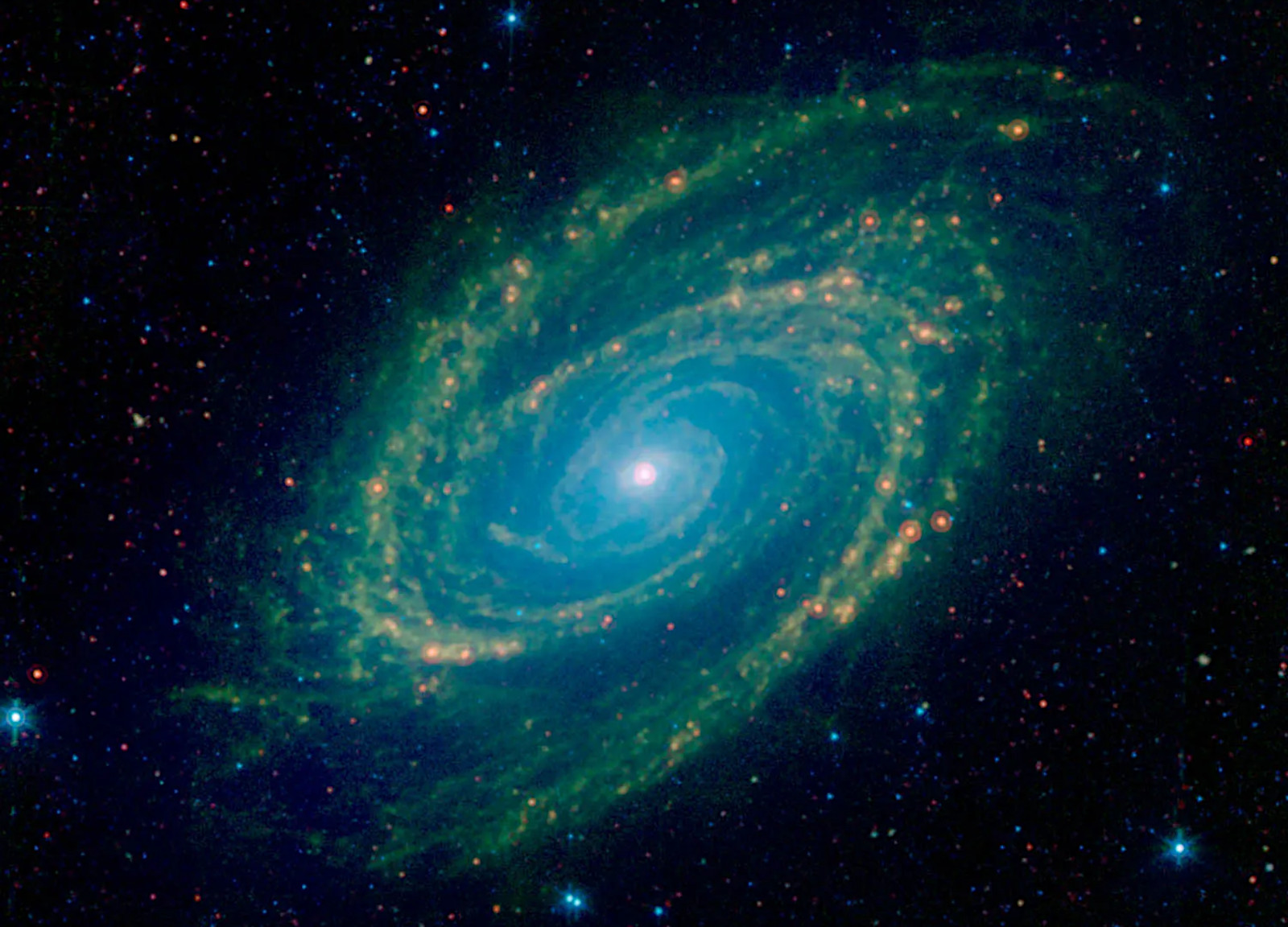
(NASA image)
In the early phase of the young, expanding universe, the primordial atoms of hydrogen, some helium, and traces of lithium were present in strings and clumps. These structures go back to the very earliest times. The cosmic microwave background hints at such structures very early on, and on the most enormous scales of astronomy they also put in an appearance. Strings and clusters of galaxies are visible everywhere, with vast voids between them where there seems to be nothing at all.
Gravity, although it’s by far the weakest of the fundamental fields, acts over enormous distances. Because of this, the tiniest fluctuations in density in the early universe have become the very largest structures we are aware of. Galaxies and clusters of galaxies began as truly enormous volumes of tenuous gas. And just as tiny density fluctuations became concentrations and voids, so imperceptible movements became enormous swirls, rotations and flows under the relentless action of gravity. Loose accumulations became ever tighter concentrations; gentle drifting became powerful vortices.
This happened at every conceivable scale. When a volume of gas is compressed by its own gravity, it doesn’t remain spherical. Rotation of the mass increases as the material is pulled together and the end result is inevitably a disk rotating slowly at the outer edge, but ever faster towards the centre. This is how proto-galaxies formed. And within those proto-galaxies, the same process on a far smaller scale allowed stars to form – but that’s another story.
For now, just ponder the fact that galaxy clusters and galaxies are emergent features given the gravitational field that permeates the universe and sufficiently large amounts of gas.
See also:
- Chronology of the universe (Wikipedia)
< Combining atoms | Index | First generation star formation >
Share this:


 Journeys of Heart and Mind