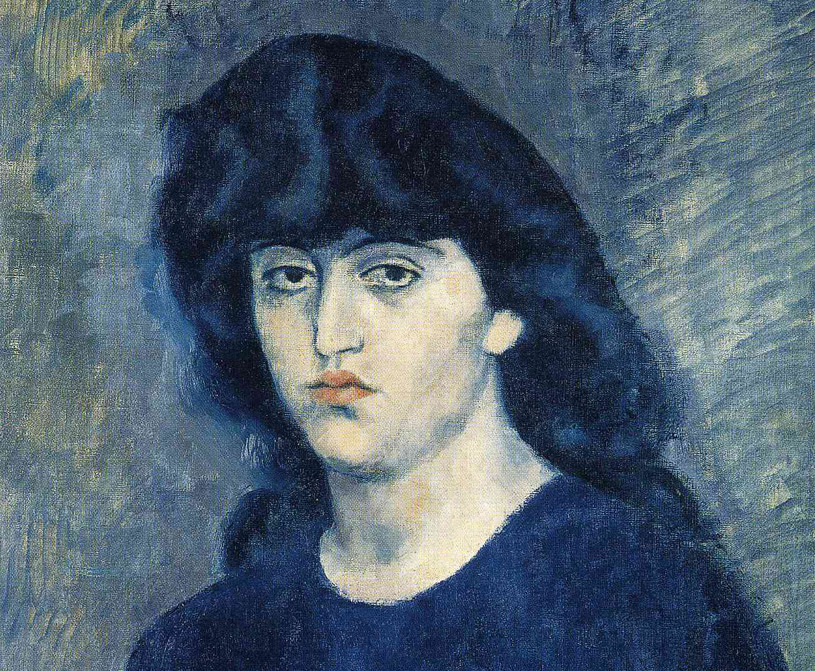
What is an exact representation? It’s a fully accurate impression of something, but still not the thing itself. For a paragraph of text it might be a carefully checked typescript or handwritten copy. It’s not the original, but it carries the essence of the original. If a single character is incorrect, the sense may still be clear, or guessable, or might become misleading. ‘If a single character his incorrect’ could still be clear though an obvious typo. ‘If a shingle character is incorrect’, might be slightly more confusing. ‘It’s now the original’, completely messes with the correct text, ‘It’s not the original’.

For a person, a colour photo is a pretty accurate representation – at least for appearance. A half hour video interview would be even better. An oil painting might give a recognisable impression, unless it was a later Picasso.
What about Jesus?
Yahshua (Jesus) is an interesting case of representation. We don’t have pictures of his appearance, though we do know quite a lot about his character and behaviour. However, he himself is a representation.
The Son is the radiance of God’s glory and the exact representation of his being, sustaining all things by his powerful word. After he had provided purification for sins, he sat down at the right hand of the Majesty in heaven.
Hebrews 1:3 (New International Version)
The sun on a clear day is very bright indeed, so bright it’s dangerous to stare at it directly (don’t try, your eyesight might be permanently damaged). But that powerful light is responsible for making everything else in our daytime world visible to us. This is one of the ways in which Jesus represents the nature of his ancestry. The Father is sometimes described as dangerous to behold, yet he makes everything in the spiritual world visible to us. But it is safe to look directly into Jesus’ face – his twelve closest followers did that, so did the seventy-two, so did the mass of the people from the towns and villages all around Galilee.
Not only is he safe but he sustains everything there is, and he has provided a purity that we could never earn for ourselves. And it works both ways in a sense. Not only does he represent the Father’s glory for us to see, but he represents us in his Father’s holy presence, sitting at his right hand!
What about the Greek?
Let’s look at some of the Greek words here, what can they add for us?
ἀπαύγασμα – apaugasma – ‘the radiance of his glory’ – This has the sense of a gleam flashing out, a flash of reflected light, as from polished metal moving in the sunlight. The Son is a dazzling flash shining out, hinting at the Father’s brightness.
χαρακτὴρ – charaktēr – ‘the exact expression‘ – From which we get the similar sounding English noun ‘character’. The Greek word has a core meaning of accuracy of expression, ‘precisely like’. Jesus is not just a bit like the Father, they are one! So what we see in him really does show us exactly what the Father is like.
ὑποστάσεως- hypostaseōs – ‘of his being’ – substance, or nature – This word is also used in Hebrews 3:14 where the NIV translators chose the word ‘conviction’ in the sense of certainty. Jesus represents the Father’s sustaining essence. What more could we ask? What more could we need?
Final thought
What a good thing that the writer of Hebrews wasn’t a cubist!

A coffee is always welcome!
Share this:


 Journeys of Heart and Mind

,_oil_on_canvas,_100.3_x_73.6_cm,_Museum_of_Modern_Art_New_York..jpg)