The Starship System

SpaceX will want to repeat the launch and landing of a booster at least monthly and then weekly going forward.

SpaceX has just made history by catching a returning Superheavy booster in mid air. Not only is this a milestone for SpaceX and a milestone for spaceflight in general, it was achieved on the first attempt.

Larger view, still from Marcus House video

The now well-known US space company, SpaceX, has made history multiple times, and now they’ve done it again. On 13th October 2024 they launched their Super Heavy booster carrying a Starship on top, this from their private factory/launch site complex at Boca Chica on the coast of Texas right next to the US border with Mexico.

What was new for this 5th test flight, and quite astonishing, was the fact that the booster rocket returned from the edge of space to Boca Chica, and was caught by the launch tower that it had left less than nine minutes earlier. That was time enough to deliver Starship to space, and return. Nobody has ever caught a returning rocket stage before – it’s a world first. And the Super Heavy booster is no lightweight, even empty of fuel it weighs 500 tonnes and it’s the world’s largest launch vehicle. Not only that, once in space Starship accelerated to orbital velocity, flew right across the Caribbean and the Atlantic, across Africa and much of the Pacific, and made a landing with pin-point accuracy in the Indian Ocean.

Why is this useful?

Quite simply, the long term goal is to launch, refuel, and launch again – several times a day. So one reusable booster and an adequate fuel supply could put several Starships into Earth orbit in a single day. Starships are intended to be developed for several different purposes, one of these will be a tanker that can refuel another Starship in orbit and return to Earth empty for another load. Several refuelling trips (at least eight) would result in a fully fuelled Starship in orbit, sufficient to deliver 100 tonnes of cargo or perhaps 50 crew members almost anywhere in the Solar System. (SpaceX claims 150 tons or 100 crew, but we’ll see. I remain conservative in my expectations.)

NASA has already chosen Starship as its human landing system for the return to the Moon. A fully fueled Starship-based Moon lander could collect several astronauts from NASA’s projected lunar space station, carry them and a lot of supplies to a Moon landing, and still have sufficient fuel for the return trip to the NASA Station and on to Earth for recovery and reflight. Today’s booster return was a necessary requirement for this plan to proceed.

What’s next?

Big improvements and lots of practice, that’s what comes next. SpaceX will want to repeat the launch and landing of a Super Heavy at least monthly and then weekly going forward. They will need to make improvements to the boosters until they can be safely and frequently re-used. They will also want to fly Starship into full orbits of Earth and practice re-entry and catching for those too. The heat shield for Starship needs improvement but the next version is already in production and incorporates some of the required changes. Then they will need to fly Starship with cargo (almost certainly the new, larger version of the Starlink satellites) until its safety record is good and it has proven reusability.

After that, they need to design, build and test the tanker and the lunar landing versions of Starship. Next comes flying astronauts to the Moon, and probably in parallel with that, landing cargo on Mars in preparation for sending crew there. This is all a huge ask, but SpaceX keeps surprising us. Can they do it? I don’t know, but if anyone can, SpaceX can.

See also:

Useful? Interesting?

If you enjoyed this or found it useful, please like, comment, and share below. My material is free to reuse (see conditions), but a coffee is always welcome!

Significant – Starship

This new space launch system may well be the means by which we really do make spaceflight far cheaper and colonise, not just Mars, but any part of the Solar System that we wish.

It occurred to me that many highly significant events, situations and occasions pass us by almost unnoticed, only to burst into history and affect our lives rather later. I thought it might be fun to look at some of these, perhaps some historical examples. but also things going on today that might loom very much larger in future. I’m going to start with an article on some spaceflight technology that’s in the news precisely because it may be the start of human expansion into the Solar System.

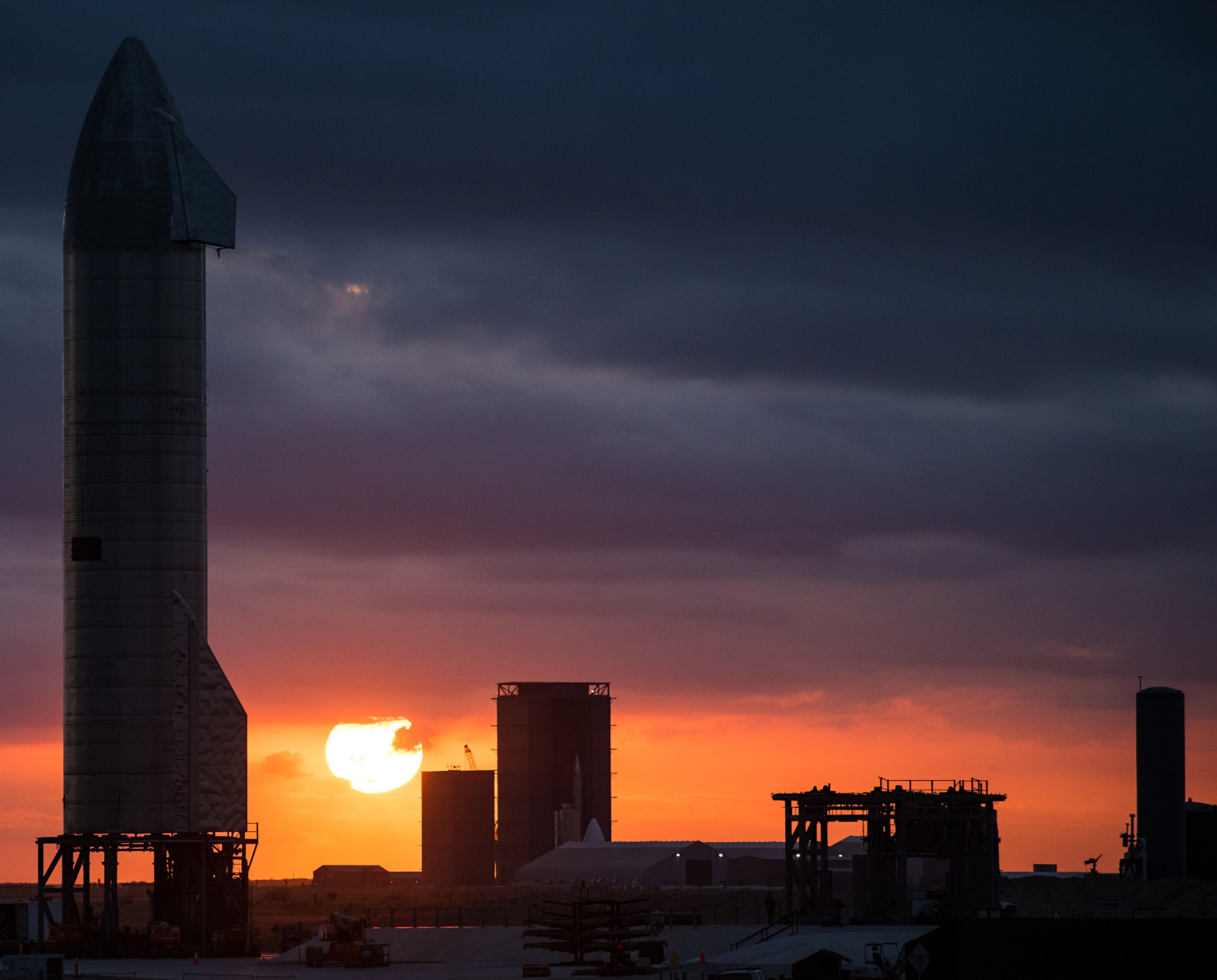
SN9, an early prototype of Starship

Because I posted just five days ago on Starship‘s planned integrated test flight (IFT-4), and because of how that flight went (stunningly successfully) , now might be a good time to look at the significance of Starship in general and this test flight in particular.

Why was Starship built?

Good question. I’m glad you asked! SpaceX is by far the foremost builder and operator of space launch vehicles. So far in 2024 they’ve launched 52% of all rockets worldwide, and their share is growing. No other American rocket company and no other nation comes close!

The rationale behind their Falcon 9 was to build a reusable rocket to reduce the cost of launches. And although only the first stage and the fairings proved to be recoverable, that is still far, far more economical than building new for every launch. Falcon Heavy increased the payload capacity by using three boosters together.

The next step is to build a fully reusable system that will reduce kilogram to orbit costs by another massive factor and will make it possible to send over 100 tonnes to any destination in the Solar System. A further goal is to use this new system to build a self-sufficient city on Mars of, perhaps, a million or more people. That’s why Starship is being developed.

Integrated Flight Test Four (IFT-4)

Well, what can I say? The purpose of this flight was to go beyond IFT-3 which was a successful launch, but both the Super Heavy booster and the Starship orbiter were lost on their return through the atmosphere.

What was so remarkable about IFT-4 is that both parts of Starship survived. Super Heavy made it back to a precise location over the Gulf of Mexico (close to the launch site), and Starship made it half way around the world and also succeeded in reaching the ocean surface at essentially zero velocity and then plunged into the water.

The loss of both parts of the system was intentional and the flight provided useful data for further improvements. In the case of Super Heavy it may be possible to recover it following IFT-5, the launch tower doubles up as a catch tower, to grab the returning booster in mid-air. Starship suffered a lot of thermal damage, parts of it even melting, but despite that it made a good approach for a catch attempt to be tried later in the test programme.

Further work on both vehicles should improve things. But knowing both are capable of recovery, at least in principle, opens the way for almost certain success in the long term.

What does that imply? This new space launch system may well be the means by which we really do make spaceflight far cheaper and colonise, not just Mars, but any part of the Solar System that we wish.

Yes. Of course. We are a long, long way from colonising other planets. But for the first time it seems we may have taken a step that will enable us to at least try at some point in the future.

Steps in the future

Let’s finish by setting out possible further developments with some guesses about the timescales.

  1. The next test flight, IFT-5, will probably come in late July. Any time between late June and late August seems possible, it’s really hard to say with any certainty.
  2. A Superheavy booster will be successfully caught, if not on IFT-5 then certainly before the end of 2024. Once success is achieved, by mid 2025 it might be completely routine to catch both boosters and Starship spacecraft.
  3. Some time in 2025 we should expect Starships to be reaching orbit with payloads (initially they will be Starlink 2 satellites).
  4. We will also see the beginning of a system of tanker Starships capable of refuelling cargo and passenger Starships to travel to the Moon and Mars. This is not going to remain science fiction for very much longer.
  5. Eventually the heat shield protection needed for Starship to return reliably to Earth will become safe enough that crewed flights can begin.
  6. We might see the Moon Landing version Starship HLS take astronauts to the surface and return them to lunar orbit, but that’s quite some time away, maybe 2030 or later.
  7. Automated Starship landers will carry equipment and supplies to the Moon and to Mars. At first they’ll remain on the surface as they will be a useful source of materials and potential habitats.
  8. People will follow as safety issues are resolved, permanent settlements will become possible in both places.
  9. Fifty years from now Starship and its successors will enable human exploration and settlement throughout the Solar System – on asteroids, moons of Jupiter and Mars, more or less anywhere will become possible.
See also:

Useful? Interesting?

If you enjoyed this or found it useful, please like, comment, and share below. My material is free to reuse (see conditions), but a coffee is always welcome!

The biggest Mach diamonds ever!

Together, all these engines produce 75.9 MN of thrust, much more than Saturn 5’s 34.5 MN.

The first question you might want answered as you read this title will be, ‘What on Earth is a ‘Mach diamond’?’ I’m glad you asked.

If you’re interested in rockets and spaceflight you may already know. Where there are rocket engines, there will be Mach diamonds (also known as ‘shock diamonds’). They are formed by the high velocity of the gases leaving a powerful jet or rocket engine. The shock waves created by this process interact with the ambient air around the nozzle, sculpting the exhaust into angled zones. When seen from the side, these appear as a repeated diamond pattern.

Mach diamonds from an F-16 on afterburner – Image from Wikimedia

The largest rocket ever built is SpaceX’s Super Heavy booster designed to lift Starship to a high altitude on the first part of its journey to orbital velocity. This booster is powered by 33 Raptor engines clustered closely together; they behave rather like a single engine with a 9 m diameter nozzle. When the rocket flew for the second time in 2023, giant Mach diamonds appeared, 9 m across and 6 m in length. These truly are the world’s biggest Mach diamonds ever – by a very considerable margin.

Super Heavy’s engines – SpaceX

This view shows all 33 Raptors firing shortly after liftoff on the 2nd flight test (IFT-2). Each engine bell has a diameter of 1.3 m and the rocket itself has a diameter of 9 m. Together, all these engines produce 75.9 MN of thrust, much more than Saturn 5’s 34.5 MN.

IFT-2 – BocaChicaGal

Here’s an image of the IFT-2 vehicle shortly after launch. The first Mach diamond is very sharply defined, subsequent diamonds less so as the exhaust plume slows, cools and becomes more ragged. Four can be clearly identified with some hints of a fifth and sixth.

So what is happening here? How are the diamonds generated?

Because a rocket engine is all about producing thrust, the velocity of the exhaust is paramount. Rocket engines are designed to maximise velocity and in doing so they minimise pressure. Inside the combustion chamber, pressures are extremely high; but the bell shape of a rocket nozzle expands the gases and directs them downwards. The pressure inside the exiting plume is much lower than the ambient air pressure. This pressure difference ‘squeezes’ the plume and prevents it spreading out sideways.

Higher in the atmosphere, air pressure is lower and the mach diamonds vanish; as atmospheric pressure drops away towards the vacuum of space, the exhaust plume spreads out sideways more and more because the exhaust gas is now at a higher pressure than the diminishing, surrounding air. Notice how the spacing of the diamonds decreases with distance from the rocket. This is because the exhaust velocity is falling off as the plume interacts and mixes with the air around it.

That’s the essence of the process in everyday language. Check the links below if you want more technical detail.

See also:

Starship launch attempt postponed

** LATEST ** – The next launch attempt is now scheduled for Thursday 20th April. Check the latest news at Spaceflight Now.

Monday’s planned test flight of the Super Heavy booster carrying Starship was called off due to a pressurisation issue caused by a failed valve. The booster’s ability to carry a significant load (like a fully fuelled Starship) depends on the fuel tanks being pressurised at all times. It’s the same process that makes drinks cans so strong despite being very thin walls. An empty can crumples whereas an unopened can is pressurised and is significantly stronger.

If the valve issue can be fixed on Tuesday, there might be a new launch attempt on Wednesday. Watch this space (no pun intended).

See also:

Starship’s first launch

Just a short post this time, to alert anyone who may not know… SpaceX is planning the first ever launch of Starship on an orbital flight tomorrow, Monday 17th April.

There are several places you can watch this attempt live on YouTube. I recommend three of them in particular. If you’re new to all this, try the SpaceX stream. If you’re more knowledgeable you might prefer one of the others.

  • Felix Schlang, a German who moved to Florida to be closer to the action
  • Marcus House, an Australian spaceflight enthusiast in Tasmania
  • SpaceX, the company’s official stream

I just wanted to get this alert out today. I’ll be back after the launch attempt with more thoughts. (More details about Super Heavy and Starship).

SpaceX’s Starship launch

For this first flight both parts of the vehicle will be lost after landing on the sea (but hopefully not before)

Elon Musk’s company, SpaceX, is close to the first launch of their new spacecraft – Starship. This is an exciting step forward in space flight technology as fully reusable Starship versions are planned to return NASA astronauts to the moon, act as orbital fuel tankers, take people and materials to destinations throughout the solar system, and colonise Mars.

The world’s most powerful rocket is likely to make its first orbital flight attempt during March. Whatever happens, the attempt will be spectacular in the extreme! With twice the thrust of NASA’s SLS rocket, SpaceX’s Super Heavy booster will attempt a launch from Starbase on the Texas coast, heading east. The Starship will separate and pass between Florida and Cuba.

Starship on the pad – Image from Wikimedia

The Super Heavy booster will attempt a landing on the surface of the sea, offshore of its launch point. When fully operational, SpaceX intends that Super Heavy boosters will return to the launch site to be caught in mid-air by arms on the launch tower. Starship will attempt a landing, also on the sea surface, north of Hawaii, but again, the intention is to eventually catch Starship at the launch site as well.

For this first flight both parts of the vehicle will be lost after landing on the sea (but hopefully not before). It’s likely they will attempt to hover above the sea surface to practice the manoeuvre they will need to perform for a catch. Once landing precision is good enough, SpaceX will attempt the first catches. But that’s something for future flights and will depend on data returned from this first attempt. You can’t put a note in your diary to watch the launch as we don’t yet know exactly when it will happen. But I’ll keep you posted here on JHM.

The previous step forward for Starship was a static fire by the Super Heavy booster on 9th February. This is worth watching in this video clip from NASA. Thirty-one of the booster’s thirty-three engines fired for the duration of the test, one was not ignited at all, and one shut down early. The engines fired at half thrust during the test, but for the first launch they’ll be run at 90% thrust.

See also:

The SpaceX website carries an introduction to the concept of the Starship system.

The launch is listed on Spaceflight Now’s Launch Schedule page and on Next Spaceflight’s SpaceX Launch Manifest page. You can check those sources for schedule updates as they become available.

Wikipedia has a good article about the Starship vehicle covering details of size, thrust, the development process, purpose, capabilities and so on.

For YouTube channels tracking Starship developments I highly recommend Everyday Astronaut, Marcus House, and What about it!?