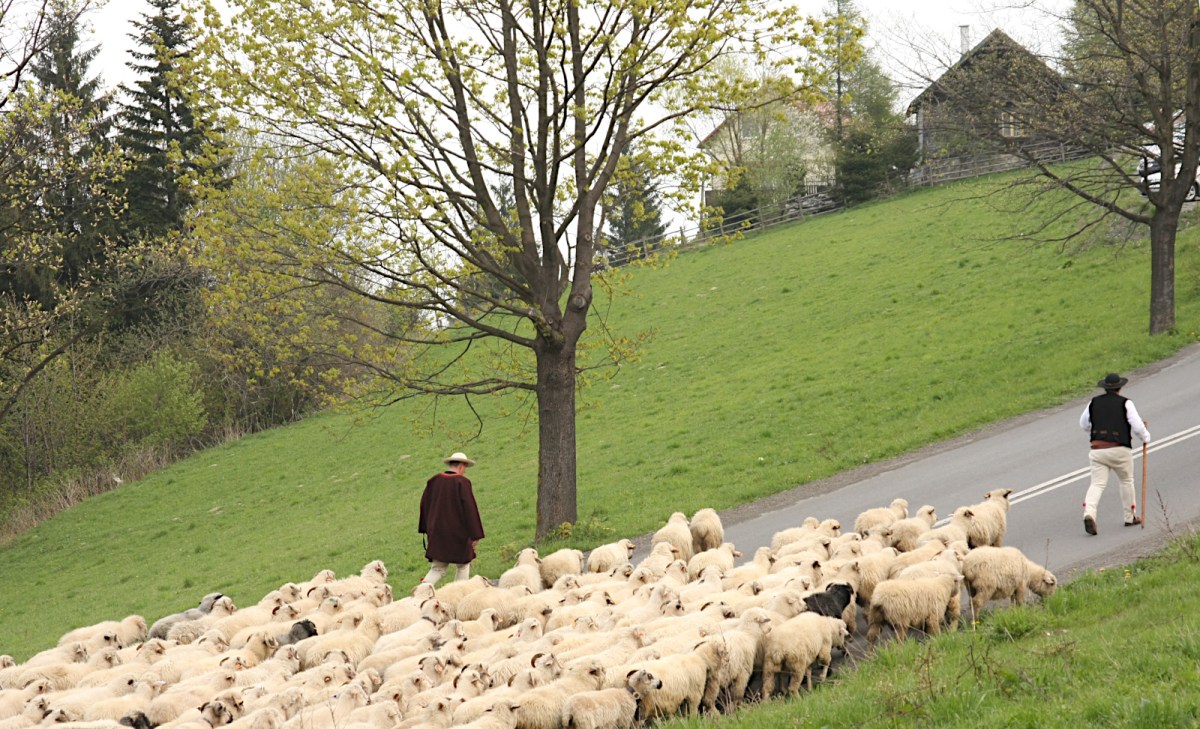
Shepherd and sheep (Wikimedia)
< Previous – Index – Next>

Continuing the flow of church life and growth, where evangelists have been at work there will be a gathering of people following Jesus to the best of their ability; some will be absolute beginners. There are bound to be some difficulties and rough edges: some may come off track, stop coming to meetings and drift away. There may be disagreements, even angry arguments. There will certainly be differences of opinion and misunderstandings; friction and differing perspectives. And there may be some who will say, ‘Don’t go that way, come this way, it’s a much easier path.’
Where there is someone with a strong shepherding gift, all of these issues will be addressed, usually in straightforward, kind and helpful ways. People will be encouraged to understand alternative points of view even though they may strongly disagree. Those who wander away will be visited, given an opportunity to explain difficulties, ask questions and be encouraged even if they decide not to return. The need to accept one another as beloved brothers and sisters will start to seem more important than having this or that position accepted. The body will work together better, there will be less confrontation and more building going on.
Although Paul’s greatest gifting may have been apostolic and he was strong also in the prophetic, you can see the shepherd in him as he shows concern for the Corinthians who were losing their way. And I can imagine James, speaking about the widows and orphans saying, ‘Hey, these people need your help and love too. You’re watching them suffer and doing nothing to show them you care about them.’ Shepherds are always alert and ready to intervene when there’s a need.
We’re at a strong disadvantage here in Britain, our agricultural history has shepherds but no tradition of leading sheep. Instead our custom is to round them up and drive them in the way we want them to go. We use sheepdogs to help us frighten the sheep into submission. Take a look at the photo in this article, the shepherd is in front and the sheep are following, that would not happen in the UK, or in France, the USA, Australia or New Zealand. The photo is from Poland where some shepherds work like the traditional pastoralists in Israel and Arab nations. When Paul writes about the gift of a shepherd he’s not thinking about rounding up or driving a herd of anxious and scared sheep with the help of a descendent of the wolf family! There may be difficult moments where someone with a shepherd gift has to act very firmly to protect someone else from continuing unkind, selfish or unthinking behaviour, but hopefully these will be rare exceptions.
Why follow?
So why do sheep follow a shepherd? It’s because the shepherd knows what the sheep need, and the sheep know that the shepherd knows what they need. What do sheep need? They need grass to eat, water to drink, and safety from predators. Sheep are far from stupid, they soon learn that the shepherd will take them to green pastures, streams of living (ie flowing) water, and if a predator comes close the shepherd will drive it away.
And that, my friends, pretty much describes the gift of Shepherd in the life of the church. If you are a gift of Shepherd in the church nobody will be afraid of you. They will know from experience that your habit is to lead them to places where they will be able to thrive and grow in peace and safety. Places where they will be fed truth and have access to the living water, and that every kind of predator will either be won over or chased off.
Do you have this gift?
Yes, as with apostle, prophet and evangelist, we all have this gift to some degree. You cannot be like Jesus without having some level of shepherd about you. Jesus is the origin and source of all the gifts we’re discussing in this series. If you believe him and follow him then Christ is in you. And if the perfect Shepherd is in you then you are going to reflect that at some level.
Psalm 23
This famous Psalm sums it up really well. If you have a well-developed and deep gift of shepherd you will be a living example of Psalm 23 in action. The psalm describes how you will make the people around you feel.
How the gift of shepherd has been misunderstood
In the 20th and 21st centuries the word ‘pastor’ has been used (or misused) to identify people who may (or may not) have a shepherding gift. Often it is used to mean something like a manager or director – as if church is a sort of business enterprise. A Pastor in this sense is heavily loaded with many duties. He is the person where the buck stops – financially and managerially. He (for it’s usually a man) is expected to fix every problem, and solve every issue. The Pastor may have a team under him, often described as elders, people he can delegate to, call on for help when needed, and share the responsibilities with. Neither the pastor nor the elders will necessarily be shepherds in the sense I’ve outlined in this article. Some of them might be, but much of their time and effort is likely to be spent on management tasks.
Meanwhile any true shepherds in the congregation may not be identified, and might struggle to fulfil the role Jesus has bestowed on them. It’s a double-bind, in which shepherds and those who need the care of a shepherd are both frustrated.
Check the Daily Meditations link below to see some of the thoughts of a shepherd’s heart. Next time, we’ll take a look at the gift of teacher, that will round off APEST for us:
Apostle
Prophet
Evangelist
Shepherd
Teacher
After thinking about the teaching gift, we’ll take a look at how all five APEST gifts can be seen in the nature and teaching of Jesus himself.
See also:
- Daily Meditations – Henri Nouwen Society
- Henri Nouwen – Wikipedia Henri Nouwen had a real shepherd’s heart
- Great Doddington – well and bike – Journeys of heart and mind
- Henri Nouwen Society – Website
- Rivers of living water – Journeys of heart and mind
< Previous – Index – Next>
You might also like:
Useful? Interesting?
If you enjoyed this or found it useful, please like, comment, and share below. (If you don’t see those links, click the article’s title above the main photo and they will appear.) Send a link to friends who might enjoy the article or benefit from it – Thanks! My material is free to reuse (see conditions), but a coffee is always welcome and encourages me to write more often! 

 (Photo from
  Journeys of Heart and Mind
_05.jpg)