Walking through the Corinium Museum is not just a walk through history; it is a pilgrimage into the very nature of human experience. These mosaics remind me that we are connected to the past not just by shared geography, but by shared themes of life, art, and the simple beauty of the world around us.
What’s in an image? Sometimes quite a lot, more than meets the eye. I’m posting an image every few days.
Walking in Cirencester
Orpheus
Almost every day, I walk over history in Cirencester. My feet tread on pavements, asphalt, and concrete, a modern tapestry built over layers of forgotten lives. But in Cirencester, the past isn’t merely buried beneath; it is visible to view, laid out in small, colourful cubes of stone or painted wall plaster. At the Corinium Museum, the mosaics of Roman Corinium offer more than just archaeological wonder; they invite a journey into the heart and mind of a world long gone.
Corinium
The Roman town of Corinium Dobunnorum was one of the most important settlements in Britain, second only to Londinium. This prosperity is captured in the magnificent mosaic floors that once adorned the villas and townhouses of its elite. As I stand before them, they cease to be mere objects of a museum. Instead, they become stories frozen in time, each tiny tessera a word in a sentence, each panel a vibrant, geometric chapter.
Sometimes we see things indirectly, and our brains are capable of retrieving far more information than you might at first think. It’s true of all our senses – hearing, touch, taste, smell and all the rest. The senses provide information but the brain makes much more of it all.
The hare
The hare
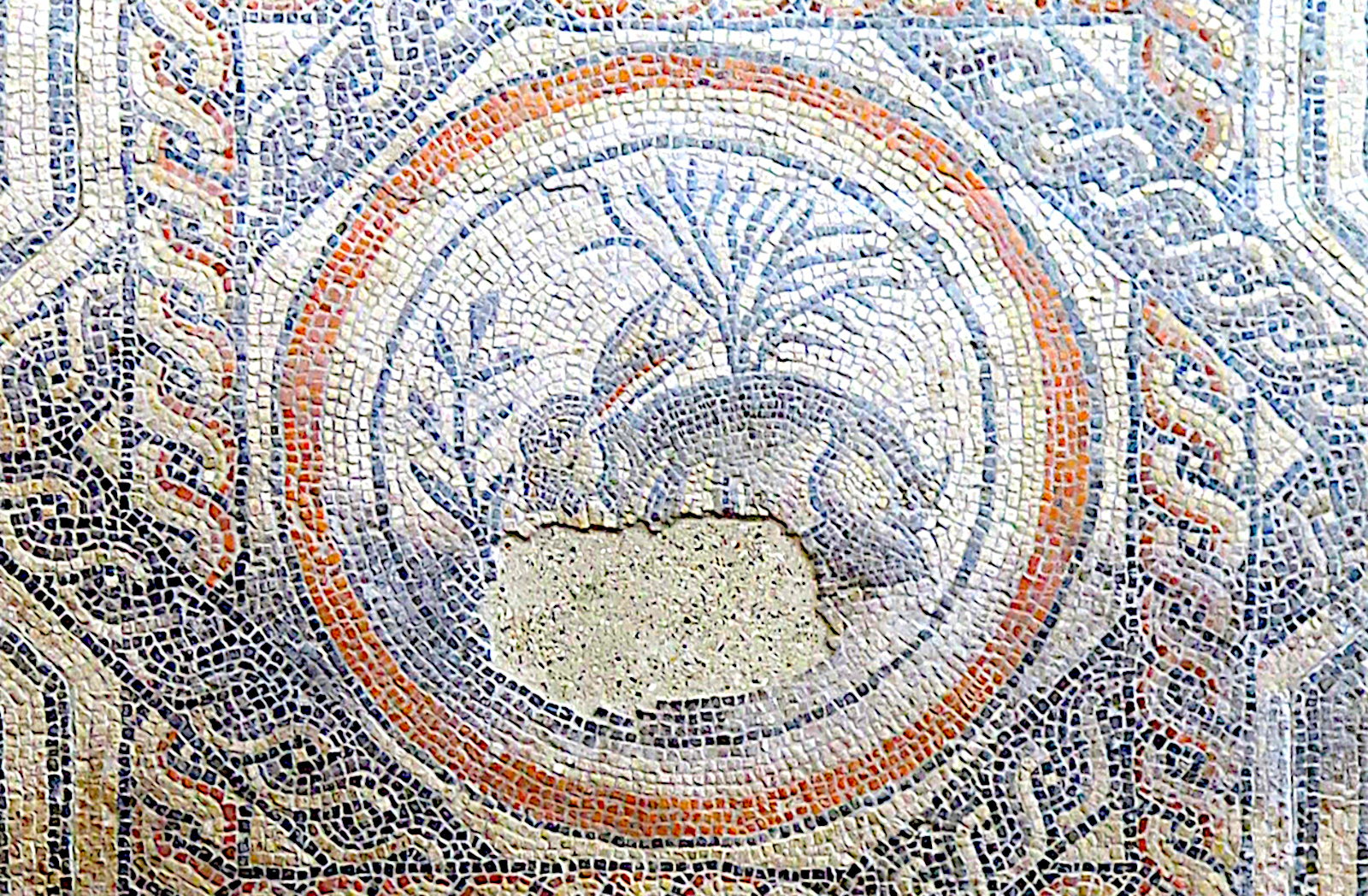
There is the famous Hare mosaic, found in Beeches Road and now a quiet emblem of our town. The artistry captivates the mind: a small hare caught in a moment of simple, vulnerable life, feeding amongst the foliage. When I look at it, I feel a curious resonance. We are so used to seeing animals in art as symbols of strength or the spoils of the hunt. Yet here is a humble creature, a snapshot of everyday nature from the fourth century. It reminds me that even in a grand Roman villa, the small, quiet moments of life were still observed and valued. It’s a message that travels two millennia, from one human heart to another.
The seasons
The Seasons mosaic presents another journey entirely. Here, Greek myth and a Roman love of the seasons mingle in intricate detail. But what strikes me is the continuity of it all. The cycle of winter pruning, spring planting, summer harvesting, and autumn gathering was as central to life then as the changing seasons are to us today. The mosaic is a reminder that some rhythms of existence are eternal, transcending the rise and fall of empires. It connects us to a shared human experience of time, of labour, and of nature’s relentless, beautiful cycle.
Orpheus
Perhaps the most poignant is the Orpheus mosaic (image at the top of the article), which once decorated a grand house just outside the town. In the centre, Orpheus charms wild animals with his music. This isn’t a scene of violent conquest, but of tranquil harmony, of nature tamed by art. In our own divided and turbulent world, the image speaks to a timeless desire for unity and peace. The mosaic suggests that art has the power to bring disparate parts of the world together, if only for a moment.
Walking through the Corinium Museum is not just a walk through history; it is a pilgrimage into the very nature of human experience. These mosaics remind me that we are connected to the past not just by shared geography, but by shared themes of life, art, and the simple beauty of the world around us. And as I step back out onto the modern pavement of Cirencester, I can imagine the ancient tesserae still underfoot, a solid reminder of the stories that lie beneath.
I didn’t write this article
OK, it’s confession time. I asked Google’s AI to write this article for me. I’ve made a few minor tweaks and edits, but that’s all. The prompt I provided wasn’t complex either. Here it is:
Write an article for ‘Journeys of Heart and Mind’ on Corinium mosaics. Follow the style and structure of existing articles.
Those twenty words resulted in this article. All you need to do is visit gemini.google.com and write a request like that, and the AI will write an answer for you. You don’t have to install anything or pay for anything, just type the request and press ‘Enter’. Give it a try! Type in ‘Write ten verses in the style of Wordsworth about laptops’ and see what comes out.
In some ways I think the AI did a better job than I would have done, but if I’d written it, it would have been me – and this isn’t! Where AI can help is to do some of the necessary research and perhaps create a first draft. But beyond that, my advice is to keep it human.
If you enjoyed this or found it useful, please like, comment, and share below. (If you don’t see those links, click the article’s title above the main photo and they will appear.) Send a link to friends who might enjoy the article or benefit from it – Thanks! My material is free to reuse (see conditions), but a coffee is always welcome and encourages me to write more often!
Notes from bygone years – October (Noctober after dark?). Hint: Click on the thumbnails for larger images.
October 2023 (1 year before publishing this article)
Text from a Herculaneum scroll
An exciting scientific paper published in the journal Nature described how X-ray data and clever data manipulation had made it possible to recover small scraps of text from scrolls lost when Vesuvius erupted in October 79 CE. Hope was expressed that it might become possible to recover much larger sections of text, or even whole scrolls.
Our cat, Erin, was not feeling well; due to a tumour she was not eating very well and often threw up afterwards. She was losing weight quickly as a result. The vet suggested a steroid injection to see if it would help her cope better, but it would clearly be only temporary relief. It seemed well worth a try and during the second half of the month she seemed very much her old self again.
We visited Westonbirt Arboretum on 23rd October to enjoy the autumn colours, and Donna’s Uncle Ken died on 26th after a long illness.
I began intermittent fasting, only eating between 11:00 and 21:00, as part of a Zoe trial. I’ve changed the timing slightly, but I’m still following the principle two years later.
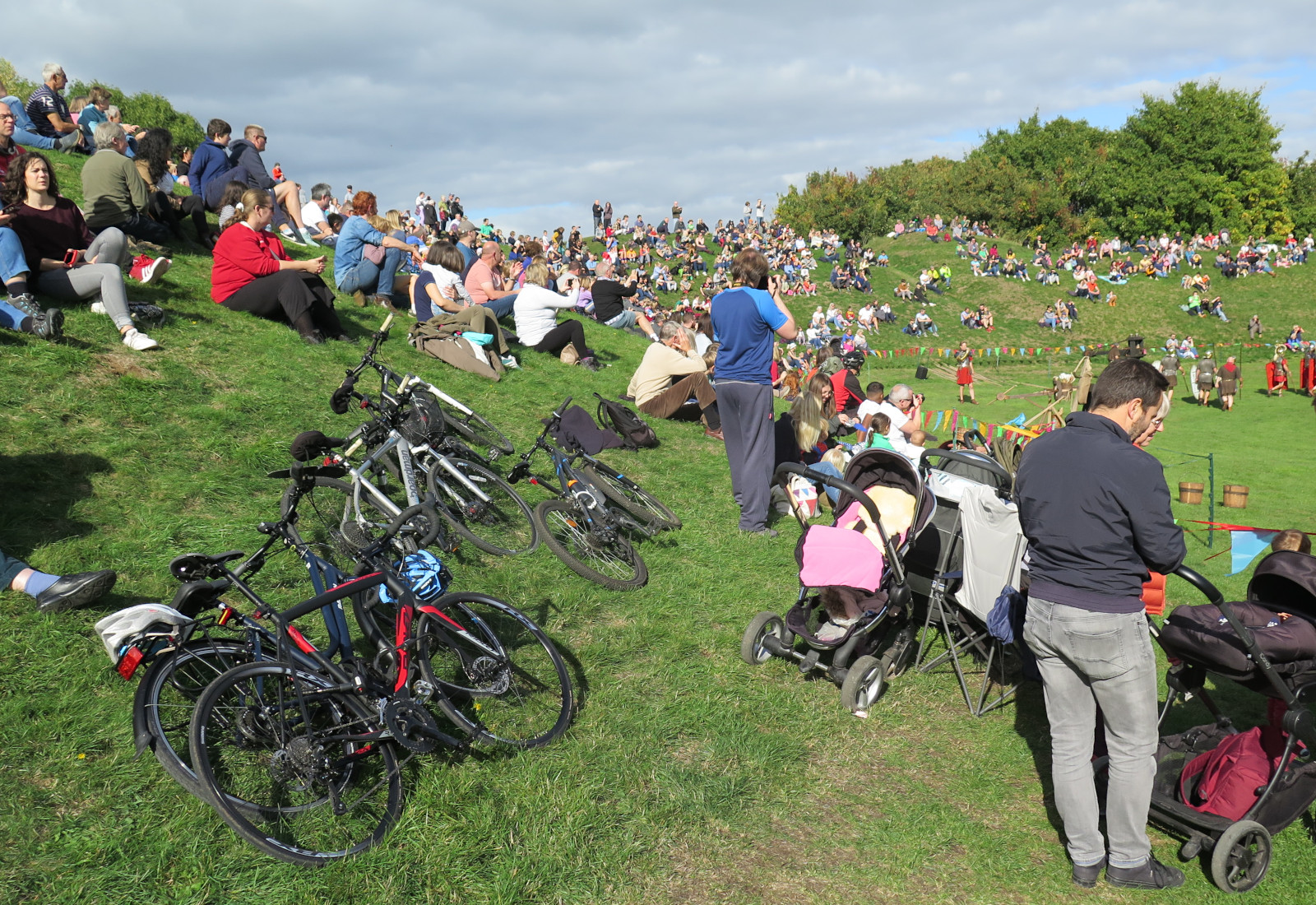
There was a Roman Army historical display in the old amphitheatre on 2nd October, it was great fun to watch the events going on and look at the Roman equipment. They fired a melon from a ballista and it sailed right out of the arena. Seeing a crowd at the amphitheatre gave me a sense of scale and made the place look much larger. The crowd in the photo is using about a third of the seating space.
On Mondays I enjoyed meeting my friend Stephen for a walk, a coffee, and a chat.
I spent some time working out the route of the old canal through the built-up parts of Cirencester, it was an interesting exercise, poring over old maps.
We were also helping Donna’s Mum and Dad quite a lot, I get on well with Tony; we’ve always enjoyed chatting and he seems to trust me. He was mostly wheelchair-bound at this time as his Parkinson’s progressed, but on a good day he could still do quite a lot for himself.
On 19th I joined the People’s Vote march in London, quite an experience!
My friends Jim and Pam ran a church Mums and Tots group (Puddles) in St Neots. Jim ask me to take a set of photos of each mum with their child for official use by the group, here’s a more general shot that I included for them.
I was meeting frequently with different people, there was the Open Door small group once a week, coffee shop meetings with some friends in town, meetings with my friends Jim, Sean and Kevin rotating around our three homes. It was all good and seemed useful, but three such different groups!
Donna’s Mum and Dad came to stay for a weekend in the middle of the month and we drove over to Olney for a walk and then to Stoke Bruerne to look at the canal and the ladder of locks. There were some great autumn colours on the day. The photo shows Isobel, Tony and Donna on a bridge.
At the end of the month we visited Cirencester to visit my Mum and Dad, and while we were there we popped over to Westonbirt Arboretum to look at the autumn colours. There’s always a wonderful display there, and the trees were more or less at their best.
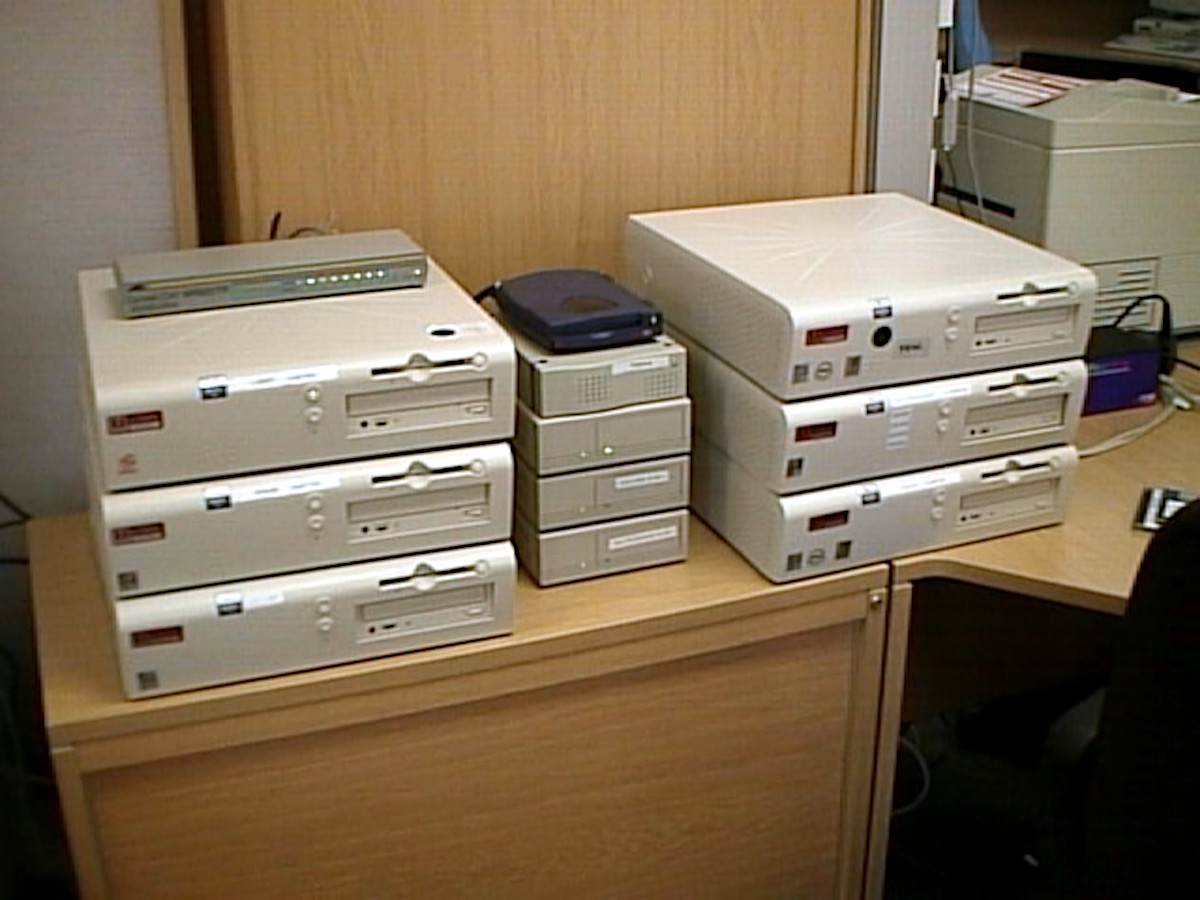
These are the web development servers in the open plan office where I worked as part of the Web Team. Today these would all be virtual servers hosted at a data centre elsewhere in the company. It was very useful to have multiple copies of each website, one for the developers to work on, another for testing purposes, and a third for the live service.
Things seemed to go from bad to worse with Judy’s colon cancer. In October (I think) she began the first of three courses of chemotherapy (5-fluorouracil) to shrink the metastases and slow them down. This was expected to give her at least a couple of extra years of healthy life. But after starting the first course she became quite unwell and the doctors discovered that she lacked an enzyme that normally enables the body to dispose of the drug. She had to spend some weeks in hospital, quite dangerously ill for some of them.
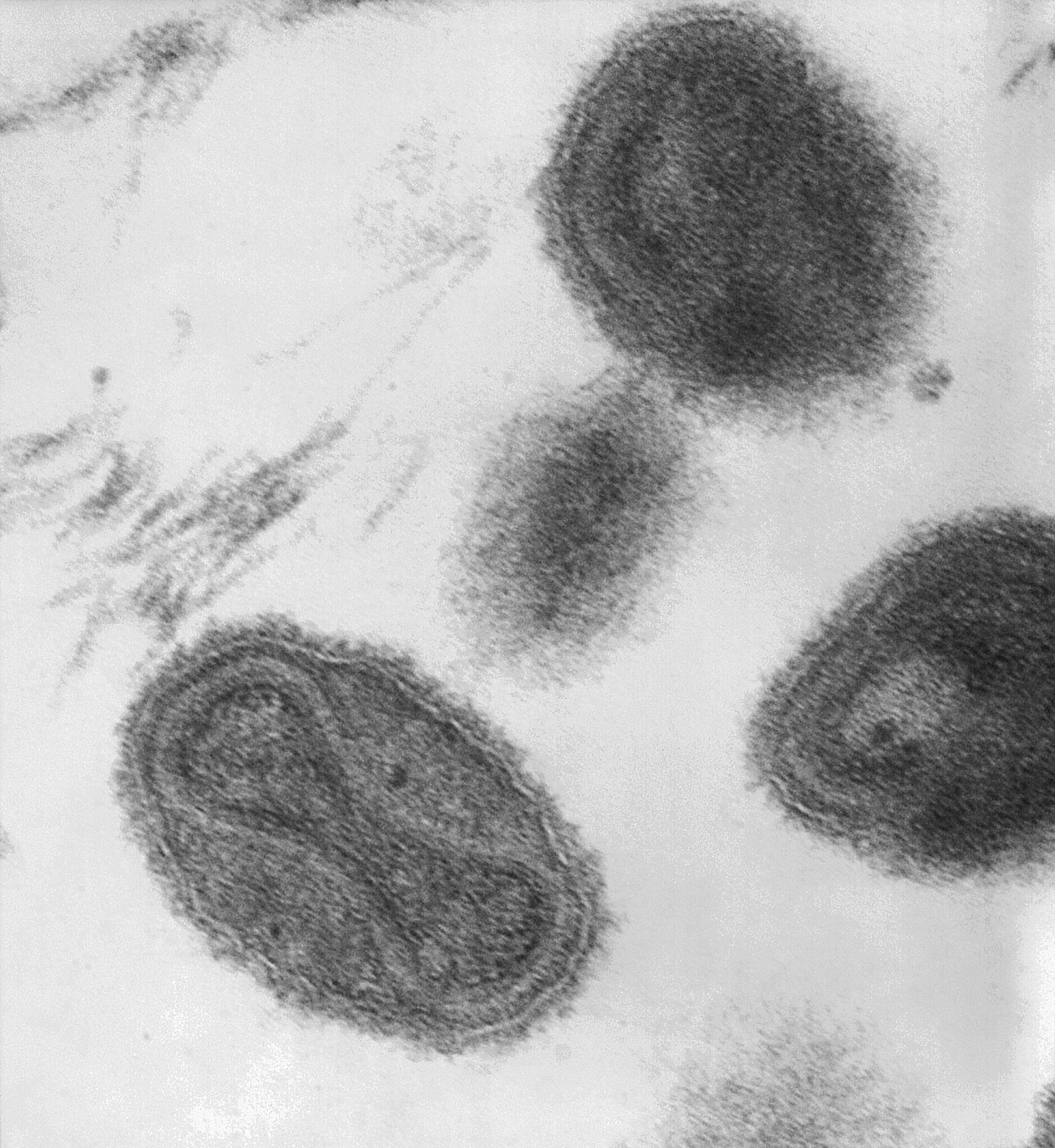
I had been working in Long Ashton’s Electron Microscopy Lab, helping to manage the instruments and operating the Scanning Electron Microscope (SEM) for staff unable to do the work themselves. But with a further reshuffle at work I’d been moved to the Computing Section and was now working on MS-DOS and developing the environment that became the LARS System.
The Good News Crusade came to Portishead and a number of us from Yatton and Claverham were involved. There were several days of the Crusade itself, and then we (and others) arranged some post-Crusade meetings as well.
Mum and Dad had a late touring holiday along the Devon and Cornwall coast. Dad took several 35 mm transparency films of that holiday.
We were living in our flat at 20 Belmont Road, and I already had a Scottish Widows life assurance policy as a first step towards securing a mortgage. We were still not well-placed despite having quite a lot of available reserves in our joint bank savings account.
I was back in Bath University and the fourth year was underway with the final exams looming after Easter. Judy’s position was similar, back at Aber (Aberystwyth) for her third and final year. She took the photo from a ground floor window in Alexandra Hall on the Aber seafront as the sun was setting.
The autumn term meant the start of my time in the Lower Sixth at Cirencester Grammar School. During half-term a friend and I dug a hole in the Lower Garden just east of the footpath behind Churnside (37 Victoria Road). We found some Roman stonework, small pieces of burnt clay, pieces of a broken amphora rim, and a small piece of Samian ware with a failed repair, also a piece of tegula (roof tile). We had no idea this was a bad thing to do!
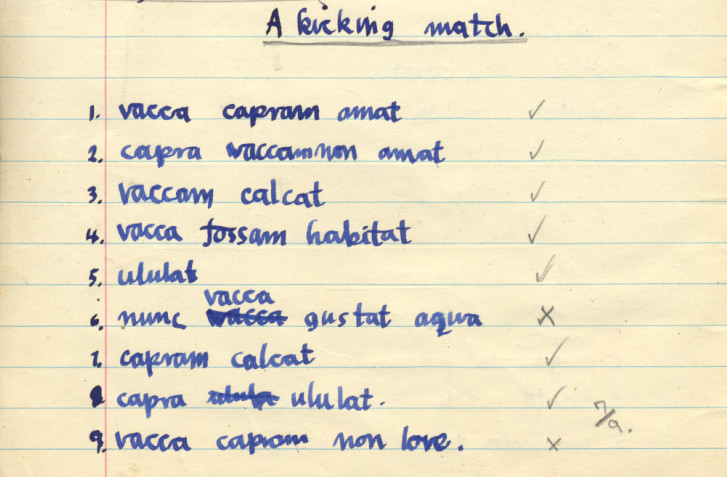
I was in my first term at Cirencester Grammar School. Amongst other subjects I had to learn some Latin, it wasn’t my favourite subject at the time. The image shows a Latin exercise in which I managed to get seven correct answers out of nine. I think my favourite subjects were maths, geography and chemistry.
World events:Luna 3 returned the first images of the far side of the Moon; and Astérix the Gaul first appeared in a French comic.
Cindy turned three and I was in my second year at Querns School; we were living on the Beeches Estate in Cirencester. 17 Queen Anne’s Road was a three-bedroom semi so I had my own room. Mum and Dad’s room had a special feature, a wall-mounted electric fire with two switches. I never saw this heater in use, but there was also a two bar plug-in electric fire that was used downstairs on very cold days in the winter.
I was 1¼-years-old, and life went on well enough as far as I’m aware. We were living in my grandparents house in Victoria Road, Cirencester and Dad was busy working on the nurseries, part of the old family business founded in 1795.
As October passed and Mum and Dad spent more time together, they became what today we would call ‘an item’. His brother Bob, an army officer and 15 years older than Dad, was married to Betty from the town of Dungannon 13 miles south of Coagh. Dad visited them from time to time, but spent much of his off-duty time with Lilias and her family.
World events: The first German Me 262 jet fighter was shot down; and Warsaw was destroyed by the occupying German forces.
If you enjoyed this or found it useful, please like, comment, and share below. (If you don’t see those links, click the article’s title above the main photo and they will appear.) Send a link to friends who might enjoy the article or benefit from it – Thanks! My material is free to reuse (see conditions), but a coffee is always welcome and encourages me to write more often!
My name is Patricius, I’m a sinner, a simple country person, and the least of all believers; I am looked down upon by many. My father was Calpornius, a deacon.
Patrick, or Saint Patrick as we normally think of him, had an interesting background and history. Of course, we know very little about him, but far more than we know about most other people who lived at that time.
What does the name, Patrick, mean? It comes from the Latin patricius, meaning “nobleman”, “of noble origin” or “patrician”. Patricians were the noble families in ancient Rome, a ruling class, and Patrick can be viewed as a Roman or perhaps a Romanised Briton. By 409 CE when all remaining Roman forces in Britannia were recalled to protect the Western empire against uncontrolled immigration across the Rhine, the distinction between Roman and Romano-Briton had pretty much vanished. Archaeological evidence makes it clear that Roman life continued well after the troops left, particularly in the west of Britain.
Patrick’s life
Patrick’s family lived in Roman style somewhere near the west coast in what is now northern England or southern Scotland (also possibly Wales). They would have been little affected by Angle and Saxon incursions into the far eastern regions of the British Isles, but raids from Ireland and northern Scotland were sometimes a problem. Farming life and indeed villa life and Roman town life would have carried on; no longer governed by the empire, but governed locally like a Roman province. Patrick was born around the time the Roman forces departed.
When he was sixteen he was captured by Irish pirates raiding the area where his parents lived. And he was sold in Ireland as a slave and had a hard life, outside in all weathers, herding sheep or pigs. He had been exposed to Christian ways as a child but had not believed in Jesus or made any attempt to follow him, but during his time in captivity he developed a faith. Spending times of great hardship as a herdsman slave, and living in the open air in all seasons, he must often have been wet and very cold. But spiritually it was a time of great growth and depth for him. He prayed incessantly and felt very close to his heavenly Father.
He made a dash for freedom when the opportunity arose, hearing a voice in his sleep telling him that a ship was waiting to return him home. He was recaptured, but escaped again and made it home successfully.
Later, sensing that his responsibility was to return to Ireland to share his faith with the pagan people there, he travelled back and began to share everything he knew of Jesus. People listened to what he told them and he started many local communities of believers. Later again, Patrick travelled back to northern Britain and spread his teaching about Jesus to the Irish and Welsh speaking Britons and also to the Saxons in the areas he visited. The Celtic church in Ireland and in Great Britain spread far and wide, even back into northern Europe. Celtic Christian monks journeyed singly or in small groups, spreading the good news and founding further communities and groups of believers.
His writings
At some point in his later life, Patrick authored books and letters, two have survived, and one of these is autobiographical in nature, telling the story of who he was and the events of his life. And that book (The Confessio) is why we know as much as we do about Patrick and the world he lived in. Here are his opening words:
My name is Patrick. I am a sinner, a simple country person, and the least of all believers. I am looked down upon by many. My father was Calpornius. He was a deacon; his father was Potitus, a priest, who lived at Bannavem Taburniae. His home was near there, and that is where I was taken prisoner. I was about sixteen at the time. At that time, I did not know the true God. I was taken into captivity in Ireland, along with thousands of others. We deserved this, because we had gone away from God, and did not keep his commandments. We would not listen to our priests, who advised us about how we could be saved. The Lord brought his strong anger upon us, and scattered us among many nations even to the ends of the earth. It was among foreigners that it was seen how little I was.
If you enjoyed this or found it useful, please like, comment, and share below. (If you don’t see those links, click the article’s title above the main photo and they will appear.) Send a link to friends who might enjoy the article or benefit from it – Thanks! My material is free to reuse (see conditions), but a coffee is always welcome and encourages me to write more often!
What’s in an image? Sometimes quite a lot, more than meets the eye.
I’m posting an image every day (or as often as I can). A photo, an image from the internet, a diagram or a map. Whatever takes my fancy.
So, what’s cooking?
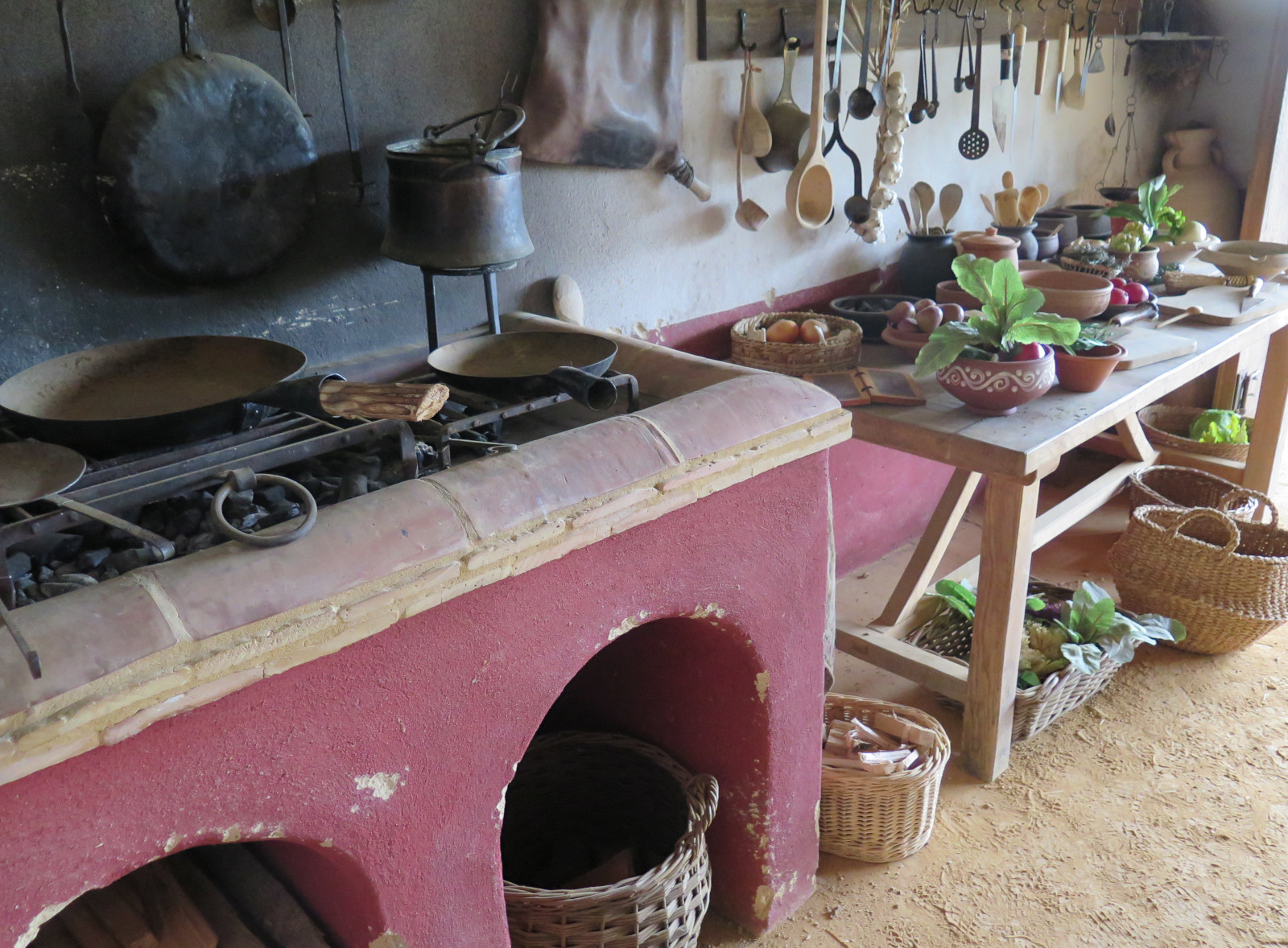
We’ve seen the dining room with its couches and cushions, ideal for reclining when the meal arrives. But how were meals prepared? In the kitchen, of course! In this photo we see the reconstruction of a villa kitchen where the cook (a slave or a hired servant) would do the work required to serve up a suitable meal for the family, and often no doubt for house guests as well.
Clearly, a Roman kitchen couldn’t boast the modern conveniences we all expect today, but think in terms of the people who lived in Britain before and after the Roman period. Iron age people usually lived in round houses with a hearth in the centre. That was it! There might have been a tripod where a cauldron could be hung over the fire or it could be placed on the hearth stones. And Saxon homes were quite similar; they were rectangular rather than circular but there was no dedicated kitchen for preparing food. In this Roman kitchen there are iron racks to keep the pans away from the fire below while letting the heat through. And notice the very practical handle; wooden handles would have scorched and been too hot to hold, so a short piece of wood was used as a temporary handle – genius!
The Roman kitchen looks familiar to us because it’s a separate space in a well-designed and well-built home. There is a cooking fire raised to a useful working height, rows of hooks for tidy storage of equipment, containers of various kinds and sizes, even a wax tablet, perhaps with recipe details or a list of requirements. There was a walk-in larder, not seen in this image, and an oven for baking bread.
Images of the Roman villa
For convenience, here’s a list of all the Roman villa images:
If you enjoyed this or found it useful, please like, comment, and share below. (If you don’t see those links, click the article’s title above the main photo and they will appear.) Send a link to friends who might enjoy the article or benefit from it – Thanks! My material is free to reuse (see conditions), but a coffee is always welcome and encourages me to write more often!
What’s in an image? Sometimes quite a lot, more than meets the eye.
I’m posting an image every day (or as often as I can). A photo, an image from the internet, a diagram or a map. Whatever takes my fancy.
An impressive ceiling
Roman ceilings ranged from plain and simple to very impressive. We’re still in the villa’s office here, a room that was required to impress, so the ceiling is moulded with recessed squares and richly decorated. Anyone visiting the Master in his office would know right away that this was a person of some privilege and power, a person not to be messed with.
Fashions come and fashions go. As in the Victorian era, Roman interior design might seem fussy to 21st century minds. We value simplicity and our ceilings are usually white and without decoration. If you could invite a Roman to visit your home today, they would assume you were either weird, or lacking the money to have your ceiling improved. They would also have found walls in plain colours baffling – again a sign of poverty. They would no doubt have been hugely impressed by your ability to conjure up music or a disembodied voice at will, and your TV would have spooked them. Your decor would have been disappointing in the extreme.
Images of the Roman villa
For convenience, here’s a list of all the Roman villa images:
If you enjoyed this or found it useful, please like, comment, and share below. (If you don’t see those links, click the article’s title above the main photo and they will appear.) Send a link to friends who might enjoy the article or benefit from it – Thanks! My material is free to reuse (see conditions), but a coffee is always welcome and encourages me to write more often!
What’s in an image? Sometimes quite a lot, more than meets the eye.
I’m posting an image every day (or as often as I can). A photo, an image from the internet, a diagram or a map. Whatever takes my fancy.
Roman office desk
After yesterday’s photo of the office, I thought you might like a closer look at the items on the desk. You can see various scrolls as well as a wax tablet in the middle at the front. The tablet would be used for making notes with a pointed stylus and could be erased with the flattened upper end of the same stylus – very convenient. This tablet is hinged so four writing surfaces are available.
The dark rectangle on the sheet of papyrus is a miniature abacus, a sort of pocket calculator! The papyrus itself has a plan of the property on it. Notice also the glass on the left and the glass decanter on the right (glass was fearfully expensive and therefore an extreme luxury item), several pottery vessels (one containing writing styli), two candlesticks for working after dark, and even some snacks. There’s a bowl of walnuts and another one containing ripe cherries.
Paperwork was just as much of a chore no doubt then as now. Despite the fact that paper had not yet been invented!
Images of the Roman villa
For convenience, here’s a list of all the Roman villa images:
If you enjoyed this or found it useful, please like, comment, and share below. (If you don’t see those links, click the article’s title above the main photo and they will appear.) Send a link to friends who might enjoy the article or benefit from it – Thanks! My material is free to reuse (see conditions), but a coffee is always welcome and encourages me to write more often!
What’s in an image? Sometimes quite a lot, more than meets the eye.
I’m posting an image every day (or as often as I can). A photo, an image from the internet, a diagram or a map. Whatever takes my fancy.
The Master’s office
The villa was a place where the master of the house continued his business while away from the cities. He would have had a small office for working on documents and meeting visiting colleagues and officials; he would also use the office when dealing with estate staff concerning the farming work.
Notice the fairly cluttered desk, the comfortable working chair, and two seats across the desk for visitors. There are cupboards for storage, and even a waste bin. We’ll take a closer look at what’s on the desk in the next Image of the day.
In some ways, Roman life would have seemed quite familiar to us, at least the life led by people of reasonable means. In Saxon and medieval times it’s almost as if the calendar has been turned back, not forwards!
Images of the Roman villa
For convenience, here’s a list of all the Roman villa images:
If you enjoyed this or found it useful, please like, comment, and share below. (If you don’t see those links, click the article’s title above the main photo and they will appear.) Send a link to friends who might enjoy the article or benefit from it – Thanks! My material is free to reuse (see conditions), but a coffee is always welcome and encourages me to write more often!
What’s in an image? Sometimes quite a lot, more than meets the eye.
I’m posting an image every day (or as often as I can). A photo, an image from the internet, a diagram or a map. Whatever takes my fancy.
The Roman villa in its surroundings
Here’s another view of the villa, you can see one of the farm outbuildings on the left, and a newly planted vineyard in front of the villa. An access road of pounded stone passes this side of a wooden fence, note the avenue of young trees growing on both sides of this road.
It looks very much the way the original villa would have done in Roman times. Two things really give the game away, though. The young vines have modern protection tubes around them to prevent animal damage (these will be removed onece the vines are three or four years old). And the pattern of modern agriculture in the background is entirely wrong. Roman fields would have been much, much smaller and would not have extended far from the villa. Instead, the more distant parts of this view would have been much more heavily wooded.
Today’s conservationists would love to see parts of our landscape return to the way it was in Roman times. A lot of mature forest was cut down during the days of the British Empire to supply timber for the Royal Navy’s ships, as well as for fuel and the growth of towns and cities. The ancient forests that were lost would have supported populations of wild boar, wolves would have roamed the forests too and would have kept the deer population density lower than it is today. This in turn would have made it more likely that tree and wild flower seeds would have survived and spread more abundantly.
Beavers would have created localised ponds and small lakes that would have naturally regulated water flow, and the natural vegetation would have trapped heavy rainfall and released if gradually, reducing flooding. Almost all the British landscape today is far from it’s natural climax state.
So the view beyond the villa would have been altogether different from the modern landscape in the photo.
Images of the Roman villa
For convenience, here’s a list of all the Roman villa images:
If you enjoyed this or found it useful, please like, comment, and share below. (If you don’t see those links, click the article’s title above the main photo and they will appear.) Send a link to friends who might enjoy the article or benefit from it – Thanks! My material is free to reuse (see conditions), but a coffee is always welcome and encourages me to write more often!
It would have been a delight to walk on a floor of this sort, especially with the underfloor heating that wealthy Romans had in their villas and town houses.
What’s in an image? Sometimes quite a lot, more than meets the eye.
I’m posting an image every day (or as often as I can). A photo, an image from the internet, a diagram or a map. Whatever takes my fancy.
A new mosaic floor
Although most of us will have seen Roman tessellated pavements in museums or at excavation sites, few people will have seen a recently laid floor of this kind. What did a new mosaic floor look like? It looked like this one at The Newt in Somerset!
It would have been a delight to walk on a floor of this sort, especially with the underfloor heating that wealthy Romans had in their villas and town houses. Cool in hot weather, but luxuriously warm in a British winter when the furnace outside had been lit and was being tended by a slave or servant, a warm floor was a wonderful thing indeed.
In the upper left, you will notice some musical instruments placed on stools, when the musicians return in a moment they’ll pick up the instruments, sit on the stools, and begin playing. And then the Master and his dinner guests will arrive to enjoy music until they go through to the triclinium for the meal to be served.
Images of the Roman villa
For convenience, here’s a list of all the Roman villa images:
If you enjoyed this or found it useful, please like, comment, and share below. (If you don’t see those links, click the article’s title above the main photo and they will appear.) Send a link to friends who might enjoy the article or benefit from it – Thanks! My material is free to reuse (see conditions), but a coffee is always welcome and encourages me to write more often!
What’s in an image? Sometimes quite a lot, more than meets the eye.
I’m posting an image every day (or as often as I can). A photo, an image from the internet, a diagram or a map. Whatever takes my fancy.
A juvenile robin
This young robin perched on the back of a chair at our table in the cafe of the Great Glasshouse. Clearly hoping for some dropped particles of food, but disappointed as we only had coffees at the time.
Is it good to feed wild birds? Sometimes this is a no-brainer. In the short, cold days of winter when food may be hard to come by, a bowl of tepid water and some fruit, seeds, fat balls or dried insect larvae may be just the thing they need to avoid dehydration, starvation or hypothermia. But when natural food supplies are plentiful, it may be better to let them find their own. Here’s some good advice from the RSPB.
If you enjoyed this or found it useful, please like, comment, and share below. (If you don’t see those links, click the article’s title above the main photo and they will appear.) Send a link to friends who might enjoy the article or benefit from it – Thanks! My material is free to reuse (see conditions), but a coffee is always welcome and encourages me to write more often!















 Journeys of Heart and Mind


