Blast from the past… 35
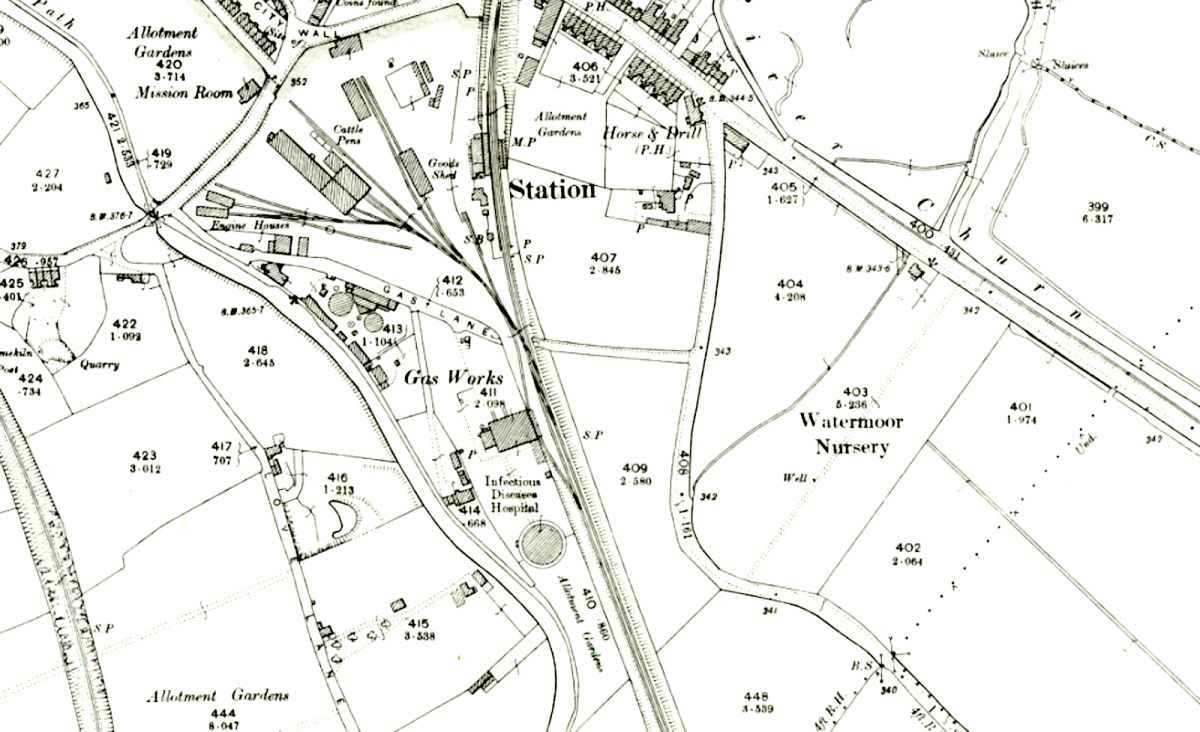
Watermoor Nursery – National Library of Scotland
Jump to October 1940
< Previous | Index | Next >
July 2025 (3 months before publishing this article)

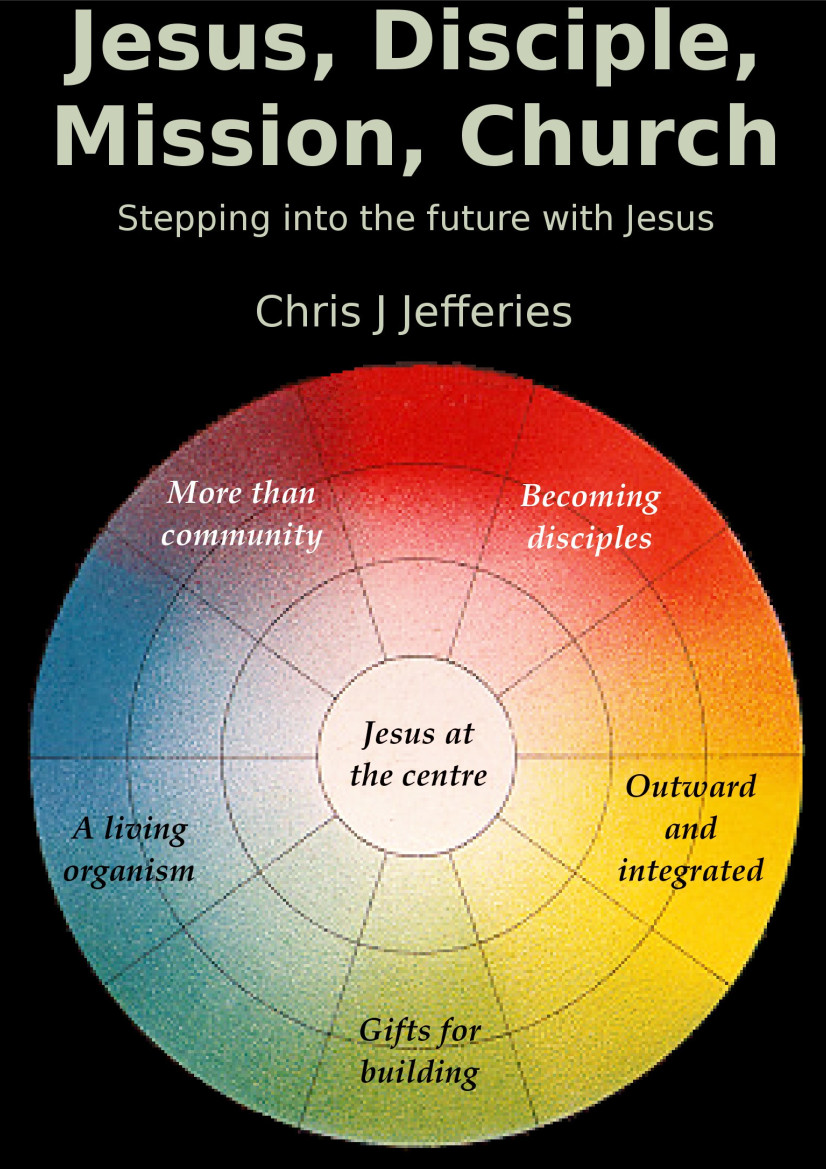
I was invited to share some material from my short book ‘Jesus, Disciple, Misson, Church’ (JDMC) with the Small Group I meet with on Tuesday evenings. This is a discussion group belonging to Cirencester Baptist Church (CBC). On 1st July we worked through the first two sections of the introduction, ‘Working together in six ways’. And the following week we worked through the third and fourth parts. Everyone seemed to think this was a useful exercise and I found it most encouraging.
Most weeks, Donna and I visited our neighbour, George, in Dursley Hospital. We also took Donna’s Mum, Isobel, for a four-day break at a Warners Hotel near Hereford (Holme Lacy House Hotel). And we bought a second-hand electric car which we’re calling ‘Erik’. All our cars get a name, and because this one is a Nissan Leaf the connection is ‘Leif Erikson‘.

We went for a walk along the Thames near Lechlade, starting from Buscot Weir. It was a pleasant stroll on a really nice day. Not an adventure or a long walk, but a lovely ramble. The river meanders a lot here, and so does the footpath as it stays close to the river all the way.
JHM: I wrote on the apostolic gift; and an old house in Cirencester. World events: Israeli aircraft struck the Presidential Palace and the General Staff headquarters in Syria; and a strong earthquake off the coast of Kamchatka, triggered tsunami warnings in Japan and Hawaii.
April 2025 (6 months before publishing)

One day, walking into Cirencester along the busy Gloucester Road, we spotted this cinnabar moth having a rest on the footpath. It had no idea how much danger it was in. We might easily have stepped on it, so we moved it on and it fluttered around and settled on a nearby lime tree where it would be safe.
This was the moth’s second danger recently. It seems to have brushed against a spider’s web. The grey mass behind its head looks like tangled, sticky spider silk, so perhaps two lucky escapes in one day.

We took Donna’s Mum out for coffee and a light meal at The Old Prison at Northleach. And we met Paul and Vanessa at Frampton on Severn for a circular walk. Their two black Labradors, Marple and Maizi are too old to join in these days, but they’re OK to be left sleeping at home for a few hours.
And at the end of the month we took Isobel to a hospital appointment in Gloucester and while she was waiting Donna and I visited Gloucester Docks nearby.
JHM: I wrote about parking on a slope; and dinosaurs and the Bible. World events: Fram2 became the first crewed spaceflight in polar orbit; and Donald Trump applied widespread tariffs on imports to the USA.
October 2024 (1 year before)
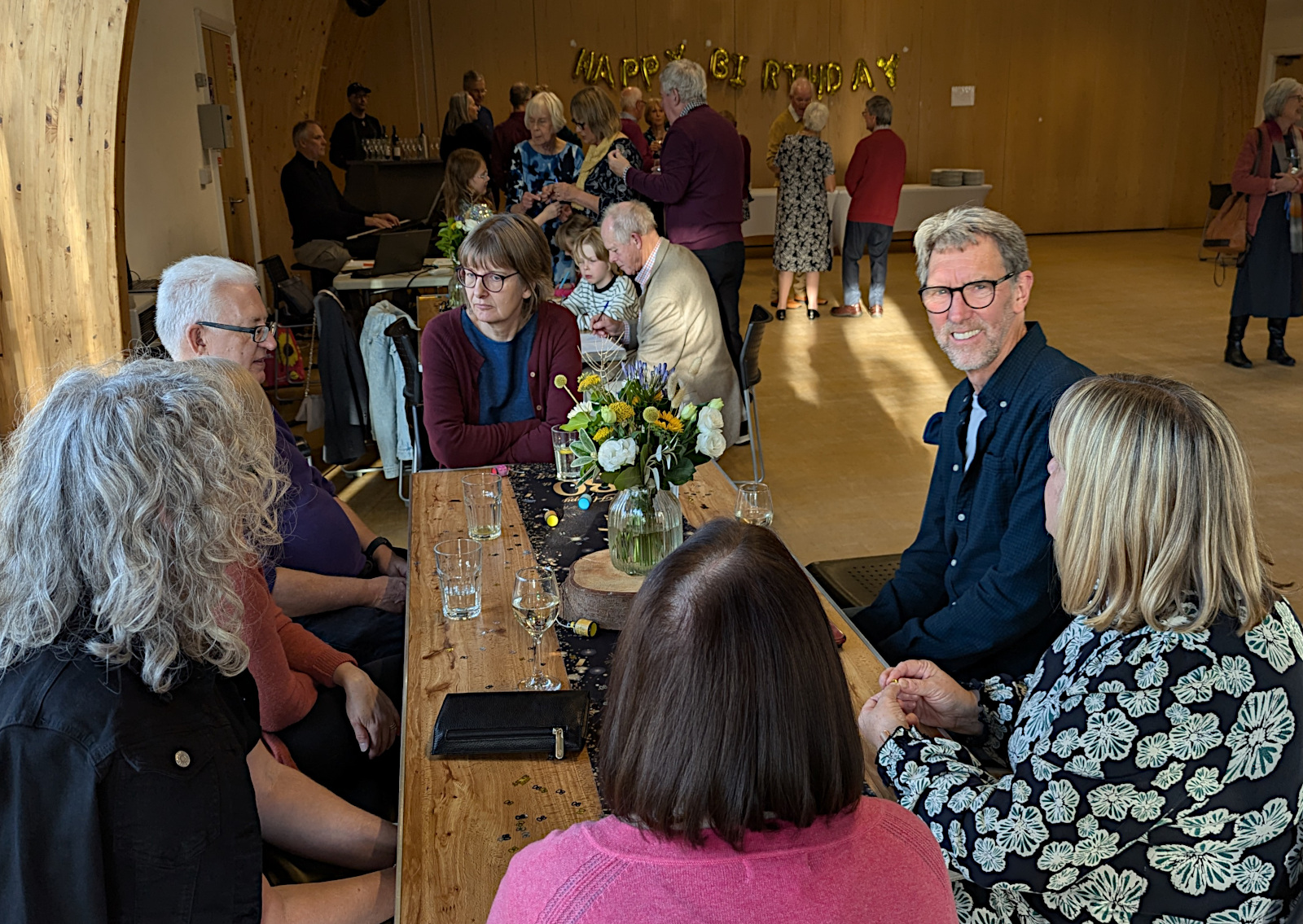
I had my flu and COVID jab early this month. We drove to Nottingham for Roger Owen’s 80th birthday party, Roger and Carolyn are good friends from our time in St Neots. There were many old friends from the Small Group that they ran and it was fun to meet everyone again.
It was disppointing to hear that the Internet Archive went down because of a denial of service attack. Why would anybody do that? it soon returned for searches, but it was a few weeks before data could be uploaded again. Our gas heating boiler failed towards the end of the month and would have cost almost £1000 to repair so we decided to buy a heat pump instead as there’s still a good government grant available.

Beth and Paz came down for an overnight visit, lovely to see them as always. At the end of the month we spent a day in Oxford, and, the Oxford Botanic Garden had a Rafflesia in flower ‘Stinking corpse flower’, though thankfully it was not in its stinking phase. The only other time I’ve seen one of these was during a forest walk in Thailand.
JHM: I wrote about the Spelga Dam in the Mountains of Mourne; and the need to go out and deep as Jesus did. World events: Iran attacked Israel with ballistic missiles; and The Europa Clipper spacecraft was launched to investigate Europa, an icy moon of Jupiter.
October 2023 (2 years)

I started walking regularly with two friends, Al and Phil, in part this was an exercise (no pun intended) to help Al improve his fitness. On 19th we walked near Miserden in pouring rain and muddy conditions, but thoroughly enjoyed it.
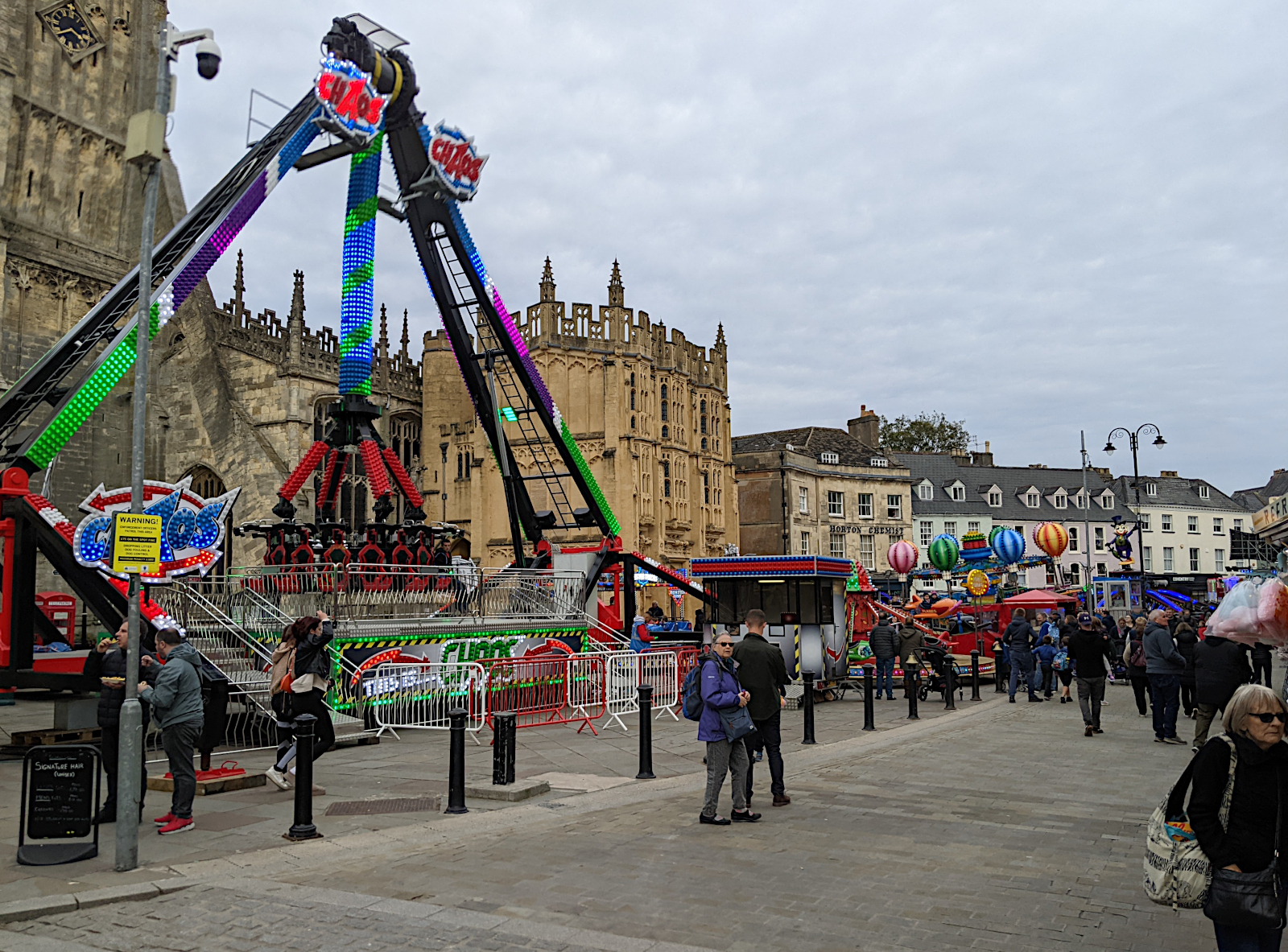
The annual Mop fair came to Cirencester as it does every October, the streets in and around the Market Place are filled with rides, stalls, people, noise and colour as well as the familiar and evocative aroma of diesel generators, candy floss and close-packed crowds. I remember Mop as a child when warmth from the thousands of incandescent light bulbs was tangible. The name ‘Mop’ goes back to the days long ago when it was the annual hiring fair. It would have been the time and place to engage domestic servants or staff for businesses; and people would have gathered to look for work.
Donna’s Uncle Ken died this month after a long battle with Parkinsons. This left Donna’s Mum with only two remaining close family members, her daughter (Donna) and her son (Paul).
JHM: I wrote about Russia’s invasion of Ukraine; and about Henry Drummond’s ‘Greatest Thing in the World‘. World events: Sam Bankman-Fried was convicted of fraud and conspiracy; and Hamas launched an incursion into southern Israel from the Gaza Strip.
October 2020 (5 years)

Paul and Vanessa went to Bath for a weekend break so we drove down to Weston-super-Mare with Isobel to look after the two dogs. Maizi and Marple were young in 2020 and were very ambitious in picking up sticks to carry home. As they aged later in their lives they chose smaller and smaller sticks, eventually seeming perfectly happy with a short twig.

We drove to Bibury and met our friends Phil and Judith for a short walk. We followed a stone track to Oxhill Wood, then turned right to come out near Bibury Court Hotel. Afterwards we had coffee and a bite to eat at the tent restaurant by the trout farm. COVID is getting more manageable, for example the possibility of walking with friends and eating out in well ventilated places. Businesses are beginning to explore way of working with the remaining restrictions in place.
There was a heavy hailstorm on 28th October, some of the hailstones were the largest I’ve ever seen.
JHM: I wrote a political post. World events: Total confirmed COVID-10 deaths passed the one million mark in October; and the Falkland Islands were declared free of land mines.
October 2015 (10 years)

Peter and Dadka were living in our spare bedroom, sharing our kitchen and shower. They were both Slovakian and had been struggling financially and in other ways as well. But things brightened for them a bit as Peter had just obtained a job driving a ready-mix cement wagon. It was hard work, but it was a secure job and reasonably well paid too. Hopefully it seemed their financial position might start to improve and they could look for a bed-sit or a small flat of their own.

On 20th October, the East Anglia Regiment visited St Neots to receive the freedom of the town; the band and a small group of soldiers marched with rifles and fixed bayonets from Huntingdon Street and along the High Street into the Market Square for the ceremony. I took some photos on my phone and there was cheering and clapping from the townsfolk.
JHM: I posted an article on Stone Ivy. World events: A series of suicide bombings killed at least 100 people at a peace rally in Ankara, Turkey; and Hurricane Patricia became the most intense hurricane ever recorded in the Western Hemisphere.
October 2010 (15 years)

Donna and I went along to some of the meetings at The Father’s Heart Conference at the King’s Arms Church in Bedford. There were some good things, but overall I didn’t find it particularly useful. It reminded me once more about the difficulties faced by ‘big’ church and the events that people get excited about. But life is not so much about big events as it is about the humbler things in life. All sorts of things fit this humbler category, including the very tiny garden snail moving along a matchstick in the photo with a £2 coin for scale. Click the image for a larger view, so amazing!
At the third Cornerstone Directors Meeting, there was a lot of talk about high costs and food wastage, and about staff requirements. Paul was rather defensive, promising that several requirements were in the pipeline but not yet fully achieved. Most of us felt everything was a bit out of control.
I helped some friends from New Zealand move house in Southgate, London. They’ve been in the UK for quite some time now and plan to return soon, some older, grown up, children live in New Zealand but a younger son and daughter are here in the UK.
JHM: I thought about unbreaking a pot; and the cost of environmental damage. World events: Instagram was launched; and The International Space Station surpassed the record for the longest continuous human occupation of space.
October 2005 (20 years)

We visited Southwold on the Suffolk coast. It’s a lovely little town and our friends Ken and Gayna had a house not far away in the village of Yoxford (though they lived at the time in Perry, not very far from St Neots). Athough Southwold is a delightful little seaside town with some lovely features, I always feel a little disoriented on the east coast; being western born and bred I expect the sun to set over the sea, not rise over it in the mornings!

At Unilever Colworth, I was busy archiving all the Web Team’s servers as everything was being migrated to new systems that we would not be managing ourselves. It seemed a good precaution to capture everything on long term storage first, so if there were any issues we could easily repair them. I don’t think we ever needed those archive disks.
World events: China launched its second crewed spacecraft, Shenzhou 6; and the trial of Saddam Hussein began.
October 2000 (25 years)

We dropped in to see my Mum and Dad on our way to visit Beth and Paz who were living in Axbridge at the time. Paz and I went out to look around Shapwick Heath National Nature Reserve where there’s a replica section of the Sweet Track and some Iron Age buildings.
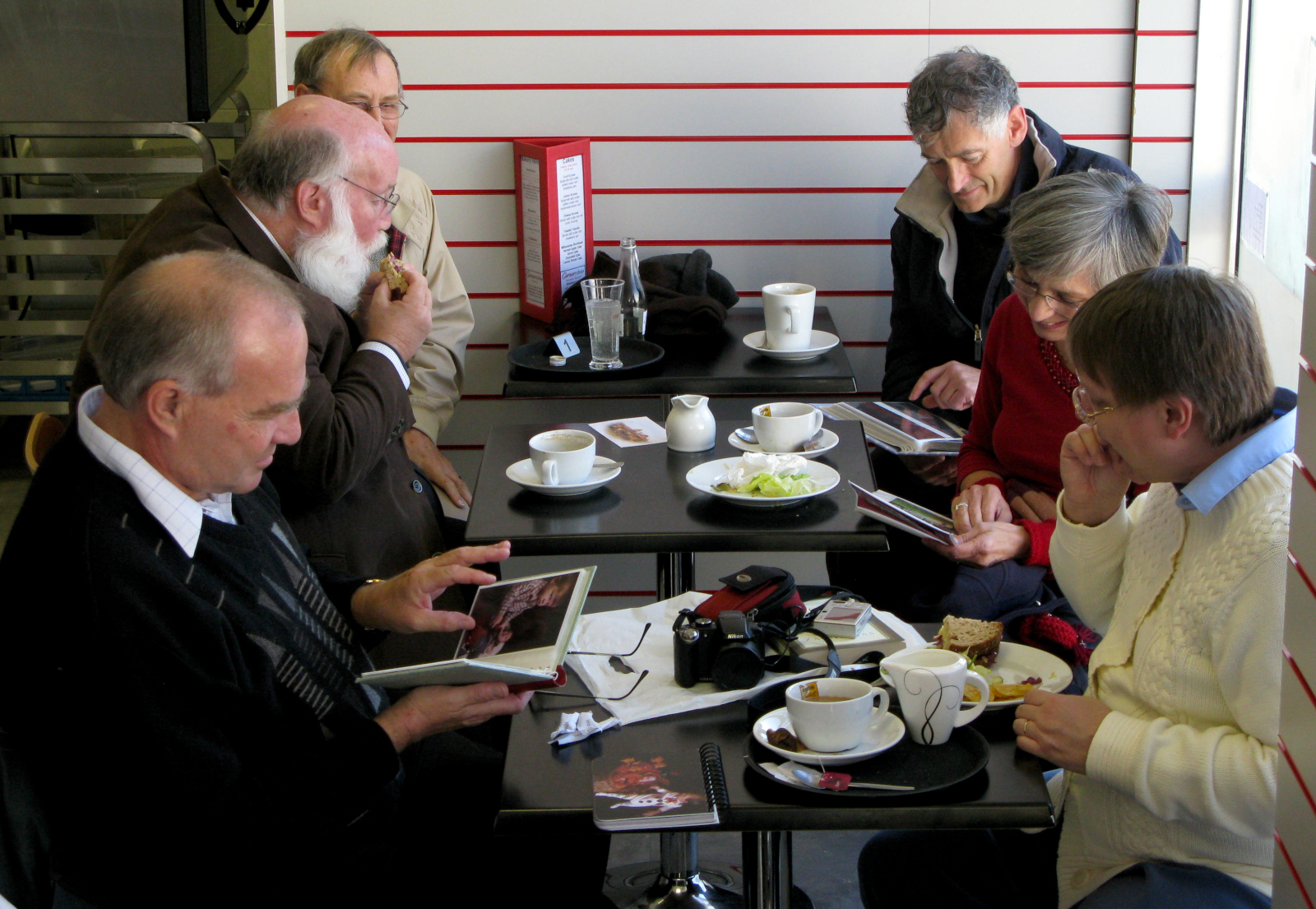
An Iron Age roundhouse was easy to build but very effective in Britain’s wet, temperate climate. A series of stout poles inserted into the soil supported the walls and roof, the walls were woven from willow or hazel and then plastered with mud and straw, and smoke from the central firepit escaped through the thatch (you can see this in the photo, click the thumbnail for a clearer view).
World events: Mass demonstrations in Belgrade led to Slobodan Milošević‘s resignation; and an Intercity 225 express train derailed in Hatfield, killing four and injuring many others.
< Sep 2000 – Nov 2000 >
October 1995 (30 years)

Judy was facing several issues. She was clearly retaining fluids and her feet were swollen and puffy. She was receiving great care from her GP at Yatton Surgery (today, Mendip Vale Medical Practice). I was beginning to feel she needed someone around more of the time so was planning to ask for more time away from work. Our 25th wedding anniversary fell on 3rd so we had visits from both sets of parents. Paul, Jenny, Tony and Faith came to visit too and we talked about Alan and Dorothy joining us on 6th to pray for Judy and anoint her with oil. In the end they didn’t appear, but did so at a later date.
On 12th, Judy began taking small doses of morphine to help her sleep more comfortably and there were signs of her liver struggling a bit, blood albumin levels were low as a result.

(Wikimedia)
Things were difficult in the LARS Computing Section too. We were overworked, needing to get Windows 95 out to the users and working correctly with the NT server. The Institute of Arable Crops Research (IACR), of which Long Ashton Research Station (LARS) was a part, wanted to take control of our computing facilities; but LARS was also the Department of Agriculture of Bristol University, and they were offering us a different route for our networking needs.
World events: The discovery was announced of the planet 51 Pegasi b, the first confirmed extrasolar planet around an ordinary main-sequence star; and O. J. Simpson was found not guilty of double murder in a criminal trial.
October 1990 (35 years)
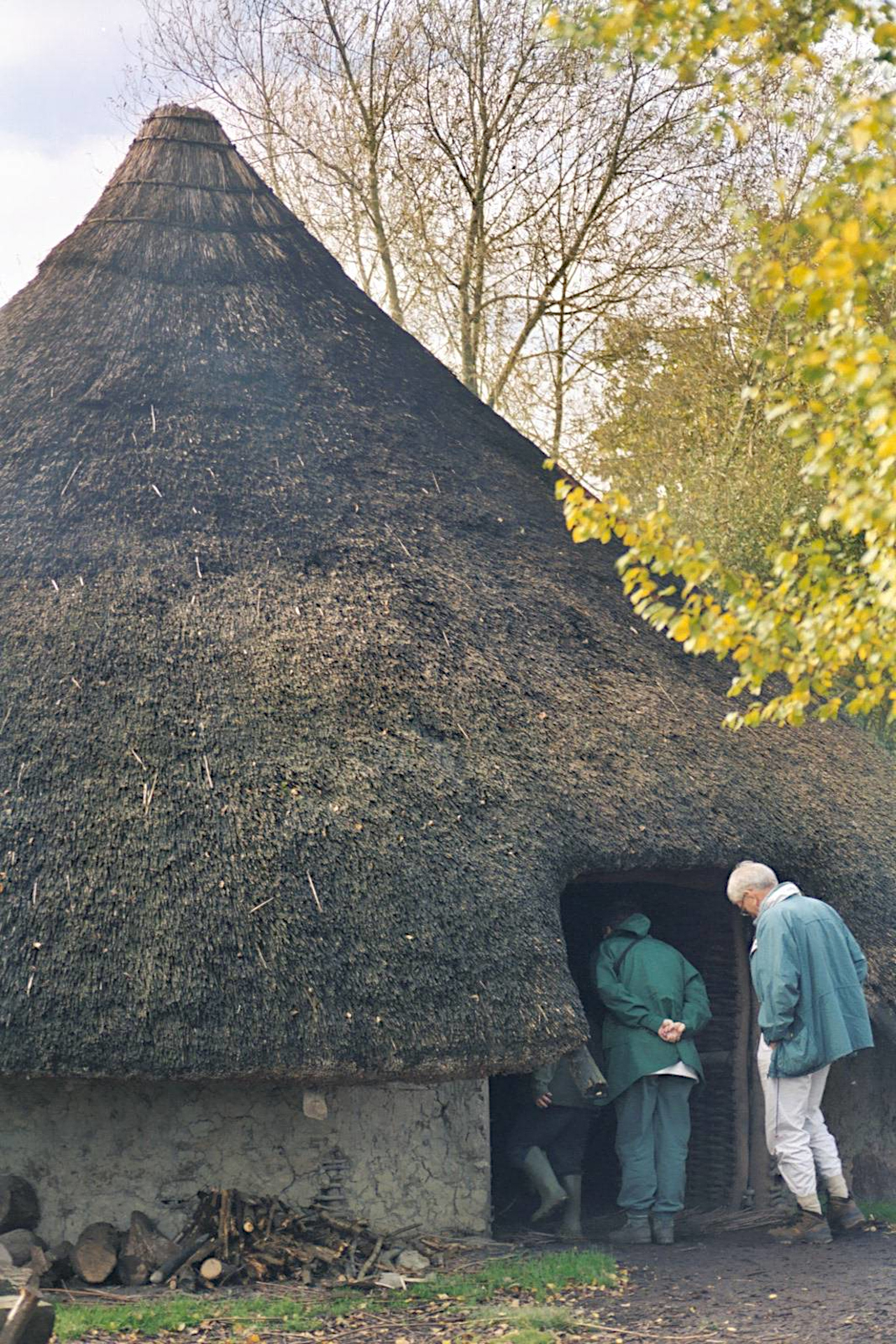
Mum and Dad drove to Yatton to visit us for the day, bringing four nieces and nephews with them (Gavin, Rebecca, Dan and Rosie). We went with them to Bristol’s Museum of Transport and enjoyed a good look around, inside and out. The weather was reasonable too and it was a great day out together.
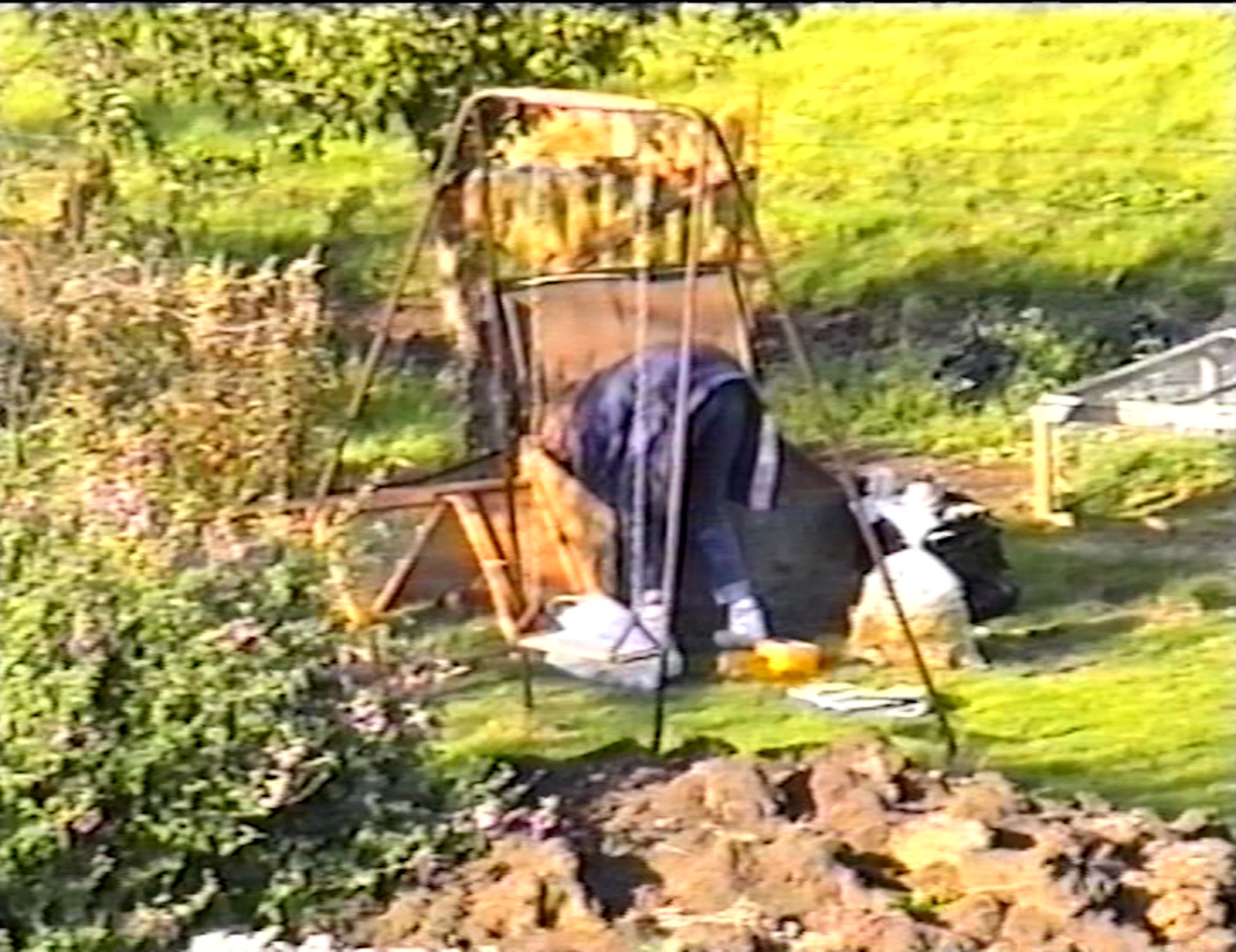
But life is not all museum visits with friends and family, there are always chores to be done as well. Debbie and Beth were always very good about this aspect of having pets. We all did our bit; Guinea pigs (Debbie and Beth), hamsters (Beth), cockatiel (Beth), budgies (Judy and me), cat – mostly feeding and grooming (Judy, Debbie, Beth). In the second photo Beth is cleaning out the guinea pig run.
World events: Tim Berners-Lee began building the World Wide Web; and the first McDonald’s restaurant in Mainland China opened in Shenzhen.
October 1985 (40 years)
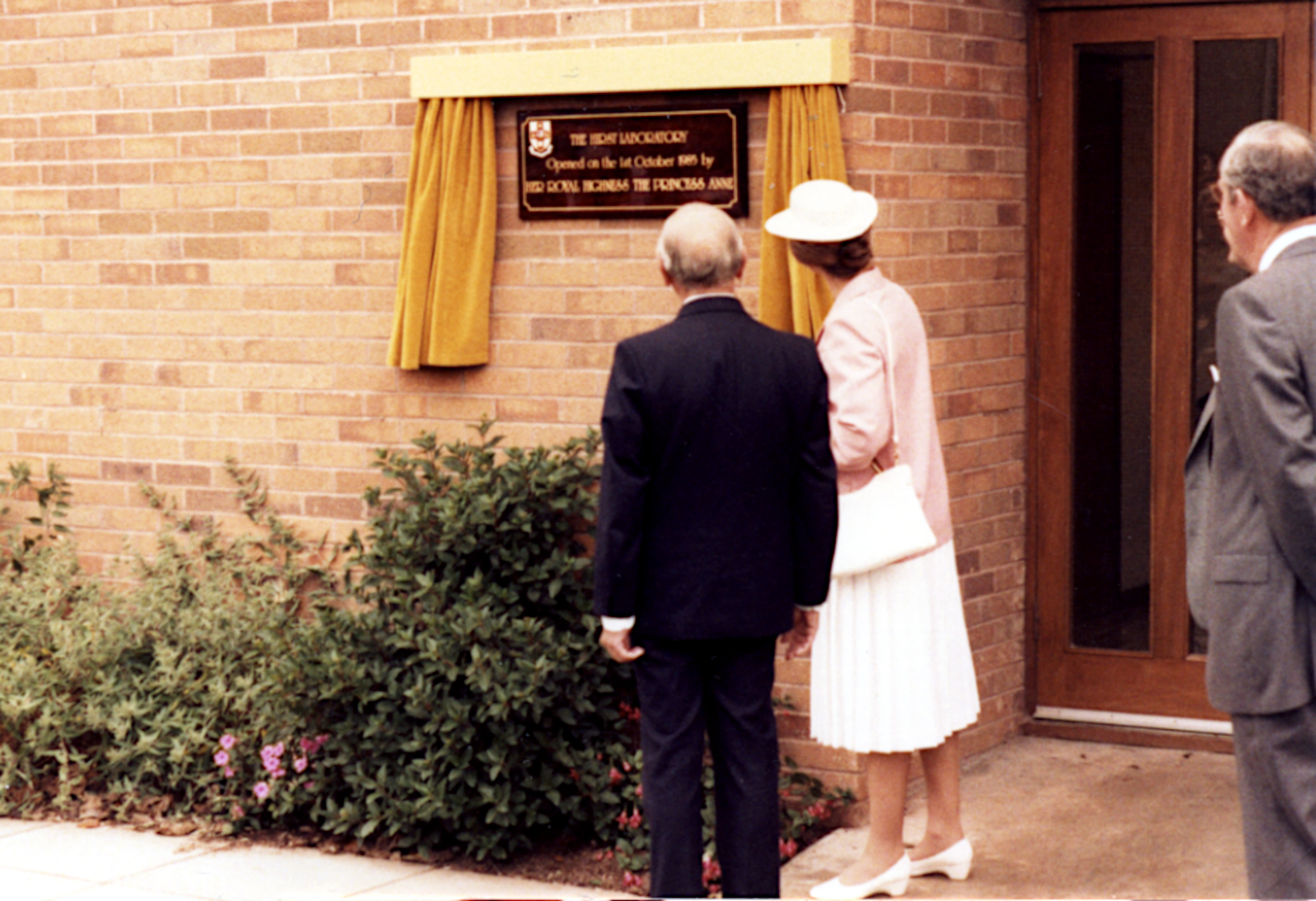
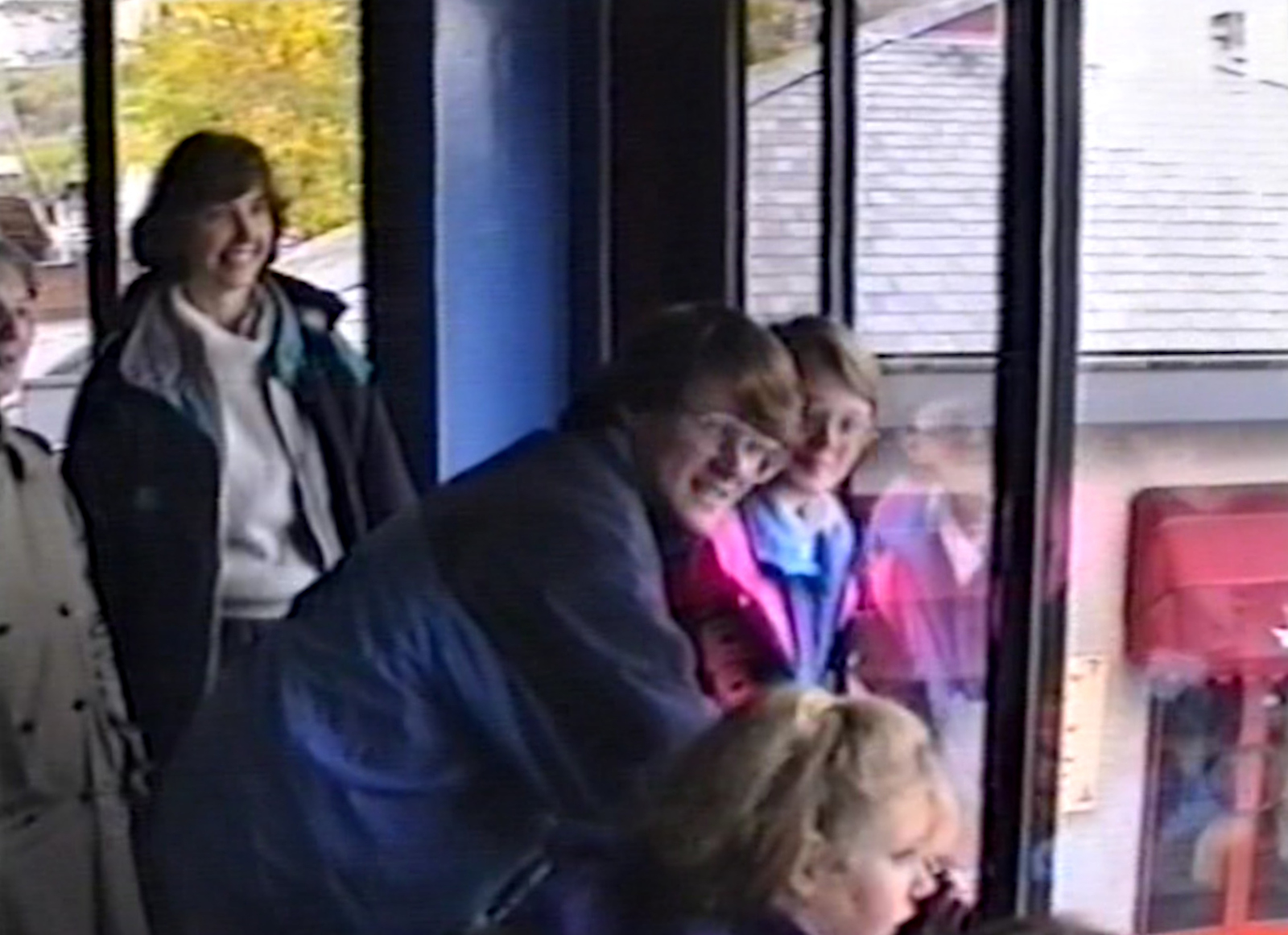
The event of the month, if not of the entire year, was Princess Anne’s visit to Long Ashton Research Station (LARS) to officially open the new Hirst Laboratory. I had an office in this building as Microcomputing Manager towards the end of my time at LARS. The photo shows an equerry or some other functionary, Princess Anne, and Professor Hirst, the retired Director after whom the Lab was named. His replacement, Professor Treharne, was out of the shot further to the right.

The second photo shows onlookers, a mix of LARS staff and their families as well as some people from the village. Debbie and Beth are in this shot too.
World events: The cruise ship Achille Lauro was hijacked in the Mediterranean by Palestinian terrorists; and NASA’s Space Shuttle Atlantis flew for the first time.
October 1980 (45 years)

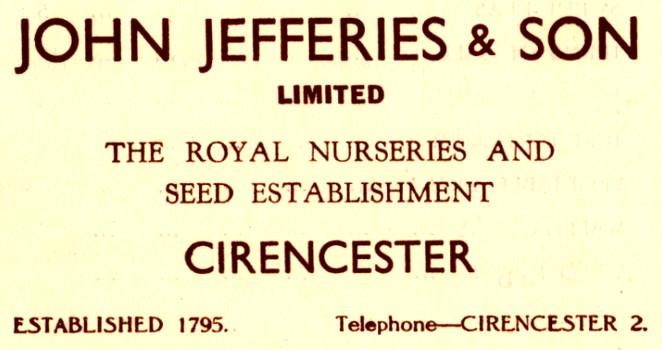
Mum and Dad bought a painting by Adrian Hill, these days it hangs in Beth and Paz’s home in York; unfortunately I don’t have a good photo of it to use here, but I do have a copy of the receipt so I can say that they bought it in October 1980 in Chedworth and this is the business card of the supplier.
I have very little material for this month. Judy and I were living at 22 Rectory Drive, Yatton. Debbie was five and Beth was two. Judy was at home with the girls on weekdays and I was researching pollen and pollen tube growth at Long Ashton Research Station. As I recall, we had no car at this stage and I was cycling or motor cycling to work during the week.
World events: Jim Callaghan announced his resignation as leader of the Labour Party; and the most recent atmospheric nuclear weapons test to date was conducted by China.
October 1975 (50 years)

We visited Mum and Dad in Cirencester a little after our fifth wedding anniversary and I took a little time out to walk around the town with my camera. This is the front of the old Cirencester Workhouse, no longer in use at that time, of course. Today it’s used as the District Council offices. The photo dates to 26th October 1975 and is one of a stereo pair.
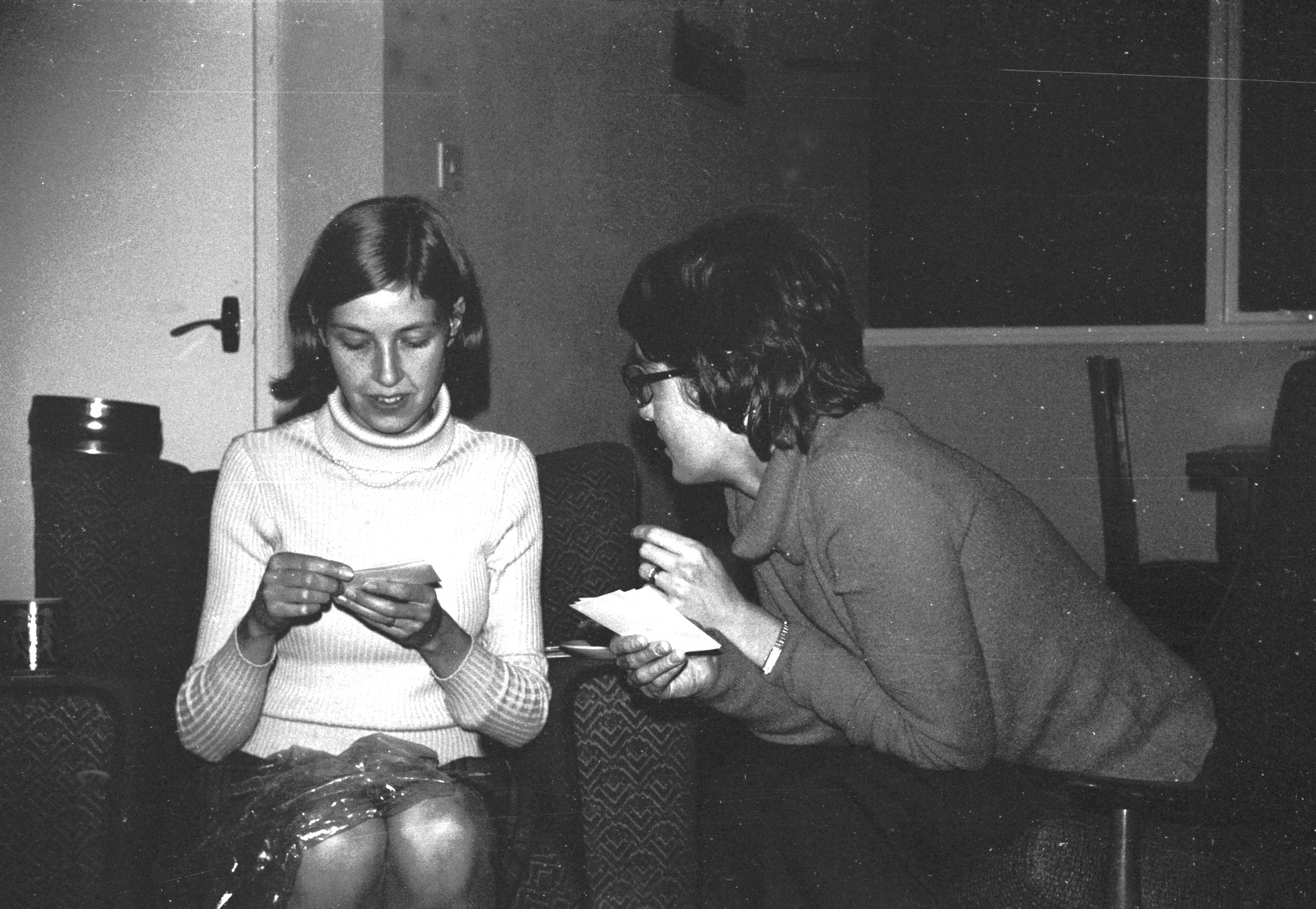
Our next door neighbours in the end-of-terrace house next to us were Mike and Mary Low, In the photo Judy and Mary are looking through some photos together.
World events: Muhammad Ali defeated Joe Frazier in a boxing match in Manila; and an RAF Vulcan exploded and crashed over Zabbar, Malta.
October 1970 (55 years)
Our wedding went well on 3rd October; I regret not being able to share a photo or two, I have them safely somewhere but I’m quite unable to locate them at present.
I can share a funny story from that day, however. We had avoided getting our car ‘decorated’ by our college friends by parking it some distance away and getting Judy’s Dad to drive us to the car after the reception. So we were already heading off for our honeymoon well before anyone was able to locate the car. With confetti down our necks and scattered all around, it seemed like a good idea to pop in to Churnside in Cirencester, let ourselves in (everyone was still in Cheltenham), get rid of the confetti, and then continue to Bournemouth where we planned to stay for a week. Unfortunately I forgot to pick up my car keys as we left the house.
I borrowed a ladder from Brian Bennett at Bennett’s Garage just a few steps along the road, got back into the house through my bedroom window, picked up the keys, returned the ladder, and we were back on the road in short order.
There was no need to book in advance in those days. We simply drove into Bournemouth until we spotted a guest house we liked the look of with a ‘Vacancies’ sign displayed. We went in, they showed us a room and gave us a price, we asked what their best price would be if we took the room for a week, and that was it. Simple! It wouldn’t work today, would it?

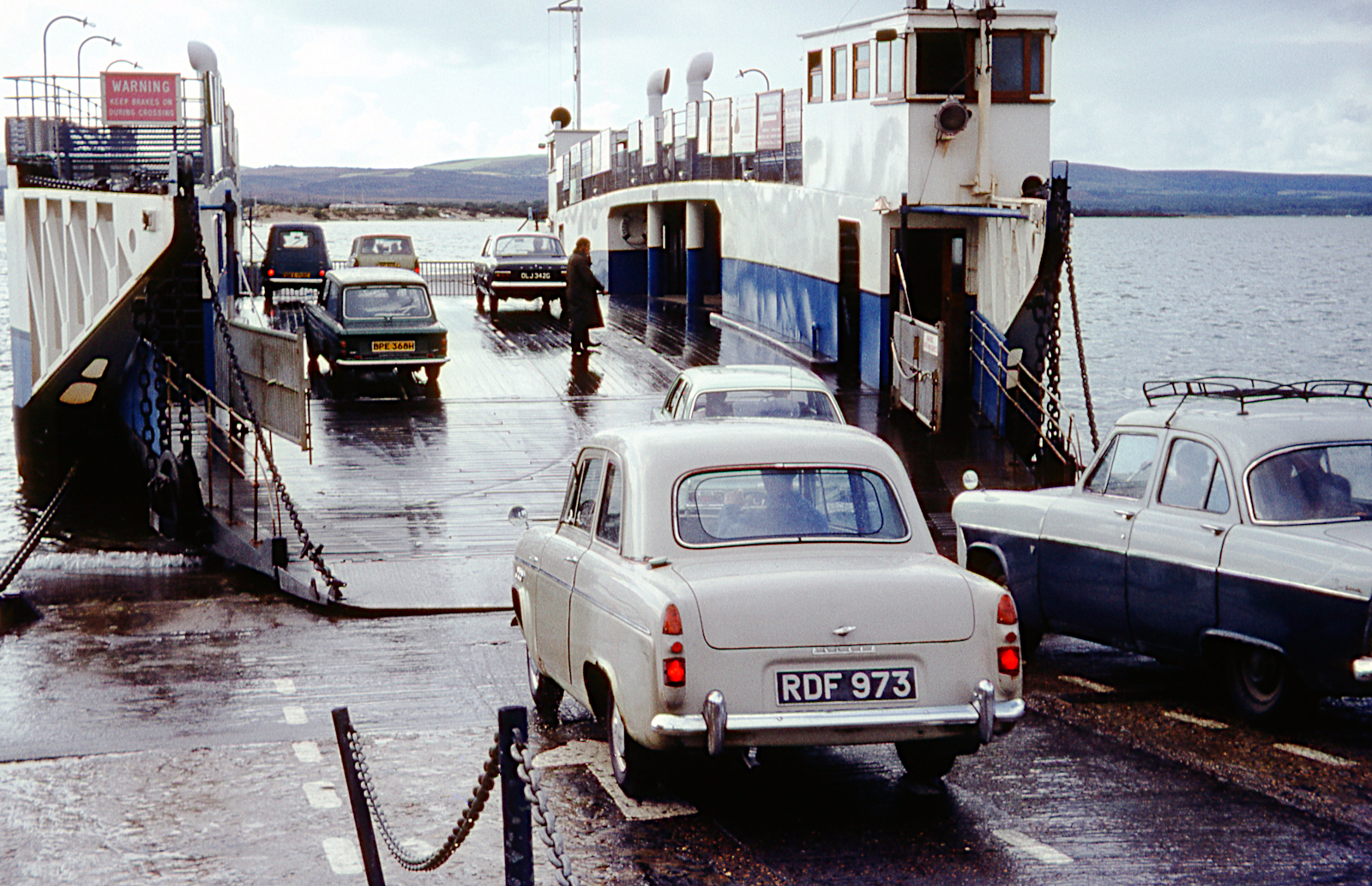
We explored Bournemouth fairly thoroughly, visited the famous Beaulieu car museum, spent a day on the Isle of Wight (Judy took the photo above while I was driving our car onto the ferry), and looked at Corfe Castle.
I had a message during the week to phone Long Ashton Research Station and they offered me a job in the willow department; starting on the following Monday, that was an enormous relief. So after our honeymoon, we drove to Bristol (visiting Salisbury and Avebury on the way) and visited Long Ashton on the Sunday evening. I rang the bell of the house where I’d lived with a bunch of other students during my industrial sandwich period in 1969. My old landlady opened the door and gave me a big smile when she saw who it was, but she also told me that they’d stopped taking guests. However, she kindly offered to give us a room for a few days while we looked for a bedsit in Bristol. Another big relief!
I began my first full-time job on Monday morning, while Judy took the car into Bristol to start looking for a bedsit. After drawing a series of blanks, an agency in Park Street said they had a suitable place up on the Downs, it was a big, three story house on Linden Road, number 59 I think. It was two rooms on the first floor with a bathroom and loo shared with a similar pair of rooms on the same floor. It was vacant so we took it and were able to move over from Long Ashton right away. I still remember the landlord, a Mr Bird; he came to collect the rent once a week. We had a furnished bedroom and sitting room, a big cupboard that opened out to reveal a tiny kitchen, a car, and I had a monthly salary. We felt great, and excited for the future.
Within a few days Judy had found a temporary job working at one of the Broadmead department stores, either Lewis’s or Jones’s. They needed extra staff over Christmas and the New Year period. The extra income made a big difference to our finances and we began saving, knowing that we would need a deposit for a mortgage eventually. During the next few weeks she began looking for a job as a newly graduated biochemist and soon found work as a lab assistant at Bristol University Biochemisty Department in Woodland Road to start in the spring term. Dr Tanner (Mike Tanner) was studying one of the proteins in the human erythrocyte membrane.
World events: A Khmer Republic was proclaimed in Cambodia, escalating the Civil War ; and the Soviet Union launched the Zond 8 lunar probe.
October 1965 (60 years)
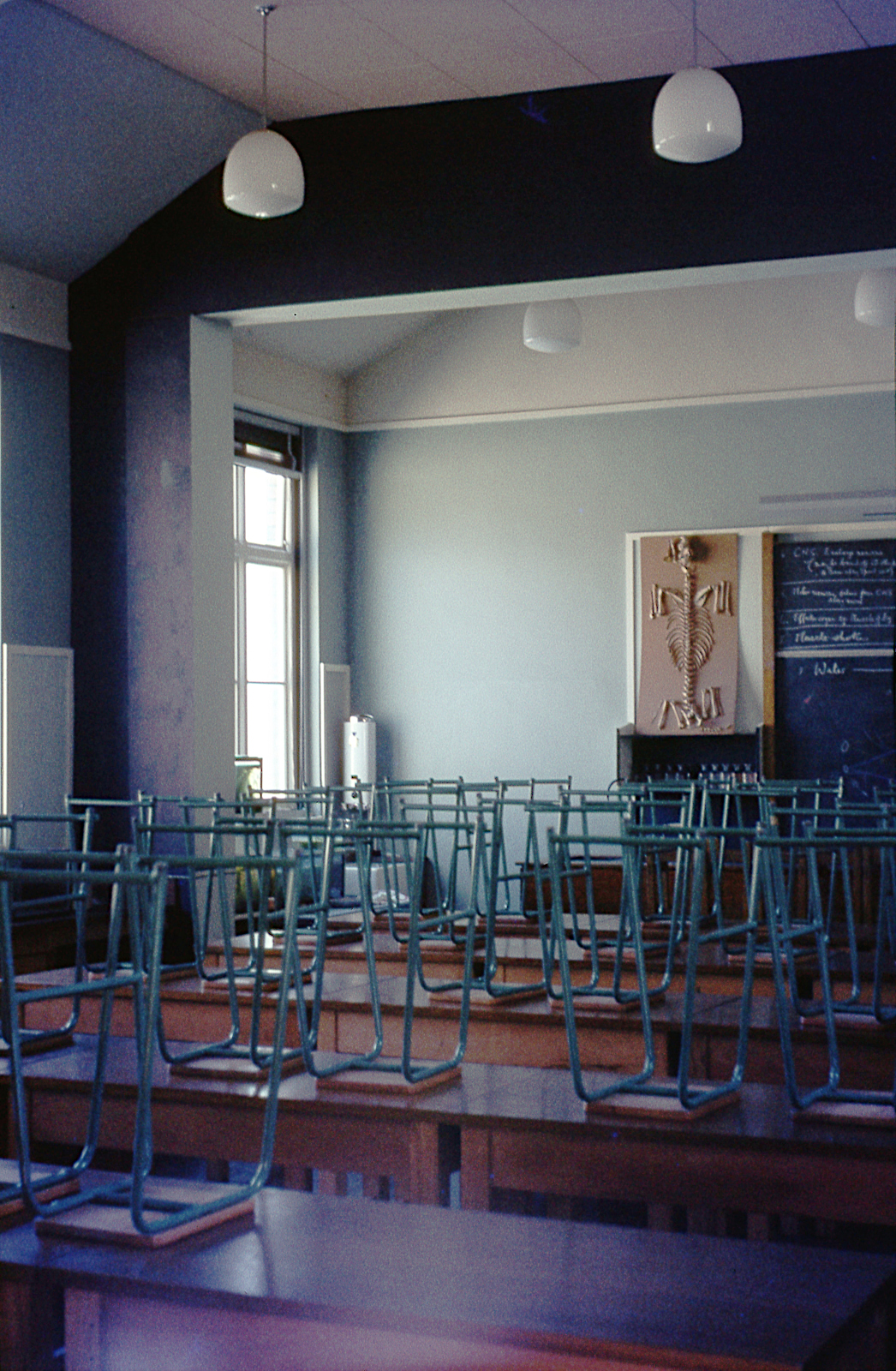
I was in the lower sixth form at Cirencester Grammar School (CGS) and it was interesting to make a start on Chemistry, Physics, and Biology A levels. I had not been able to cover Biology at O level so had some catching up to do, Physics became more mathematical than I’d expected, and Organic Chemistry was way harder than the inorganic studies at O level. But my teachers were good, especially ‘Pop’ Green who taught us Biology. He stood no nonsense, but he was a lot of fun and very helpful to anyone who wanted to learn and showed a real interest in the subject. I took these photos in 1966, but everything looked just the same in 1965.
My sister Cindy turned 14-years-old at the beginning of the month, Ruth and Rachael were 9 and 8 respectively, and I was already 17 and taking my first steps in learning to drive. It was easy in those days, I applied for a provisional driving licence and received it quite quickly, then we put L plates on the car and Dad took me out to the disused Chedworth Airfield to learn the first steps of clutch, accelerator, footbrake and steering and once he felt I was safe enough, he took me on quiet roads to get used to traffic. Meanwhile I studied the Highway Code to learn the theory aspects, the meanings of various road signs, stopping distances and their relationship to road speed and so forth.

Judy and I continued to grow closer and spent a lot of time in free periods talking about every imaginable topic, in cold weather we would lean on one of the radiators in the Wooden Corridor to stay warm while we talked. We didn’t hold the same views on everything, but that just made it more interesting. I was also reading about science, buying the monthly magazine ‘Science Journal’ which was a UK publication similar in many ways to the American magazine ‘Scientific American’. I was very interested in electronics and the early computers, also the American and Russian space programs as well as European efforts to build a launcher. The European Launcher Development Organisation (ELDO) was trying to cobble together the British Blue Streak ballistic missile, the French Coralie as the second stage, and a smaller German vehicle as the third stage to reach low Earth orbit (LEO). This programme proved unsuccessful.
Judy introduced me to classical music, something that had passed me by before we met. When I was younger, Dad was into jazz, particularly the piano solos of Jelly Roll Morton, Earl Hines and most of all, those of Fats Waller. He played many of them rather well on the upright piano we had at home. And Mum liked much of the popular music of the day, especially anything by Danny Kaye. But neither of them had been into classical stuff. Judy and I both enjoyed some of the popular groups (not ‘bands’ in the 1960s) of our own day. I was very much into The Shadows and, to be perfectly honest, I still am.
World events: Fidel Castro announced that Che Guevara had resigned and left Cuba; and the 7 Fundamental Principles of the Red Cross and Red Crescent were adopted at the XX International Conference in Vienna, Austria.
October 1960 (65 years)
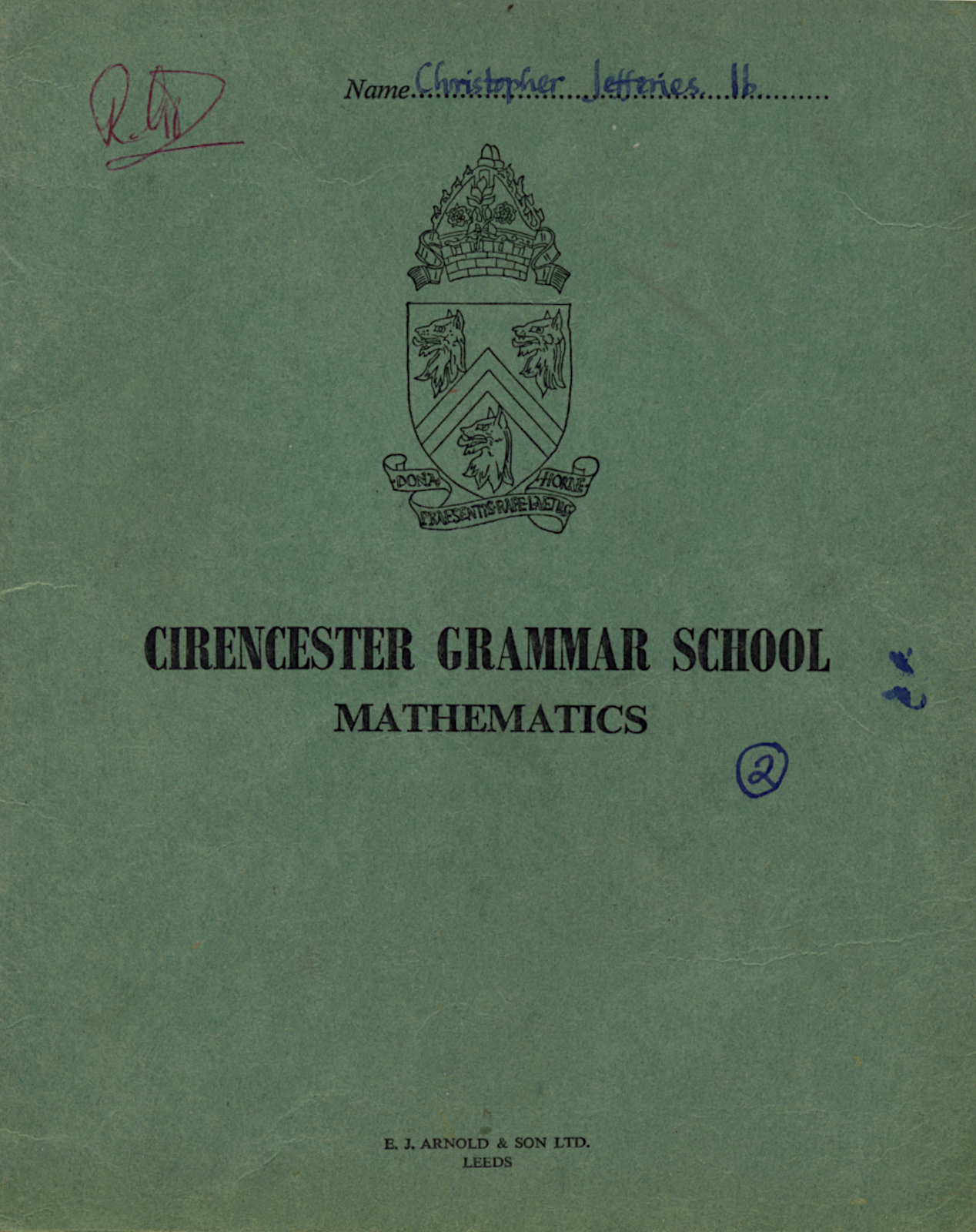
This was the start of my second year at Cirencester Grammar School, my sisters were younger than me and still at junior school. The exercise book was from my first year, carries the Grammar School Crest, and the book’s been initialled by my maths teacher to show it’s full; the school office issued new books, but only if they’d been initialled by a teacher. Click the image for a closer look.
The exercise books were coloured to indicate the subject, this one is green for maths, rough books were dark blue, geography was orange, history was a dark maroon and so on.
World events: Nigeria became independent from the United Kingdom and the 99th member of the UN; and a large rocket exploded on the launch pad at the Baikonur Cosmodrome, killing at least 92 staff of the Soviet space program.
October 1955 (70 years)
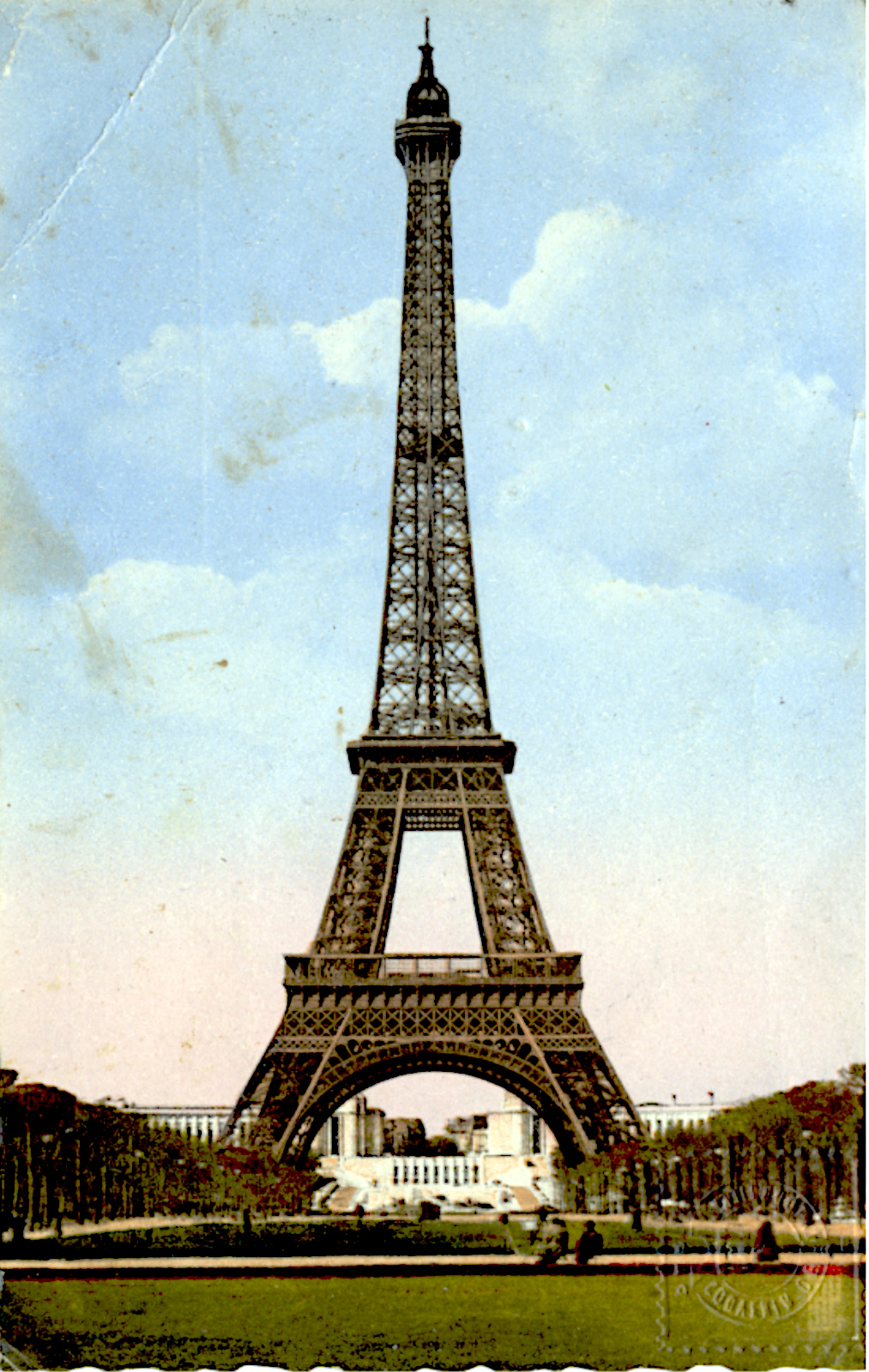
My sister, Cindy, turned four at the beginning of the month, and at seven-years-old I had already begun my third year at Junior school. We were advancing to more challenging tasks, taking dictation was one of these and although the vocabulary remained simple, there were potential pitfalls. I remember being puzzled when having been careful to use a capital E for a person’s name, it was crossed out as being wrong. The sentence was something like, ‘The fair was coming to town and he had thought of little Else all day.’ Surely if her name was ‘Else’ she deserved a capital?

The images show the front and back of a postcard from my cousin (also my godmother), Jill. She was grown up, about 18 or so at this time, and was teaching English to the daughter of a French family in Morocco. They were visiting Paris and she thoughtfully sent me the postcard. (Click the images to enlarge them.) (I have no images from October, the card is probably from August.)
World events: Sun Myung Moon was released from prison in South Korea; and 70-mm film was introduced for cinema projection, with the release of Rodgers and Hammerstein’s musical, Oklahoma!.
October 1950 (75 years)

This photo is from the Facebook ‘Old Ciren’ group (it’s definitely October and must be a year not far from 1950). Local people, especially children and young adults, look forward to the fair and certainly have a good time. As you can see, Mop takes over the entire Market Place. My memories of Mop as a child include the sound of diesel generators, warmth from the many light bulbs in use, the mixture of smells (diesel fumes, candy floss, fried onions and so on, the noise of the crowds and the shouts of the people managing the attractions (Roll up, roll up).
I probably didn’t witness Mop in 1950, I was only 2¼ years old, but I might have been carried down or taken in the pram by Mum and Dad.
World events: China began the process of annexing Tibet, beginning by invading across the Jinsha River and seizing the border town of Chamdo; and the USA’s FCC issued the first license to broadcast television in colour.
October 1945 (80 years)

Mike received inoculations and then visited Bombay (Mumbai) with some friends and was emphatically unimpressed. He met a sergeant he’d known from his time at Ballinderry in Northern Ireland. The toing and froing of letters with Lilias and with Dad’s family in Cirencester continued, and he had photos taken at a booth in the bazaar and sent one to Lilias.
On 10th he had a bad headache, felt rotten on 11th, and reported sick on 12th. By 14th he was feeling normal apart from some mouth ulcers that persisted for several days. He left hospital on 18th despite a temperature of 100 F (37.8 C).

On the 19th he was given work as a lorry driver – Driver Mechanical Transport (DMT). Then on 21st he was posted to Santa Cruz, a nearby RAF airfield where he met someone he knew from Ashton Keynes as well as someone from Stroud and a man from Sampson’s Nurseries! He was seeing films at the station cinema, and practising cricket while waiting to start his new role. His first driving practice was taking a 3-ton Chevrolet around the airfield perimeter track on a meals run. By the end of the month he was driving quite regularly and teaching himself to change down to a lower gear correctly.
So that was a fairly slow-paced start to Dad’s RAF service in India, and a strange way to employ an experienced radar operator!
World events: Arthur C. Clarke published the idea of a geosynchronous communications satellite; and the UN Charter was ratified by 29 nations.
October 1940 (85 years)
There’s not enough information to write something for every month in the 1940s. Dad’s diaries start in January 1943, so for January 1940 to December 1942 I’ll write about things I know, or draw on dated photos and documents. Sometimes I might use a photo or document with a guessed date.
Continuing the nursery theme, this time I’ll describe Watermoor Nursery. When I was growing up Watermoor was the place where Dad spent most of his time, he was the foreman at Watermoor during those years, before taking on responsibility for all of the nurseries in due course. What do I remember about Watermoor in those days? I suspect it had changed very little from 1940 until the 1950s when I first remember it.
Perhaps the first thing to say is that before Cirencester’s ring road was built in the 1980s, Watermoor Road used to continue along what is now Watermoor End, heading south-east towards Cricklade and, eventually Swindon and Marlborough. This was the line of the old Roman Ermin Street. If you visit Watermoor End and walk right down to the Ring Road (Bristol Road at this point) you’ll notice the old pub on the right at the end stands at a strange angle (it’s marked on the map as ‘The Horse & Drill’). Cricklade Road, now the other side of Bristol Road, continues along the line of the Roman Road and you can follow it, straight as a die, past Tesco Extra and on beyond Tesco where it’s fenced off. It’s still a footpath so walk through the fence and continue. All of this was once known as the Swindon Road. You can see the details on the map.
Returning to that old pub at an odd angle, it was built to respect the line of Watermoor Road, a junction to the right off what is now Watermoor End. You can follow the old Watermoor Road from the southern side of Bristol Road, and when you reach Rose Way on your left you are more or less at the old entrance to what was once Watermoor Nursery. Entering the long-gone wooden gate you would have seen the potting shed on the left and beds edged with lightweight breeze blocks and filled with crushed clinker on the right. This was the standing area for the Alpine plants propagated at Watermoor. The main track ran ahead from the gate to the Swindon Road gate at the far end. Both sides of this track (especially the left hand side) were filled with row after row of herbaceous perennials which would be lifted and split in the winter months, packed in moist soil and straw for insulation, wrapped in sacking, and sold as bare-rooted plants to be collected from the nursery or despatched by road, rail or post to distant customers, or delivered by van along with other plants, cut flowers, wreaths, seeds, garden sundries and chemicals in Cirencester and the local villages, often by my Dad.
On the left of the track, at the Swindon Road end, was the carter’s cottage. Up until the end of the Second World War a horse and cart were used for local deliveries. The Horse was stabled at Tower Street Nursery. There was a story that the carter sometimes stopped at a pub for refreshment on his long delivery round, and that if he drank too much he would doze off afterwards while driving, but the horse knew the customary route and would plod along without any need for guidance. Companies like Tesla and Waymo are trying to perfect vehicles than can drive themselves, perhaps they just need a well-trained horse! I suppose you’d need a different horse for each route, so that might be an insurmountable issue. The carter’s cottage was still there when I moved back to Cirencester in 2016; it’s since been demolished to make way for several new houses. The carter’s vegetable garden made it a reasonable-sized building plot. You can see the cottage and its garden on the map, in the northern corner of the nursery.
I remember Miss Brown (Rosemary, I think) who was Dad’s assistant at Watermoor. And in the calm, warm days of summer time I remember thousands of butterflies making the most of the flowers on the herbaceous stock plants. The air seemed to shimmer with them – large and small tortoiseshells, painted ladies, red admirals, peacocks and much, much more. In the summer, our house always had vases of flowers, cut at Watermoor and brought home by Dad.
You can view the map in full online, the area was surveyed and mapped by Ordnance Survey between 1892 and 1947.
World events: Adolf Hitler made a Berlin Sportpalast speech declaring that Germany would make retaliatory night air raids on British cities and threatening invasion; the Blitz began on 7th September and although tough for civilians and ruinous to cities, it probably saved the RAF from collapse and an invasion of Britain never became feasible.
< Sep 1940 – Nov 1940 > (Jump to top)
1930-1939 (95 to 86 years ago)
Anything that appears in this section will have some connection with the 1930’s but may extend beyond the decade to follow a meaningful topic more fully.
This time I thought I might take a more general look at the Jefferies family living in Cirencester in the 1930s. The family hub was ‘Churnside’, an Edwardian semi-detatched property at 37 Victoria Road. My grandparentswere Mr and Mrs Edward Arthur Jefferies, my grandmother was born Norah Monger and had two sisters. They had the house built, probably shortly before they were married, living in the right hand part and renting out the left half. I remember Mrs Morgan who lived there when I was a child, and later Mr and Mrs Handy and their family. I believe the house was built on land once belonging to Cirencester Abbey which owned a good deal of agricultural land around the town. It might later have been owned by the Chestermaster family and/or the Bathurst estate before being sold for town expansion. Before New Road was built (later renamed Victoria Road) the land was probably used as grazing for sheep, cattle, and perhaps horses. It was low lying land with the River Churn running along the eastern edge (hence the name ‘Churnside’). When Purley Road was built in the 1920s or ’30s, the fact that ‘Churnside’ was beside the River Churn became a great deal less obvious, but the name stuck. As far as I know, this semi-detached pair of homes was one of the first properties built on this side of New Road. My grandfather, Ted or the Guv’ner, and my grandmother Nor, were quite well off. I remember they had a black Wolsley car and a chauffer, Cooper, to drive it. They also had a live-in maid to help with the household chores and not only did they have a reasonably large garden, but also a further plot, the ‘Lower Garden’ in Purley Road was purchased for use as tennis courts and later, during World War 2, a chicken run and then finally a fruit and vegetable garden. I remember helping Grandpa feed the chickens. That gives you some idea of the Jefferies family and their lifestyle in the 1930s.
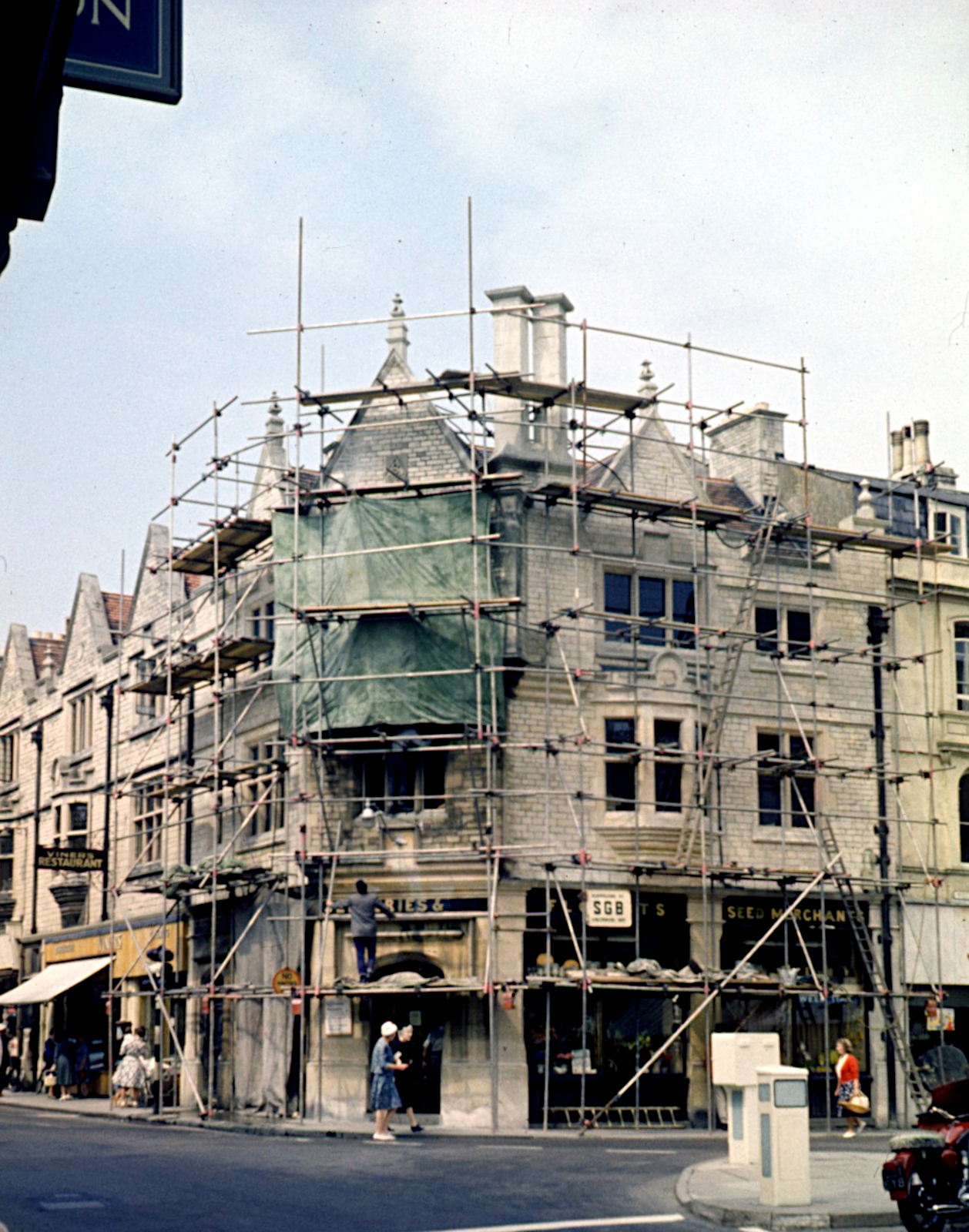
The business hub was at 2 Castle Street, now the Vodafone shop in the Market Place. The phone number was Cirencester 2 (Cirencester 1 was the Post Office, also in Castle Street), with private extensions to each of the nurseries. At this time the post office was happy to provide external extensions like this for any business that asked for them. When I was a child there was a small automatic exchange in the company’s main office. Previously, one of the office staff would have connected the extensions manually. The building housed a florist’s and garden shop downstairs with storage below in the cellar, there were offices upstairs, and on the second storey the landscape design department with enormous garden plans rolled up or pinned out on drawing boards. I don’t have a photo of the shop in the 1930s, but this one shows it being cleaned in the summer of 1962.
Dad was born in 1926, almost an afterthought following his older brothers born in 1907, 1910 and 1912. During the second world war John and Robert (Bob) joined the army while Richard (Dick) signed up for the navy. All three joined as officers. Mike signed up for the RAF as soon as he was old enough (in 1944). So towards the end of the 1930s running the family business fell entirely to my grandfather.
World events (October 1935): The Turkish government abolished all Masonic lodges in the country. (October 1930): The British airship R101, the world’s largest flying craft, crashed in France en route to India, 48 lives were lost.
1900-1929 (125 to 96 years ago)
As with the 1930s material, everything in this section will have a connection of some kind with these two decades.
Probably few people reading this will know that there was another branch of the Jefferies family, also running a nursery business, but in Lancashire. As far as I’m aware there was no connection between the two businesses, but there is a family connection.
John Edward Jefferies was born in October 1886 and ran his nursery business in the Stockport area. His second son, also John Jefferies continued running the business though the rest of the family went into teaching, the British Gas accounts department, and research (first with Glaxo-Welcome and later at Salford University’s Chemistry Department.
The John Jefferies of Somerford Keynes and later, Cirencester, had a brother. His name was Bradford Jefferies and he was a few years older than John. Bradford had two sons also called Bradford, though one died in infancy. The surviving Bradford’s uncle was therefore the John Jefferies from Cirencester. With me so far? It is a bit convoluted.
This Bradford Jefferies had several children, and one of them (Edward) is the one who ran a nursery business near Stockport. He married and their children were born in the 1920s, one of these, John Anthony Jefferies, continued to run the business . The business was still going in 2022 but I can’t find a recent website for them. They do have an entry on Facebook, however, and various listings on other business directories, though nothing seems to be being updated. I left a message on the Facebook page and had a reply from a member of staff so the company survives. It’s lasted a good deal longer its Cirencester equivalent.
World events(October 1925): John Logie Baird successfully transmitted the first television pictures with a greyscale image. (October 1920): The Polish army captured the Soviet cities of Tarnopol, Dubno, Minsk and Dryssa. (October 1915): In WW1 France, Russia and Italy declared war on Bulgaria. (October 1910): Infra-red photographs were first published. (October 1900): Quantum mechanics began when Max Planck put forward his law of black-body radiation.
< Previous | Index | Next >
Useful? Interesting?
If you enjoyed this or found it useful, please like, comment, and share below. (If you don’t see those links, click the article’s title above the main photo and they will appear.) Send a link to friends who might enjoy the article or benefit from it – Thanks! My material is free to reuse (see conditions), but a coffee is always welcome and encourages me to write more often! 






 Journeys of Heart and Mind

