< Previous | Index | Next >
Image of the day – 165
What’s in an image? Sometimes quite a lot, more than meets the eye. I’m posting an image every few days.

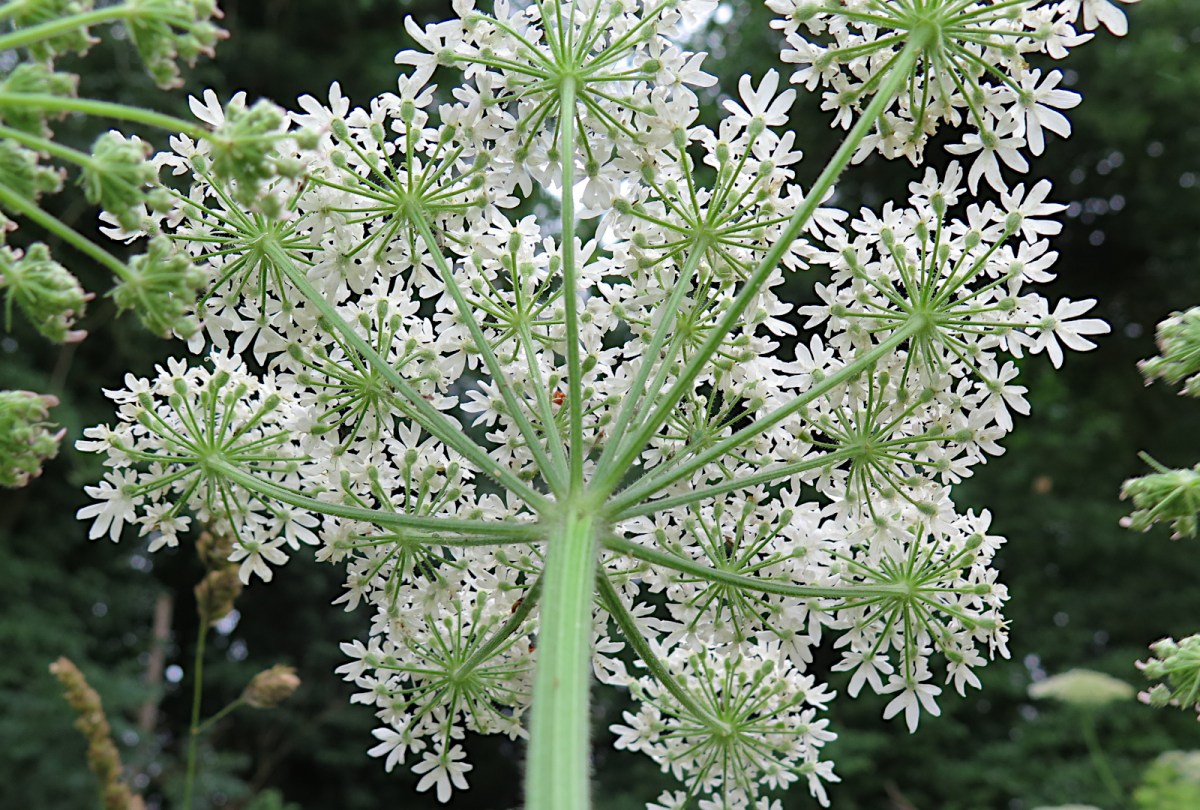
This photo was taken at a different time and place from the previous Umbellifer image, but the structure of this flower is very similar to the previous one. The main difference is that this time we’re viewing it from below. This reveals the exquisite architecture of an umbel.
Notice how every part is sized precisely for the task it performs. The main stem is stout and sturdy, the stems that spring from it are much smaller and each one carries a number of flowers. Those flower stalks in turn are smaller yet, and each one carries a single, tiny flower. It’s exactly how an engineer might design something, each part as large and strong as it needs to be, but no more. Why and how? Well, in the case the engineer, because lightness means less material, less mass, and therefore lower cost. Failure will be unusual because the forces will have been calculated and the values increased just a little to ensure safety.
Your car is designed this way, it could be designed and built to survive a collision with little or no damage, but it would be unaffordable because of the high cost of the extra material required, and it would consume much more fuel because of its high mass. That’s why you drive a car when travelling, not a tank!
The same argument applies to plant structures. The umbel could be made to survive a hurricane, but it would demand much more photosynthesis to provide the cullulose and other materials required to make it tough enough to survive such powerful winds. That’s why coconut palms have far stronger stems than the umbellifer! Living things are not designed by engineers, they adjust to their environment little by little over many generations by a trial and error system we call evolution.
Sometimes people say, ‘It’s only a theory’, meaning that something is a bit shaky and not to be trusted. That is to misunderstand what scientists mean by the word ‘theory’. In everyday use the word has a sense of an untested idea, something you just dreamed up as a way to explain something – might be wrong, might be right. Scientists have a word for that, but the word is not ‘theory’ – it’s ‘hypothesis’. In science, a theory is something so well tested as to be essentially unrejectable. Evolution is a theory in that sense, like the theories of relativity or quantum physics or plate tectonics. Theories have almost no room left for argument.
You can’t believe in evolution, it’s not a matter of faith but of overwhelming evidence. Following Jesus, as I and many others do, is based on faith, and I write about that too on Journeys of heart and mind.
You might be surprised to learn that engineers sometimes use evolution to design things like aircraft wings. The software to do that makes a long series of small tweaks to an initial design and calculates which changes improve performance. And this process is repeated many times enabling the final result to be stronger, lighter and more effective. An aircraft wing (or other structure) created in this way is not designed with paper and pencil or with CAD in the normal way, it evolves.
See also:
- Evolutionary algorithm – Wikipedia
- Previous umbellifer image – Journeys of heart and mind
< Previous | Index | Next >
Useful? Interesting?
If you enjoyed this or found it useful, please like, comment, and share below. (If you don’t see those links, click the article’s title above the main photo and they will appear.) Send a link to friends who might enjoy the article or benefit from it – Thanks! My material is free to reuse (see conditions), but a coffee is always welcome and encourages me to write more often! 
You might also like:
Share this:


 Journeys of Heart and Mind