< Previous | Index | Next >
Image of the day – 151
What’s in an image? Sometimes quite a lot, more than meets the eye. I’m posting an image every few days.

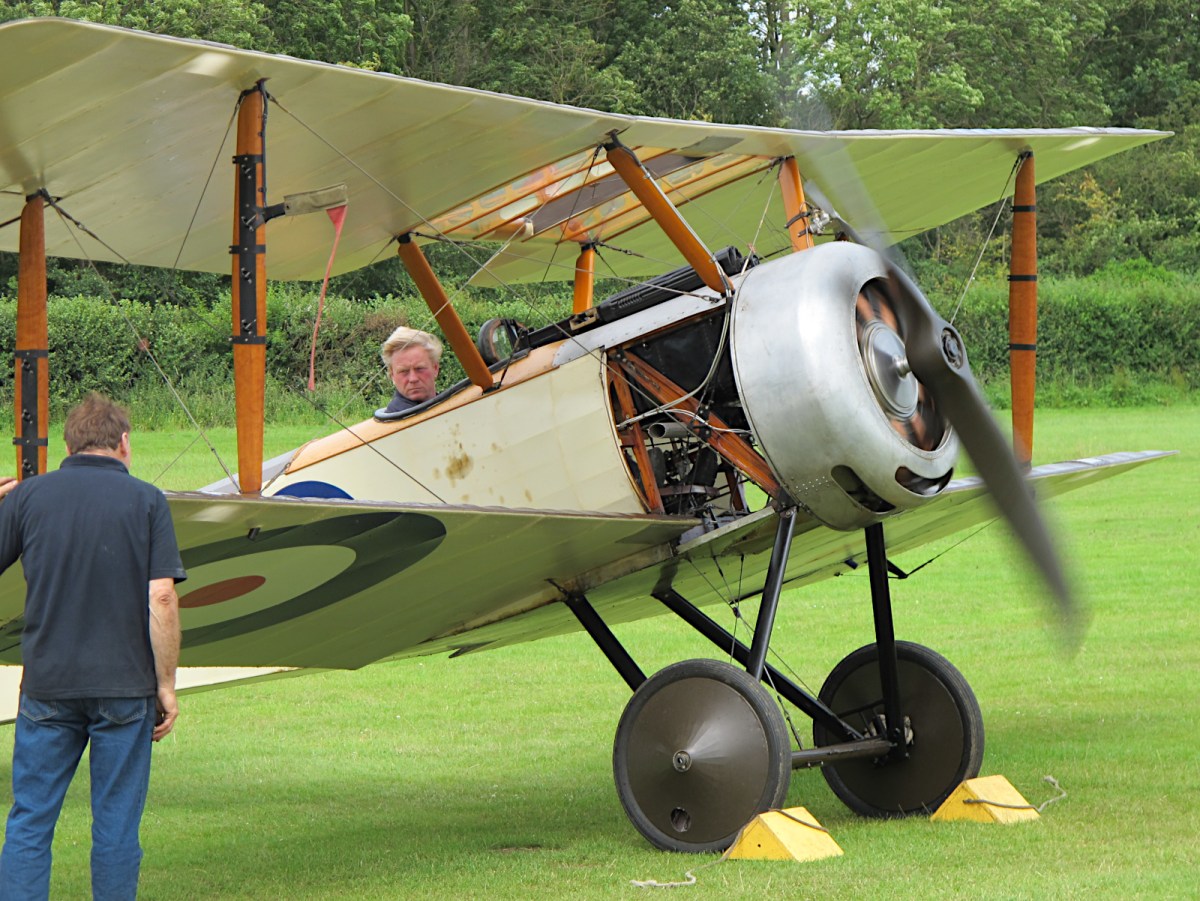
This lovely old aeroplane is a Sopwith Pup, as used by the Royal Flying Corp during the First World War. Sopwith was a major British aircraft manufacturer of the day. This aircraft is still flying from time to time in England where it’s based at Old Warden Airfield, itself a survivor of the First World War. This particular aircraft was built after the war and modified back to the fighter configuration.
In the photo the engine is being tested after maintenance, so a couple of side panels have been removed for inspection. The propeller was spinning, you can see the motion blur in the image.
Here’s the same aircraft in action.
Design and construction
Based on a smaller, earlier aircraft, Sopwith designed the larger Pup as a fighter in 1915 with the first prototype appearing in 1916. Both the navy and the army (the Royal Flying Corp was part of the army) ordered numbers of the planes and they served well until superseded and transferred for training purposes as newer, more effective fighting planes rapidly evolved.
This aircraft was much lighter than its German counterparts. It could take off and land on grass surfaces, in quite short distances. The Pup was very manoeuvrable, had a tight turning circle, and a high service ceiling for those times.
The Pups were replaced with Sopwith Camels during 1917.
Old Warden Aerodrome
Old Warden was a First World War air station, as already mentioned. It lies just north of Shefford and south-east of Bedford. Today it’s the home of the Shuttleworth collection of old aircraft and motor vehicles, a very fine and famous collection with a long history, originally as a private collection, but now open to the public. The old aircraft are frequently rolled out, and often one or more are performing in the air.
Everything that’s not active on a particular day is stored in a series of First World War hangers and those are all open to visit as a museum with informative explanatory material on display as well. There is active maintenance and restoration going on, and some of that may be on display too.
If you’re interested in this sort of thing, and are in the area, I highly recommend popping over for a visit.
See also:
- Old Warden Aerodrome – Wikipedia
- Shuttleworth Aerodrome – Website
- Shuttleworth Collection – Website
- Shuttleworth Collection – Wikipedia
- Sopwith Pup – BAE Systems
- Sopwith Pup – Wikipedia
< Previous | Index | Next >
Useful? Interesting?
If you enjoyed this or found it useful, please like, comment, and share below. (If you don’t see those links, click the article’s title above the main photo and they will appear.) Send a link to friends who might enjoy the article or benefit from it – Thanks! My material is free to reuse (see conditions), but a coffee is always welcome and encourages me to write more often! 
You might also like:
Nearly a year ago now…
Share this:


 Journeys of Heart and Mind