< Previous | Index | Next >
What’s in an image? Sometimes quite a lot, more than meets the eye.
I’m posting an image every day (or as often as I can). A photo, an image from the internet, a diagram or a map. Whatever takes my fancy.
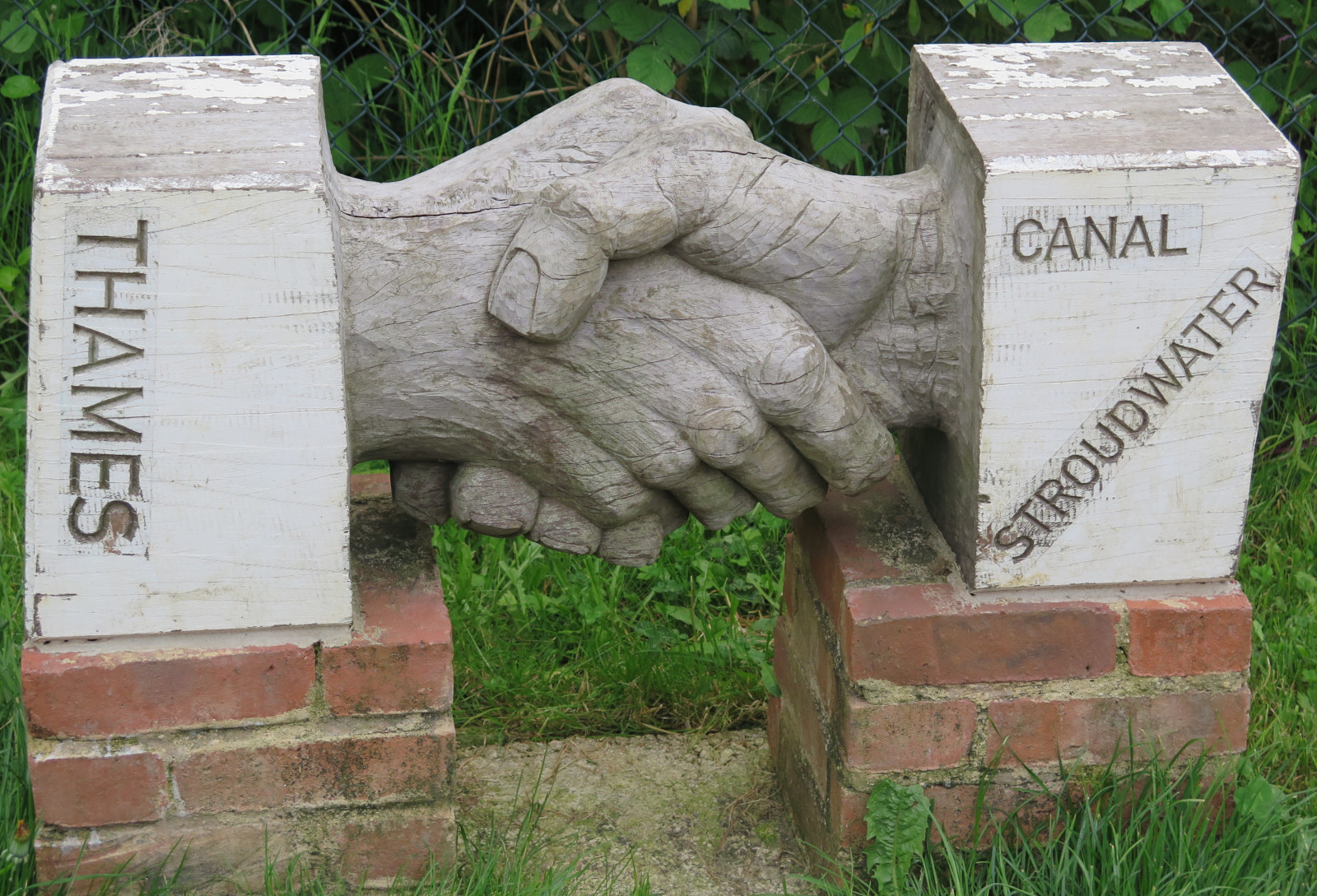
This wooden carving marks the point where two canals meet in Stroud. The Stroudwater Canal to the right allowed Severn river boats (trows) to carry Welsh coal to Stroud to power the steam engines taking over from the less efficient water power in the late 18th and early 19th centuries.
The Thames and Severn Canal, opening a few years later, enabled the smaller London barges to make their way to and from Oxford and London to the east.
Cargoes would need to be unloaded from barges and reloaded on trows or vice versa to make the entire journey. But London barges were not suitable for the waves, winds and currents of the River Severn, while trows were too large for the locks and other facilities of the upper Thames.
Shaking hands is an interesting choice in a sculpture to signal agreement and mutual benefit. Agreement and mutual benefit are essential and helpful in human societies, and are recognised as such worldwide. When agreement and mutual benefit break down we have arguments, murders, violent demonstrations, and even wars. These are all social on some scale or other. How much better it would be to stop those behaviours and shake hands. But that’s not always possible, sadly.
There’s a saying that it takes two to have an argument. That’s true – but it also takes two to stop arguing and shake hands.
Themed image collections
The links below will take you to the first post in each collection
Cirencester, Favourites, Irish holiday 2024, Roman villa
< Previous | Index | Next >
Useful? Interesting?
If you enjoyed this or found it useful, please like, comment, and share below. (If you don’t see those links, click the article’s title above the main photo and they will appear.) Send a link to friends who might enjoy the article or benefit from it – Thanks! My material is free to reuse (see conditions), but a coffee is always welcome and encourages me to write more often! 
Share this:


 Journeys of Heart and Mind
I have to hand it to you, Chris. That’s a good image and a good message.
LikeLiked by 1 person